












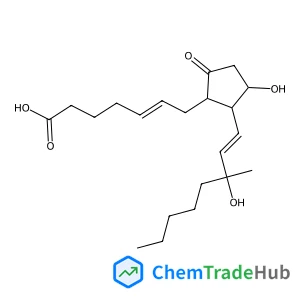
(5Z,11alpha,13E,15R)-11,15-Dihydroxy-15-methyl-9-oxoprosta-5,13-dien-1-oic acid
CAS Number:
55028-70-1
Molecular Formula:
C21H34O5
M. Gnanaprakasam, G. Saranya, S. Bandaru, N. J. English, K. Senthilkumar
2-Bromo-4,6-dinitroaniline (BNA) is identified as a domestic-dust pollutant in urban environments, with deleterious atmospheric effects. In the present work, we studied the reaction pathways and kinetics for BNA oxidation by the OH radical using quantum-chemical methods and canonical-variational transition-state theory with small-curvature tunneling correction (CVT/SCT). OH-radial-mediated BNA oxidation was studied by considering OH addition to carbon atoms (C1 to C6) of BNA and H-atom abstraction at the –NH2 group and carbon atoms (C3 and C5) of BNA by OH radicals. It is observed that an OH-addition reaction is energetically more favorable. In addition, the rate constant was calculated for the favorable initial OH-addition reactions over the temperature range of 278 to 1000 K. The subsequent reactions for the favorable BNA-OH adduct intermediate with O2, HO2 and NO radicals are studied. We have identified the following possible end products from this BNA-oxidation reaction: (i) 2-amino-3-bromo-6-hydroperoxy-5-methyl-1-nitro-cyclohexa-2,4 dienol, (ii) 2-amino-1-bromo-6-hydroperoxy-5-methyl-3-nitro-cyclohexa-2,4-dienol, (iii) 2-amino-1-bromo-6-hydroperoxy-5-methyl-3-nitro-cyclohexa-2,4-dienol, (iv) 3-amino-4-bromo-4-hydroperoxy-8-methyl-2-nitro-6,7-dioxa-bicyclo oct-2-en-8-ol, (v) 2-amino-1-bromo-6-hydroperoxy-5-methyl-3-nitro-cyclohexa-2,4-dienol, and (vi) 3-amino-2-bromo-8-methyl-4-nitro-6,7-dioxa-bicyclo oct-3-ene-2,8-diol.
Garret M. Miyake, Eugene Y.-X. Chen
DOI: 10.1039/C1PY00245G
Natasha A. Birkin, Nicholas J. Arrowsmith, Eun Ju Park, Alexandre P. Richez, Steven M. Howdle
DOI: 10.1039/C1PY00062D
Zacharoula Iatridi, Yuri Roiter, Sergiy Minko
DOI: 10.1039/C1PY00090J
Gaojian Chen, Martina H. Stenzel
DOI: 10.1039/C1PY00048A
Claudio De Rosa, Finizia Auriemma
DOI: 10.1039/C1PY00129A
Tongjie Yao, Tieyu Cui, Jie Wu, Qiuzhi Chen, Shiwen Lu, Kening Sun
DOI: 10.1039/C1PY00311A
T. S. Anirudhan, S. Sandeep
DOI: 10.1039/C1PY00059D
Simon Harrisson, Patrick Couvreur, Julien Nicolas
DOI: 10.1039/C1PY00131K
Jared F. Mike, Jeremy J. Intemann, Min Cai, Teng Xiao, Ruth Shinar, Joseph Shinar, Malika Jeffries-EL
DOI: 10.1039/C1PY00218J
When handling 2-Methyl-2-propanyl 5-amino-2-thiophenecarboxylate (CAS: 1498311-5...
5-Bromo-1,2-dichloro-3-fluorobenzene (CAS: 1000572-93-9) is a crystalline solid ...
(2R)-2-Amino-2-(4-bromophenyl)ethanol (CAS: 354153-64-3) should be stored in a c...
Methyl 4-(aminomethyl)tetrahydro-2H-pyran-4-carboxylate hydrochloride (CAS: 3627...
1,4-Dimethyl-1H-pyrazole-5-sulfonyl chloride is primarily used as an intermediat...
Dinaphtho[1,2-b:2',1'-d]furan is generally safe when handled with appropriate pe...
The market for 7-Methyl-7,9-dihydro-1H-purine-2,6,8(3H)-trione (CAS: 612-37-3) i...
2-(4-Chlorophenyl)malonaldehyde (CAS: 205676-17-1) is a colorless or light yello...
2-Methylchrysene (CAS: 3351-32-4) is typically synthesized via the reaction of c...
N-(6-aminopyrimidin-4-yl)acetamide (CAS: 89533-23-3) is generally considered saf...

Physical Chemistry Chemical Physics (PCCP) is an international journal co-owned by 19 physical chemistry and physics societies from around the world. This journal publishes original, cutting-edge research in physical chemistry, chemical physics and biophysical chemistry. To be suitable for publication in PCCP, articles must include significant innovation and/or insight into physical chemistry; this is the most important criterion that reviewers and Editors will judge against when evaluating submissions. The journal has a broad scope and welcomes contributions spanning experiment, theory, computation and data science. Topical coverage includes spectroscopy, dynamics, kinetics, statistical mechanics, thermodynamics, electrochemistry, catalysis, surface science, quantum mechanics, quantum computing and machine learning. Interdisciplinary research areas such as polymers and soft matter, materials, nanoscience, energy, surfaces/interfaces, and biophysical chemistry are welcomed if they demonstrate significant innovation and/or insight into physical chemistry. Joined experimental/theoretical studies are particularly appreciated when complementary and based on up-to-date approaches.
![2-[2-(2-Methoxyethoxy)ethoxy]-2-methylpropane structure](https://static.chemtradehub.com/structs/527/52788-79-1-71c1.webp "2-[2-(2-Methoxyethoxy)ethoxy]-2-methylpropane structure")
![1-Oxa-8-azaspiro[4.5]decan-3-ol structure](https://static.chemtradehub.com/structs/757/757239-76-2-a0ec.webp "1-Oxa-8-azaspiro[4.5]decan-3-ol structure")
![L-Lysine,N6-[2-[[(1,1-dimethylethoxy)carbonyl]amino]benzoyl]-N2-[(9H-fluoren-9-ylmethoxy)carbonyl]- structure](https://static.chemtradehub.com/structs/159/159322-59-5-c046.webp "L-Lysine,N6-[2-[[(1,1-dimethylethoxy)carbonyl]amino]benzoyl]-N2-[(9H-fluoren-9-ylmethoxy)carbonyl]- structure")




