












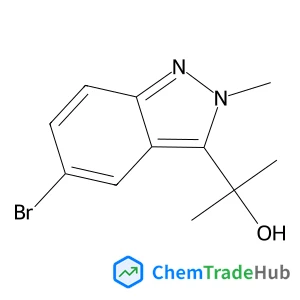
2-(5-Bromo-2-methyl-2H-indazol-3-yl)-2-propanol
CAS Number:
1823787-20-7
Molecular Formula:
C11H13BrN2O
Guanghong Wei
The amyloid formation of human islet amyloid polypeptide (hIAPP)—an intrinsically disordered peptide, is associated with type II diabetes. Cellular membranes, especially those composed of negatively-charged lipids, accelerate the hIAPP amyloid fibrillation, and their integrity is disrupted during the aggregation process, leading to cell apoptosis. However, the underlying molecular mechanism is not well understood. Herein, we investigated the conformational dynamics during the interactions of hIAPP monomer with POPG membrane bilayer, by carrying out μs-long all-atom molecular dynamics simulations. Starting from the metastable coiled conformations in water, hIAPP monomers tend to adopt transient α-helical and β-sheet structures when adsorbing to the membrane surface. The amphiphilic N-terminal region further inserts into the membrane interior and is located at the lipid head–tail interface, mainly in turn and α-helical structures. In contrast, the β-hairpin structures reside on the membrane surface without insertion, and expand laterally with the hydrophobic residues exposed to the solvent. Moreover, the adsorption and insertion of hIAPP monomers induce two distinct local membrane deformations: (1) the hIAPP adsorption on the membrane surface mainly causes membrane bending; (2) the insertion of both turns and α-helices synchronizes with the formation of hydrophobic defects on the POPG membrane, leading to stronger membrane stretching and a longer coherence length of membrane thinning. Based on the structural and dynamical results, we propose that β-hairpin structures may be a precursor for the fibrillation on the membrane surface due to the flat geometry and hydrophobic regions exposed to solvent, while N-terminal amphiphilic α-helices would facilitate hIAPP assembling into toxic oligomers inside the membrane.
Laurent Chabanne, Inmaculada Matas, Sanjib K. Patra, Ian Manners
DOI: 10.1039/C1PY00298H
Denise Azambuja, José I. Iribarren, Carlos A. Ferreira
DOI: 10.1039/C1PY00291K
Ting Guo, Rong Guan, Jianhua Zou, Jie Liu, Lei Ying, Wei Yang, Hongbin Wu, Yong Cao
DOI: 10.1039/C1PY00075F
Emily F. Crownover, Anthony J. Convertine, Patrick S. Stayton
DOI: 10.1039/C1PY00060H
Eun Hee Min, Kok Hou Wong, Eki Setijadi, François Ladouceur, Mark Straton, Alexander Argyros
DOI: 10.1039/C1PY00056J
Shi-Min Shau, Tzong-Yuan Juang, Wei-He Ting, Min-Yu Wu, Shenghong A. Dai
DOI: 10.1039/C1PY00238D
Qianfu Luo, Hui Cheng, He Tian
DOI: 10.1039/C1PY00167A
When handling 2-Methyl-2-propanyl 5-amino-2-thiophenecarboxylate (CAS: 1498311-5...
5-Bromo-1,2-dichloro-3-fluorobenzene (CAS: 1000572-93-9) is a crystalline solid ...
(2R)-2-Amino-2-(4-bromophenyl)ethanol (CAS: 354153-64-3) should be stored in a c...
Methyl 4-(aminomethyl)tetrahydro-2H-pyran-4-carboxylate hydrochloride (CAS: 3627...
1,4-Dimethyl-1H-pyrazole-5-sulfonyl chloride is primarily used as an intermediat...
Dinaphtho[1,2-b:2',1'-d]furan is generally safe when handled with appropriate pe...
The market for 7-Methyl-7,9-dihydro-1H-purine-2,6,8(3H)-trione (CAS: 612-37-3) i...
2-(4-Chlorophenyl)malonaldehyde (CAS: 205676-17-1) is a colorless or light yello...
2-Methylchrysene (CAS: 3351-32-4) is typically synthesized via the reaction of c...
N-(6-aminopyrimidin-4-yl)acetamide (CAS: 89533-23-3) is generally considered saf...

Physical Chemistry Chemical Physics (PCCP) is an international journal co-owned by 19 physical chemistry and physics societies from around the world. This journal publishes original, cutting-edge research in physical chemistry, chemical physics and biophysical chemistry. To be suitable for publication in PCCP, articles must include significant innovation and/or insight into physical chemistry; this is the most important criterion that reviewers and Editors will judge against when evaluating submissions. The journal has a broad scope and welcomes contributions spanning experiment, theory, computation and data science. Topical coverage includes spectroscopy, dynamics, kinetics, statistical mechanics, thermodynamics, electrochemistry, catalysis, surface science, quantum mechanics, quantum computing and machine learning. Interdisciplinary research areas such as polymers and soft matter, materials, nanoscience, energy, surfaces/interfaces, and biophysical chemistry are welcomed if they demonstrate significant innovation and/or insight into physical chemistry. Joined experimental/theoretical studies are particularly appreciated when complementary and based on up-to-date approaches.
methyl]-N,2-dimethyl-2-propanesulfinamide structure](https://static.chemtradehub.com/structs/256/2565792-50-7-8a26.webp "N-[(R)-[3-(Benzyloxy)-2-(dicyclohexylphosphino)phenyl](phenyl)methyl]-N,2-dimethyl-2-propanesulfinamide structure")
![3-(benzotriazol-1-yl)-N-[[2-[(3-bromophenyl)methoxy]phenyl]methylideneamino]propanamide structure](https://static.chemtradehub.com/structs/559/5595-78-8-0a32.webp "3-(benzotriazol-1-yl)-N-[[2-[(3-bromophenyl)methoxy]phenyl]methylideneamino]propanamide structure")
![N-[(1-Ethyl-2-pyrrolidinyl)methyl]-2-hydroxy-5-sulfamoylbenzamide structure](https://static.chemtradehub.com/structs/673/67381-52-6-877f.webp "N-[(1-Ethyl-2-pyrrolidinyl)methyl]-2-hydroxy-5-sulfamoylbenzamide structure")





