













Novel photoacid generators for cationic photopolymerization
Literature Information
Publication Date
2017-06-29
DOI
10.1039/C7PY00855D
Impact Factor
5.582
Authors
Nicolas Klikovits, Patrick Knaack, Daniel Bomze, Ingo Krossing, Robert Liska
View Original
Abstract
Cationic photopolymerization is a powerful method for UV-curing of epoxy, vinyl ether and oxetane monomers. Little attention has been paid to it over the last few decades compared to the corresponding free radical applications due to unsuitable and inefficient photo-acid generators (PAGs) used for photoinitiation. We introduce a novel type of PAG based on the tetrakis(perfluoro-t-butyloxy)aluminate anion. In facile preparations, diphenyliodonium and triarylsulfonium salts were synthesized, followed by characterization of absorbance and thermal stability. Comparative photo-differential scanning calorimetry (photo-DSC) studies with common onium salt PAGs showed the advantageous reactivity of the novel alkoxyaluminate-based cationic photoinitiators. The novel diphenyliodonium PAG was also examined in photosensitization studies for potential use in higher wavelength applications.
Recommended Journals
Related Literature
The glass transition relaxation in a side-chain liquid crystalline polymer studied by modulated temperature differential scanning calorimetry
Cristina Alvarez, Joaquim J. Moura-Ramos
2000-09-29
Paper
DOI: 10.1039/B004133P
Van der Waals energy contour map describing the orthorhombic hydrocarbon chain packing of symmetry Pbnm
Günter Förster, Annette Meister, Alfred Blume
2000-08-02
Paper
DOI: 10.1039/B003278F
Confirmation of the strongest nitriles–hydroxy groups interaction in the side pockets of mordenite zeolites
Olivier Marie, Frédéric Thibault-Starzyk, Jean-Claude Lavalley
2000-10-31
Paper
DOI: 10.1039/B005901N
Solid-state NMR investigations on the structure and topological equilibria of polypeptides associated with biological membranes. Invited Lecture
2000-09-01
Paper
DOI: 10.1039/B003695L
Detection of muoniated organic free radicals in supercritical water
Paul W. Percival, Khashayar Ghandi, Jean-Claude Brodovitch, Brenda Addison-Jones, Iain McKenzie
2000-09-19
Paper
DOI: 10.1039/B005762M
Photoinduced energy and electron transfer in bis-porphyrins with quinoxaline Tröger's base and biquinoxalinyl spacers
Edwin K. L. Yeow, Paul J. Sintic, Nuno M. Cabral, Joost N. H. Reek, Maxwell J. Crossley, Kenneth P. Ghiggino
2000-09-13
Paper
DOI: 10.1039/B003612I
Photophysical and photochemical properties of bis-silylated C60 derivatives
Paper
DOI: 10.1039/A902939G
You might also like
Compound Q&A
What precautions should be taken when handling 4-(2-Furylmethyl)thiomorpholine 1,1-dioxide (CAS: 79206-94-3)?
When handling 4-(2-Furylmethyl)thiomorpholine 1,1-dioxide (CAS: 79206-94-3), it ...
79206-94-34-(2-Furylmethyl)thi...
Compound Q&A
What precautions should be taken when handling 4-Chloro-N-[2-(4-morpholinyl)ethyl]benzamide (CAS: 71320-77-9)?
When handling 4-Chloro-N-[2-(4-morpholinyl)ethyl]benzamide (CAS: 71320-77-9), it...
71320-77-94-Chloro-N-[2-(4-mor...
Compound Q&A
How should waste containing 2-[2-(2-Methoxyethoxy)ethoxy]ethyl 4-methylbenzenesulfonate (CAS: 62921-74-8) be handled?
Waste containing this compound (CAS: 62921-74-8) should be handled according to ...
62921-74-82-[2-(2-Methoxyethox...
Compound Q&A
How should waste containing (S)-Methyl 2-amino-3-cyclohexylpropanoate be handled?
Waste containing (S)-Methyl 2-amino-3-cyclohexylpropanoate should be collected i...
40056-18-6(S)-Methyl 2-amino-3...
Compound Q&A
How is 5-({4-[(2S,4R)-4-Hydroxy-2-methyltetrahydro-2H-pyran-4-yl]-2-thienyl}sulfanyl)-1-methyl-1,3-dihydro-2H-indol-2-one (CAS: 166882-70-8) typically synthesized?
This compound can be synthesized using a multi-step process involving the conjug...
166882-70-85-({4-[(2S,4R)-4-Hyd...
Compound Q&A
Are there alternatives to (2E)-3-(3,4-Dichlorophenyl)acrylic acid (CAS: 7312-27-8) in synthesis?
There are several alternatives to (2E)-3-(3,4-Dichlorophenyl)acrylic acid in syn...
7312-27-8(2E)-3-(3,4-Dichloro...
Compound Q&A
How should Ethyl 6-(2-nitrophenyl)imidazo[2,1-b][1,3]thiazole-3-carboxylate (CAS: 925437-84-9) be stored?
Ethyl 6-(2-nitrophenyl)imidazo[2,1-b][1,3]thiazole-3-carboxylate (CAS: 925437-84...
925437-84-9Ethyl 6-(2-nitrophen...
Compound Q&A
How should waste containing 2-(1,3-Thiazol-2-yl)ethanamine (CAS: 18453-07-1) be handled?
Waste containing 2-(1,3-Thiazol-2-yl)ethanamine (CAS: 18453-07-1) should be coll...
18453-07-12-(1,3-Thiazol-2-yl)...
Compound Q&A
How is Methyl 5-iodo-2-methylbenzoate (CAS: 103440-54-6) typically synthesized?
Methyl 5-iodo-2-methylbenzoate can be synthesized through the iodination of meth...
103440-54-6Methyl 5-iodo-2-meth...
Compound Q&A
How is 5-Chloro[1,2,4]triazolo[1,5-a]pyridine (CAS: 1427399-34-5) typically synthesized?
5-Chloro[1,2,4]triazolo[1,5-a]pyridine is commonly synthesized via the condensat...
1427399-34-55-Chloro[1,2,4]triaz...
Source Journal
Polymer Chemistry

CiteScore:
8.6
Self-citation Rate:
7.3%
Articles per Year:
457
Polymer Chemistry welcomes submissions in all areas of polymer science that have a strong focus on macromolecular chemistry. Manuscripts may cover a broad range of fields, yet no direct application focus is required.
Recommended Compounds
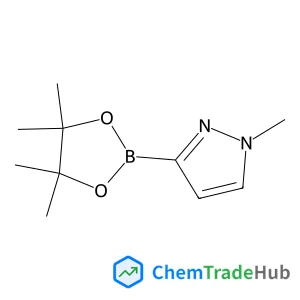
1-Methyl-3-(4,4,5,5-tetramethyl-1,3,2-dioxaborolan-2-yl)-1H-pyrazole
CAS Number:
1020174-04-2
Molecular Formula:
C10H17BN2O2
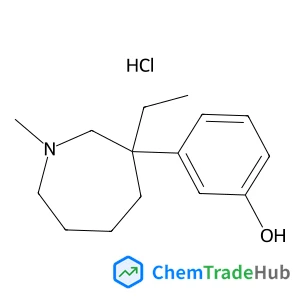
3-(3-Ethyl-1-methyl-3-azepanyl)phenol hydrochloride (1:1)
CAS Number:
59263-76-2
Molecular Formula:
C15H24ClNO

![1-Naphthalenesulfonic acid, 2-[(2-hydroxy-1-naphthalenyl)azo]-, bariumsalt (2:1) structure](https://static.chemtradehub.com/structs/110/1103-38-4-0b33.webp "1-Naphthalenesulfonic acid, 2-[(2-hydroxy-1-naphthalenyl)azo]-, bariumsalt (2:1) structure")
1-Naphthalenesulfonic acid, 2-[(2-hydroxy-1-naphthalenyl)azo]-, bariumsalt (2:1)
CAS Number:
1103-38-4
Molecular Formula:
C20H14BaN2O4S
Recommended Suppliers






Disclaimer
This page provides academic journal information for reference and research purposes only. We are not affiliated with any journal publishers and do not handle publication submissions. For publication-related inquiries, please contact the respective journal publishers directly.
If you notice any inaccuracies in the information displayed, please contact us at support@chemtradehub.com. We will promptly review and address your concerns.