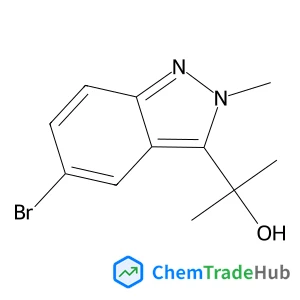
2-(5-Bromo-2-methyl-2H-indazol-3-yl)-2-propanol
CAS Number:
1823787-20-7
Molecular Formula:
C11H13BrN2O
Dylan G. Karis, Robert J. Ono, Musan Zhang, Ankit Vora, Duane Storti, Mark A. Ganter, Alshakim Nelson
Triple stimuli-responsive ABA triblock copolymer hydrogels composed of poly(allyl glycidyl ether)-stat-poly(alkyl glycidyl ether)-block-poly(ethylene glycol)-block-poly(allyl glycidyl ether)-stat-poly(alkyl glycidyl ether) were synthesized using controlled ring-opening polymerization of glycidyl ethers. These polymers form triple stimuli-responsive hydrogels that respond to temperature, pressure (shear-thinning), and UV light. The stimuli-responsive behaviors of the gels were dependent upon the composition and the molecular weight of the ‘A’ blocks of the triblock copolymers. The hydrogels were analyzed rheometrically to characterize their stimuli-responsive properties. The optimized compositions were 3D printed using a direct-write 3D printer to afford robust 3D objects. We anticipate these materials creating new opportunities in the biomedical and biotechnological fields, by enabling the simple and rapid fabrication of 3D hydrogels.

Foundations of Chemistry

Angewandte Chemie International Edition

Environmental Toxicology and Pharmacology

Current Pharmaceutical Biotechnology

Mini-Reviews in Medicinal Chemistry

Advanced Engineering Materials

Journal of Enzyme inhibition and Medicinal Chemistry

Nature Reviews Drug Discovery

Lab on a Chip

Coloration Technology
Xiao-Ting Chang, Ying Li, Jia-Yuan Liu, Hai-Di Ma, Di Wu
DOI: 10.1039/C9CP01284B
Antonio Frontera, Antonio Bauzá
DOI: 10.1039/C9CP03858B
Karolina Rachuta, Jacek Koput, Gordon L. Hug, Mariusz Majchrzak
DOI: 10.1039/C9CP03749G
Maximilian Lasserus, Daniel Knez, Florian Lackner, Martin Schnedlitz, Roman Messner, Daniel Schennach, Gerald Kothleitner, Ferdinand Hofer, Andreas W. Hauser, Wolfgang E. Ernst
DOI: 10.1039/C9CP04357H
Helder M. Marques, Preston J. MacDougall
DOI: 10.1039/C9CP03783G
Arifin Luthfi Maulana, Refaldi Intri Dwi Putra
DOI: 10.1039/C9CP02970B
Narcisse T. Tsona, Shanshan Tang, Lin Du
DOI: 10.1039/C9CP03612A
M. Gnanaprakasam, G. Saranya, S. Bandaru, N. J. English, K. Senthilkumar
DOI: 10.1039/C9CP04271G
When handling 2-Methyl-2-propanyl 5-amino-2-thiophenecarboxylate (CAS: 1498311-5...
5-Bromo-1,2-dichloro-3-fluorobenzene (CAS: 1000572-93-9) is a crystalline solid ...
(2R)-2-Amino-2-(4-bromophenyl)ethanol (CAS: 354153-64-3) should be stored in a c...
Methyl 4-(aminomethyl)tetrahydro-2H-pyran-4-carboxylate hydrochloride (CAS: 3627...
1,4-Dimethyl-1H-pyrazole-5-sulfonyl chloride is primarily used as an intermediat...
Dinaphtho[1,2-b:2',1'-d]furan is generally safe when handled with appropriate pe...
The market for 7-Methyl-7,9-dihydro-1H-purine-2,6,8(3H)-trione (CAS: 612-37-3) i...
2-(4-Chlorophenyl)malonaldehyde (CAS: 205676-17-1) is a colorless or light yello...
2-Methylchrysene (CAS: 3351-32-4) is typically synthesized via the reaction of c...
N-(6-aminopyrimidin-4-yl)acetamide (CAS: 89533-23-3) is generally considered saf...

Polymer Chemistry welcomes submissions in all areas of polymer science that have a strong focus on macromolecular chemistry. Manuscripts may cover a broad range of fields, yet no direct application focus is required.
![3-(benzotriazol-1-yl)-N-[[2-[(3-bromophenyl)methoxy]phenyl]methylideneamino]propanamide structure](https://static.chemtradehub.com/structs/559/5595-78-8-0a32.webp "3-(benzotriazol-1-yl)-N-[[2-[(3-bromophenyl)methoxy]phenyl]methylideneamino]propanamide structure")