












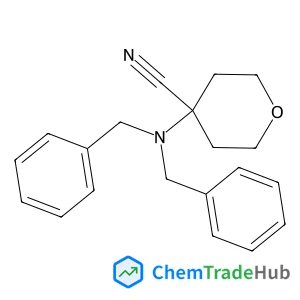
4-(Dibenzylamino)tetrahydro-2H-pyran-4-carbonitrile
CAS Number:
1630906-81-8
Molecular Formula:
C20H22N2O
Maximilian Lasserus, Daniel Knez, Florian Lackner, Martin Schnedlitz, Roman Messner, Daniel Schennach, Gerald Kothleitner, Ferdinand Hofer, Andreas W. Hauser, Wolfgang E. Ernst
Vanadium oxide clusters with a mean diameter below 10 nm are investigated by high resolution Scanning Transmission Electron Microscopy (STEM), Electron Energy Loss Spectroscopy (EELS) and UV-vis absorption spectroscopy. The clusters are synthesised by sublimation from bulk vanadium(V) oxide, in combination with a pick-up by superfluid helium droplets. The latter act as reaction chambers which enable cluster growth under fully inert and solvent-free conditions. High-resolution STEM images of deposited vanadium oxide particles allowing for the determination of lattice constants, clearly indicate a dominating presence of V2O5. This finding is further supported by UV-vis absorption spectra of nanoparticles after deposition on fused silica substrates, which indicates that the oxidation state of the material is preserved over the entire process. From the results of the UV-vis measurement, the band gap of the nanosized V2O5 could be determined to be 3.3 eV. The synthesis approach provides a route to clean V2O5 clusters as it does not involve any surfactant or solvents, which is crucial for an unbiased measurement of intrinsic catalyst properties.
T. S. Anirudhan, S. Sandeep
DOI: 10.1039/C1PY00059D
Cyrille Boyer, Thomas P. Davis
DOI: 10.1039/C1PY00049G
DOI: 10.1039/C1PY00065A
Natanya M. L. Hansen, David Plackett
DOI: 10.1039/C1PY00086A
Yan Lu, Yuqiao Han, Jinhuan Liang, Hongxia Meng, Fengli Han, Xudong Wang, Chenxi Li
DOI: 10.1039/C1PY00098E
Tao Cai, Rong Wang, K. G. Neoh, E. T. Kang
DOI: 10.1039/C1PY00106J
Thierry Tassaing, Jean-Daniel Marty, Mathias Destarac
DOI: 10.1039/C1PY00209K
Cheng-Liang Liu, Wen-Chang Chen
DOI: 10.1039/C1PY00189B
Sofia Benyahya, Myriam Desroches, Rémi Auvergne, Stéphane Carlotti, Sylvain Caillol, Bernard Boutevin
DOI: 10.1039/C1PY00289A
Jaewon Choi, So Yeon Park, Hye Yun Yang, Hae Jin Kim, Kyuwook Ihm, Jeong Ho Nam, Joung Real Ahn, Seung Uk Son
DOI: 10.1039/C1PY00260K
When handling 2-Methyl-2-propanyl 5-amino-2-thiophenecarboxylate (CAS: 1498311-5...
5-Bromo-1,2-dichloro-3-fluorobenzene (CAS: 1000572-93-9) is a crystalline solid ...
(2R)-2-Amino-2-(4-bromophenyl)ethanol (CAS: 354153-64-3) should be stored in a c...
Methyl 4-(aminomethyl)tetrahydro-2H-pyran-4-carboxylate hydrochloride (CAS: 3627...
1,4-Dimethyl-1H-pyrazole-5-sulfonyl chloride is primarily used as an intermediat...
Dinaphtho[1,2-b:2',1'-d]furan is generally safe when handled with appropriate pe...
The market for 7-Methyl-7,9-dihydro-1H-purine-2,6,8(3H)-trione (CAS: 612-37-3) i...
2-(4-Chlorophenyl)malonaldehyde (CAS: 205676-17-1) is a colorless or light yello...
2-Methylchrysene (CAS: 3351-32-4) is typically synthesized via the reaction of c...
N-(6-aminopyrimidin-4-yl)acetamide (CAS: 89533-23-3) is generally considered saf...

Physical Chemistry Chemical Physics (PCCP) is an international journal co-owned by 19 physical chemistry and physics societies from around the world. This journal publishes original, cutting-edge research in physical chemistry, chemical physics and biophysical chemistry. To be suitable for publication in PCCP, articles must include significant innovation and/or insight into physical chemistry; this is the most important criterion that reviewers and Editors will judge against when evaluating submissions. The journal has a broad scope and welcomes contributions spanning experiment, theory, computation and data science. Topical coverage includes spectroscopy, dynamics, kinetics, statistical mechanics, thermodynamics, electrochemistry, catalysis, surface science, quantum mechanics, quantum computing and machine learning. Interdisciplinary research areas such as polymers and soft matter, materials, nanoscience, energy, surfaces/interfaces, and biophysical chemistry are welcomed if they demonstrate significant innovation and/or insight into physical chemistry. Joined experimental/theoretical studies are particularly appreciated when complementary and based on up-to-date approaches.
![N-[(1-Ethyl-2-pyrrolidinyl)methyl]-2-hydroxy-5-sulfamoylbenzamide structure](https://static.chemtradehub.com/structs/673/67381-52-6-877f.webp "N-[(1-Ethyl-2-pyrrolidinyl)methyl]-2-hydroxy-5-sulfamoylbenzamide structure")
methyl]-N,2-dimethyl-2-propanesulfinamide structure](https://static.chemtradehub.com/structs/256/2565792-50-7-8a26.webp "N-[(R)-[3-(Benzyloxy)-2-(dicyclohexylphosphino)phenyl](phenyl)methyl]-N,2-dimethyl-2-propanesulfinamide structure")
![3-(benzotriazol-1-yl)-N-[[2-[(3-bromophenyl)methoxy]phenyl]methylideneamino]propanamide structure](https://static.chemtradehub.com/structs/559/5595-78-8-0a32.webp "3-(benzotriazol-1-yl)-N-[[2-[(3-bromophenyl)methoxy]phenyl]methylideneamino]propanamide structure")



