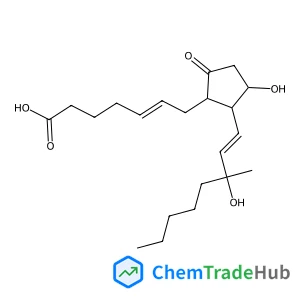
(5Z,11alpha,13E,15R)-11,15-Dihydroxy-15-methyl-9-oxoprosta-5,13-dien-1-oic acid
CAS Number:
55028-70-1
Molecular Formula:
C21H34O5
Xiao-Ting Chang, Ying Li, Jia-Yuan Liu, Hai-Di Ma, Di Wu
Based on density functional theory (DFT) calculations, hydrogenated hyperhalogen HM(BO2)2, lithiated hyperhalogen LiM(BO2)2 (M = Cu, Ag, Au), and their compounds with xenon were studied. Different insertion sites of Xe resulted in various isomers. According to the natural population analysis, the Xe atom donated 0.12–0.77 electrons to HM(BO2)2 and 0.14–0.41 electrons to LiM(BO2)2 when they combined, leading to metastable charge-transfer compounds in most cases. The nature of bonding between xenon and HM(BO2)2/LiM(BO2)2 was found to be related to its location. Covalent bonds were formed when Xe bound with hydrogen atoms, as indicated by the large Wiberg bond indices of the Xe–H bonds. The same was true for most Xe–M bondings. When an Xe–O connection was formed, it was either an ionic or van der Waals force in nature depending on the specific structural feature of the isomer. A parallel study on hyperhalogen-supported Ar and Kr compounds indicated that they were not very stable and were less likely to exist at room temperature, which was in accordance with the high inertness of both Ar and Kr atoms.
Garret M. Miyake, Eugene Y.-X. Chen
DOI: 10.1039/C1PY00245G
Ting Guo, Rong Guan, Jianhua Zou, Jie Liu, Lei Ying, Wei Yang, Hongbin Wu, Yong Cao
DOI: 10.1039/C1PY00075F
Najib Hayki, Nicolas Desilles, Fabrice Burel
DOI: 10.1039/C1PY00199J
Mathurin Grogna, Rudi Cloots, André Luxen, Christine Jérôme, Catherine Passirani, Nolwenn Lautram, Jean-F. Desreux, Mike Collodoro, Marie-Claire De Pauw-Gillet, Christophe Detrembleur
DOI: 10.1039/C1PY00198A
Markus Döbbelin, Irantzu Llarena, Luis J. Claros Marfil, Germán Cabañero, Javier Rodriguez, David Mecerreyes
DOI: 10.1039/C1PY00044F
Xuemin Lu, Sufang Xiao, Xumeng Chen, Qinghua Lu
DOI: 10.1039/C1PY00236H
Mohammed Hashem, C. Grazia Bezzu, Benson M. Kariuki, Neil B. McKeown
DOI: 10.1039/C1PY00288K
Maxime Ayer, Justyna Kowal, Frederik R. Wurm, Harm-Anton Klok
DOI: 10.1039/C0PY00422G
Cheng-Liang Liu, Wen-Chang Chen
DOI: 10.1039/C1PY00189B
Christophe Barnier Quer, Hana Robson Marsden, Stefan Romeijn, Harshal Zope, Alexander Kros, Wim Jiskoot
DOI: 10.1039/C1PY00010A
When handling 2-Methyl-2-propanyl 5-amino-2-thiophenecarboxylate (CAS: 1498311-5...
5-Bromo-1,2-dichloro-3-fluorobenzene (CAS: 1000572-93-9) is a crystalline solid ...
(2R)-2-Amino-2-(4-bromophenyl)ethanol (CAS: 354153-64-3) should be stored in a c...
Methyl 4-(aminomethyl)tetrahydro-2H-pyran-4-carboxylate hydrochloride (CAS: 3627...
1,4-Dimethyl-1H-pyrazole-5-sulfonyl chloride is primarily used as an intermediat...
Dinaphtho[1,2-b:2',1'-d]furan is generally safe when handled with appropriate pe...
The market for 7-Methyl-7,9-dihydro-1H-purine-2,6,8(3H)-trione (CAS: 612-37-3) i...
2-(4-Chlorophenyl)malonaldehyde (CAS: 205676-17-1) is a colorless or light yello...
2-Methylchrysene (CAS: 3351-32-4) is typically synthesized via the reaction of c...
N-(6-aminopyrimidin-4-yl)acetamide (CAS: 89533-23-3) is generally considered saf...

Physical Chemistry Chemical Physics (PCCP) is an international journal co-owned by 19 physical chemistry and physics societies from around the world. This journal publishes original, cutting-edge research in physical chemistry, chemical physics and biophysical chemistry. To be suitable for publication in PCCP, articles must include significant innovation and/or insight into physical chemistry; this is the most important criterion that reviewers and Editors will judge against when evaluating submissions. The journal has a broad scope and welcomes contributions spanning experiment, theory, computation and data science. Topical coverage includes spectroscopy, dynamics, kinetics, statistical mechanics, thermodynamics, electrochemistry, catalysis, surface science, quantum mechanics, quantum computing and machine learning. Interdisciplinary research areas such as polymers and soft matter, materials, nanoscience, energy, surfaces/interfaces, and biophysical chemistry are welcomed if they demonstrate significant innovation and/or insight into physical chemistry. Joined experimental/theoretical studies are particularly appreciated when complementary and based on up-to-date approaches.
![1-Oxa-8-azaspiro[4.5]decan-3-ol structure](https://static.chemtradehub.com/structs/757/757239-76-2-a0ec.webp "1-Oxa-8-azaspiro[4.5]decan-3-ol structure")
methyl]-N,2-dimethyl-2-propanesulfinamide structure](https://static.chemtradehub.com/structs/256/2565792-50-7-8a26.webp "N-[(R)-[3-(Benzyloxy)-2-(dicyclohexylphosphino)phenyl](phenyl)methyl]-N,2-dimethyl-2-propanesulfinamide structure")