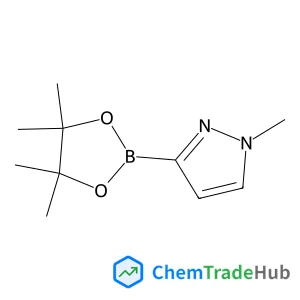
1-Methyl-3-(4,4,5,5-tetramethyl-1,3,2-dioxaborolan-2-yl)-1H-pyrazole
CAS Number:
1020174-04-2
Molecular Formula:
C10H17BN2O2
Hiroaki Shimomoto, Junya Kawamata, Hirokazu Murakami, Kazuki Yamashita, Tomomichi Itoh, Eiji Ihara
The initiating ability of a new system, amidinate/Pd, for the polymerization of diazoacetates is described. The system is effective in affording relatively high number-average molecular weight (Mn) polymers from ethyl diazoacetate (EDA, e.g., Mn = 45 100, 44% yield) and methyl diazoacetate (MDA, e.g., Mn = 26 200, 56% yield) in moderate yield. The polymerization of n-hexyl diazoacetate (nHDA) and benzyl diazoacetate (BDA) by the amidinate/Pd system yields high Mn polymers (Mn = ca.100 000), although the yield was below 10%. The system is also effective in the copolymerization of EDA with nHDA, BDA, and cyclohexyldiazoacetate (cHDA), affording high Mn copolymers in moderate yield. NMR spectra of the products obtained with the system suggest that the polymerization proceeds with significantly higher stereoregularity compared to that with previously reported Pd-based initiating systems.
Gauthier Winé, Joseph Matta, Jean-Philippe Tessonnier, Cuong Pham-Huu, Marc-Jacques Ledoux
DOI: 10.1039/B209858J
Tareque S. M. Abedin, Laurence K. Thompson, David O. Miller, Erik Krupicka
DOI: 10.1039/B211401C
Artur Krężel, Jacek Wójcik, Maciej Maciejczyk, Wojciech Bal
DOI: 10.1039/B300632H
Sergi Morais, P. C. Pandey, Wilfred Chen, Ashok Mulchandani
DOI: 10.1039/B302112B
Alex Ionkin, William Marshall
DOI: 10.1039/B211252C
Pierre Braunstein, Xavier Morise, Marc Bénard, Marie-Madeleine Rohmer, Richard Welter
DOI: 10.1039/B211289M
Moloy Banerjee, Sujit Roy
DOI: 10.1039/B211555G
Leonardus W. Jenneskens, Patrick W. Fowler, Erich Steiner
DOI: 10.1039/B212251K
Sofia M. Fonseca, Anna L. Barker, Samina Ahmed, Terence J. Kemp, Patrick R. Unwin
DOI: 10.1039/B212222G
Sergio Bambirra, Daan van Leusen, Auke Meetsma, Bart Hessen, Jan H. Teuben
DOI: 10.1039/B208502J
When handling 4-(2-Furylmethyl)thiomorpholine 1,1-dioxide (CAS: 79206-94-3), it ...
When handling 4-Chloro-N-[2-(4-morpholinyl)ethyl]benzamide (CAS: 71320-77-9), it...
Waste containing this compound (CAS: 62921-74-8) should be handled according to ...
Waste containing (S)-Methyl 2-amino-3-cyclohexylpropanoate should be collected i...
This compound can be synthesized using a multi-step process involving the conjug...
There are several alternatives to (2E)-3-(3,4-Dichlorophenyl)acrylic acid in syn...
Ethyl 6-(2-nitrophenyl)imidazo[2,1-b][1,3]thiazole-3-carboxylate (CAS: 925437-84...
Waste containing 2-(1,3-Thiazol-2-yl)ethanamine (CAS: 18453-07-1) should be coll...
Methyl 5-iodo-2-methylbenzoate can be synthesized through the iodination of meth...
5-Chloro[1,2,4]triazolo[1,5-a]pyridine is commonly synthesized via the condensat...

Polymer Chemistry welcomes submissions in all areas of polymer science that have a strong focus on macromolecular chemistry. Manuscripts may cover a broad range of fields, yet no direct application focus is required.