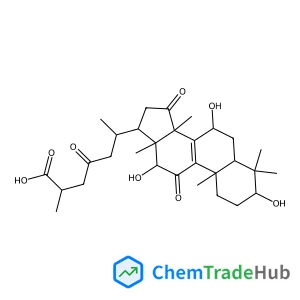
(3beta,7beta,12beta)-3,7,12-Trihydroxy-11,15,23-trioxolanost-8-en-26-oic acid
CAS Number:
98665-22-6
Molecular Formula:
C30H44O8
Agnès Kuroki, Ivan Martinez-Botella, Christian H. Hornung, Liam Martin, Elizabeth G. L. Williams, Katherine E. S. Locock, Matthias Hartlieb
A looped flow process was designed for the synthesis of well-defined multiblock copolymers using reversible addition–fragmentation chain transfer (RAFT) polymerization. The reaction conditions were optimized to reach high conversions whilst maintaining a high end-group fidelity. The loop set-up proved to be a flexible, robust and time-efficient process for scaling-up multiblock copolymers.
Christophe Bucher, Charles H. Devillers, Jean-Claude Moutet, Guy Royal, Eric Saint-Aman
DOI: 10.1039/B301177A
Tareque S. M. Abedin, Laurence K. Thompson, David O. Miller, Erik Krupicka
DOI: 10.1039/B211401C
Lionel Salmon, Pierre Thuéry, Eric Rivière, Jean-Jacques Girerd, Michel Ephritikhine
DOI: 10.1039/B212635D
Pierre Braunstein, Xavier Morise, Marc Bénard, Marie-Madeleine Rohmer, Richard Welter
DOI: 10.1039/B211289M
Shigeru Sakamoto, Isao Saito
DOI: 10.1039/B212432G
Lee-Jon Ball, Anthony P. Dickie, Francis S. Mair, David A. Middleton, Robin G. Pritchard
DOI: 10.1039/B211745B
Iver Schmidt, Anna Carlsson, Søren Dahl, Michael Brorson, Claus J. H. Jacobsen
DOI: 10.1039/B212646J
Alex Ionkin, William Marshall
DOI: 10.1039/B211252C
Dong Qian, J.Z. Jiang, Poul Lenvig Hansen
DOI: 10.1039/B301504A
When handling 4-(2-Furylmethyl)thiomorpholine 1,1-dioxide (CAS: 79206-94-3), it ...
When handling 4-Chloro-N-[2-(4-morpholinyl)ethyl]benzamide (CAS: 71320-77-9), it...
Waste containing this compound (CAS: 62921-74-8) should be handled according to ...
Waste containing (S)-Methyl 2-amino-3-cyclohexylpropanoate should be collected i...
This compound can be synthesized using a multi-step process involving the conjug...
There are several alternatives to (2E)-3-(3,4-Dichlorophenyl)acrylic acid in syn...
Ethyl 6-(2-nitrophenyl)imidazo[2,1-b][1,3]thiazole-3-carboxylate (CAS: 925437-84...
Waste containing 2-(1,3-Thiazol-2-yl)ethanamine (CAS: 18453-07-1) should be coll...
Methyl 5-iodo-2-methylbenzoate can be synthesized through the iodination of meth...
5-Chloro[1,2,4]triazolo[1,5-a]pyridine is commonly synthesized via the condensat...

Polymer Chemistry welcomes submissions in all areas of polymer science that have a strong focus on macromolecular chemistry. Manuscripts may cover a broad range of fields, yet no direct application focus is required.