












A general route to chiral nanostructures from helical polymers: P/M switch via dynamic metal coordination
Literature Information
Publication Date
2017-05-19
DOI
10.1039/C7PY00561J
Impact Factor
5.582
Authors
Sandra Arias, Manuel Núñez-Martínez, Emilio Quiñoá, Ricardo Riguera, Félix Freire
View Original
Abstract
A general method for the conversion of a polyphenylacetylene into its P or M helically oriented polymer, and into its corresponding P/M helical nanoparticles via dynamic metal coordination is presented. Addition of Mn+ ions (e.g., Ca2+, Zn2+, Ag+, among others) to poly(phenylacetylene)s (poly-2 to poly-6), bearing OMe protected amino acids, produces complex I (chelation of the two carbonyl groups; sp conformation) associated with a helix inversion of the polymer. Ulterior addition of a small amount of MeOH transforms complex I into complex II (metal ion coordinated only to the ester group; ap conformation), where a second helix inversion is produced. This dynamic coordination process between complex I and complex II works also at the nanoscale level, and therefore chiral nanoparticles with either P or M helices can be generated or transformed into each other by controlling the polymer/metal/methanol ratio in the helical polymer metal complex (HPMC).
Recommended Journals
Related Literature
Ultrafast IR laser control of photodissociation: single- vs. multi-pulse schemes
Paper
DOI: 10.1039/A902136A
Spectroscopic properties of Mg-chlorin, Mg-porphin and chlorophyllsa, b, c1, c2, c3 and d studied by semi-empirical and ab initio MO/CI methods
Juha Linnanto, Jouko Korppi-Tommola
2000-10-05
Paper
DOI: 10.1039/B004998K
Van der Waals energy contour map describing the orthorhombic hydrocarbon chain packing of symmetry Pbnm
Günter Förster, Annette Meister, Alfred Blume
2000-08-02
Paper
DOI: 10.1039/B003278F
pH and Ca2+ dependent interaction of Annexin V with phospholipid membranes: a combined study using fluorescence techniques, microelectrophoresis and infrared spectroscopy
H. Binder, G. Köhler, K. Arnold, O. Zschörnig
2000-09-27
Paper
DOI: 10.1039/B003033N
Temperature-dependent self-diffusion coefficients of water and six selected molecular liquids for calibration in accurate 1H NMRPFG measurements
Manfred Holz, Stefan R. Heil, Antonio Sacco
2000-10-03
Paper
DOI: 10.1039/B005319H
Confirmation of the strongest nitriles–hydroxy groups interaction in the side pockets of mordenite zeolites
Olivier Marie, Frédéric Thibault-Starzyk, Jean-Claude Lavalley
2000-10-31
Paper
DOI: 10.1039/B005901N
Density functional theory: X-ray reflectivity studies of pure fluid liquid/vapour interfaces
Paper
DOI: 10.1039/A902914A
Nature of the lowest triplet states of 4′-substituted N-phenylphenothiazine derivatives
Paweł Borowicz, Jerzy Herbich, Andrzej Kapturkiewicz, Romana Anulewicz-Ostrowska, Jacek Nowacki, Günter Grampp
2000-09-08
Paper
DOI: 10.1039/B005058J
You might also like
Compound Q&A
What precautions should be taken when handling 4-(2-Furylmethyl)thiomorpholine 1,1-dioxide (CAS: 79206-94-3)?
When handling 4-(2-Furylmethyl)thiomorpholine 1,1-dioxide (CAS: 79206-94-3), it ...
79206-94-34-(2-Furylmethyl)thi...
Compound Q&A
What precautions should be taken when handling 4-Chloro-N-[2-(4-morpholinyl)ethyl]benzamide (CAS: 71320-77-9)?
When handling 4-Chloro-N-[2-(4-morpholinyl)ethyl]benzamide (CAS: 71320-77-9), it...
71320-77-94-Chloro-N-[2-(4-mor...
Compound Q&A
How should waste containing 2-[2-(2-Methoxyethoxy)ethoxy]ethyl 4-methylbenzenesulfonate (CAS: 62921-74-8) be handled?
Waste containing this compound (CAS: 62921-74-8) should be handled according to ...
62921-74-82-[2-(2-Methoxyethox...
Compound Q&A
How should waste containing (S)-Methyl 2-amino-3-cyclohexylpropanoate be handled?
Waste containing (S)-Methyl 2-amino-3-cyclohexylpropanoate should be collected i...
40056-18-6(S)-Methyl 2-amino-3...
Compound Q&A
How is 5-({4-[(2S,4R)-4-Hydroxy-2-methyltetrahydro-2H-pyran-4-yl]-2-thienyl}sulfanyl)-1-methyl-1,3-dihydro-2H-indol-2-one (CAS: 166882-70-8) typically synthesized?
This compound can be synthesized using a multi-step process involving the conjug...
166882-70-85-({4-[(2S,4R)-4-Hyd...
Compound Q&A
Are there alternatives to (2E)-3-(3,4-Dichlorophenyl)acrylic acid (CAS: 7312-27-8) in synthesis?
There are several alternatives to (2E)-3-(3,4-Dichlorophenyl)acrylic acid in syn...
7312-27-8(2E)-3-(3,4-Dichloro...
Compound Q&A
How should Ethyl 6-(2-nitrophenyl)imidazo[2,1-b][1,3]thiazole-3-carboxylate (CAS: 925437-84-9) be stored?
Ethyl 6-(2-nitrophenyl)imidazo[2,1-b][1,3]thiazole-3-carboxylate (CAS: 925437-84...
925437-84-9Ethyl 6-(2-nitrophen...
Compound Q&A
How should waste containing 2-(1,3-Thiazol-2-yl)ethanamine (CAS: 18453-07-1) be handled?
Waste containing 2-(1,3-Thiazol-2-yl)ethanamine (CAS: 18453-07-1) should be coll...
18453-07-12-(1,3-Thiazol-2-yl)...
Compound Q&A
How is Methyl 5-iodo-2-methylbenzoate (CAS: 103440-54-6) typically synthesized?
Methyl 5-iodo-2-methylbenzoate can be synthesized through the iodination of meth...
103440-54-6Methyl 5-iodo-2-meth...
Compound Q&A
How is 5-Chloro[1,2,4]triazolo[1,5-a]pyridine (CAS: 1427399-34-5) typically synthesized?
5-Chloro[1,2,4]triazolo[1,5-a]pyridine is commonly synthesized via the condensat...
1427399-34-55-Chloro[1,2,4]triaz...
Source Journal
Polymer Chemistry

CiteScore:
8.6
Self-citation Rate:
7.3%
Articles per Year:
457
Polymer Chemistry welcomes submissions in all areas of polymer science that have a strong focus on macromolecular chemistry. Manuscripts may cover a broad range of fields, yet no direct application focus is required.
Recommended Compounds
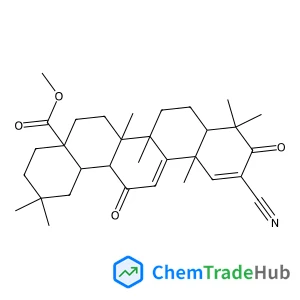
Methyl 2-cyano-3,12-dioxooleana-1,9(11)-dien-28-oate
CAS Number:
218600-53-4
Molecular Formula:
C32H43NO4
![[4-(Heptyloxy)phenyl]boronic acid structure](https://static.chemtradehub.com/structs/136/136370-19-9-ad33.webp "[4-(Heptyloxy)phenyl]boronic acid structure")

Recommended Suppliers





Disclaimer
This page provides academic journal information for reference and research purposes only. We are not affiliated with any journal publishers and do not handle publication submissions. For publication-related inquiries, please contact the respective journal publishers directly.
If you notice any inaccuracies in the information displayed, please contact us at support@chemtradehub.com. We will promptly review and address your concerns.