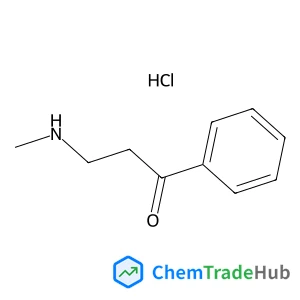
3-(Methylamino)-1-phenyl-1-propanone hydrochloride (1:1)
CAS Number:
2538-50-3
Molecular Formula:
C10H14ClNO
Manling Tang, Minglu Zhou, Yuan Huang, Jiaju Zhong, Zhou Zhou, Kui Luo
In this study, to increase the blood stability and circulation time of polymeric nanoparticles as well as to investigate the effects of the structure on therapeutic indexes, 2 types of N-(2-hydroxypropyl)methacrylamide (HPMA) block copolymer–doxorubicin (copolymer–DOX) conjugates, including an amphiphilic linear one and a core cross-linked one, were designed. Comparative studies on their self-assembled nanoparticles, as advanced drug delivery systems, were investigated. Both conjugates could self-assemble into polymeric nanoparticles (block copolymer-NPs and cross-linked copolymer-NPs) with sizes of ∼20 nm. Those cross-linked nanoparticles demonstrated pH-sensitive drug release features as a much higher accumulative drug release (∼80.2%) in the presence of glutathione (GSH) and pH 5.0 was observed than that in PBS (pH 7.4) without GSH (about 27.0%, 24 h). The degraded segments with low MW (MW ∼28 kDa) can be observed in the presence of a reduction agent. In addition, in vivo pharmacokinetic behaviour studies showed that the cross-linked copolymer-NPs resulted in good blood stability and long-lasting circulation time compared with the linear block copolymer-NPs and the free drug. The cell viability test and migration and invasion assay showed that both nanoparticles can inhibit cancer cell proliferation. Finally, the cross-linked copolymer-NPs exhibited the best in vivo anticancer efficacy due to the highest tumor inhibition rate of 77.75% on the A549 lung tumor model. These results suggested that cross-linked copolymer-NPs could be a potential delivery system in cancer therapy.
Stefan Vuckovic, Tom J. P. Irons, Lucas O. Wagner, Andrew M. Teale, Paola Gori-Giorgi
DOI: 10.1039/C6CP08704C
Yuri Mikhlin, Vladimir Nasluzov, Alexander Romanchenko, Yevgeny Tomashevich, Alexey Shor, Roberto Félix
DOI: 10.1039/C6CP07598C
Paulo R. Bueno, David A. Miranda
DOI: 10.1039/C6CP02504H
Lingyun Zhu, Hua Geng, Yuanping Yi, Zhixiang Wei
DOI: 10.1039/C6CP07417K
Natasha W. Pettinger, Robert E. A. Williams, Jinquan Chen
DOI: 10.1039/C6CP08227K
Hua-Bin Sun, Ying-Xian Zhou, Lu-Lu Zhang, Xue-Lin Yang, Xing-Zhong Cao, Hanu Arave, Hui Fang, Gan Liang
DOI: 10.1039/C6CP07760A
Hui Li, Wei Chen, Xiaopeng Shen, Jingwei Liu, Xuri Huang, Guangtao Yu
DOI: 10.1039/C6CP06717D
Tao Cheng, William A Goddard, III, Qi An, Hai Xiao, Boris Merinov, Sergey Morozov
DOI: 10.1039/C6CP08055C
Christof Drechsel-Grau, Dominik Marx
DOI: 10.1039/C6CP05679B
Dannie J. G. P. van Osch, Laura J. B. M. Kollau, Sari Asikainen, Marisa A. A. Rocha
DOI: 10.1039/C6CP07499E
When handling 4-(2-Furylmethyl)thiomorpholine 1,1-dioxide (CAS: 79206-94-3), it ...
When handling 4-Chloro-N-[2-(4-morpholinyl)ethyl]benzamide (CAS: 71320-77-9), it...
Waste containing this compound (CAS: 62921-74-8) should be handled according to ...
Waste containing (S)-Methyl 2-amino-3-cyclohexylpropanoate should be collected i...
This compound can be synthesized using a multi-step process involving the conjug...
There are several alternatives to (2E)-3-(3,4-Dichlorophenyl)acrylic acid in syn...
Ethyl 6-(2-nitrophenyl)imidazo[2,1-b][1,3]thiazole-3-carboxylate (CAS: 925437-84...
Waste containing 2-(1,3-Thiazol-2-yl)ethanamine (CAS: 18453-07-1) should be coll...
Methyl 5-iodo-2-methylbenzoate can be synthesized through the iodination of meth...
5-Chloro[1,2,4]triazolo[1,5-a]pyridine is commonly synthesized via the condensat...

Polymer Chemistry welcomes submissions in all areas of polymer science that have a strong focus on macromolecular chemistry. Manuscripts may cover a broad range of fields, yet no direct application focus is required.