













Quantitatively monitoring polymer chain growth and topology formation based on monodisperse polymers
Literature Information
Publication Date
2017-03-21
DOI
10.1039/C7PY00322F
Impact Factor
5.582
Authors
Zimu Wang, Zhihao Huang, Nianchen Zhou, Xue-Hui Dong, Xiulin Zhu, Zhengbiao Zhang
View Original
Abstract
In this work, for the first time, polymer chain growth and topology formation was monitored and quantitatively evaluated using a maleimide-based fluorogenic probe based on a photo-induced electron transfer (PET) mechanism. A fluorene-containing monomer bearing terminal maleimide and thiol functional groups was rationally designed. The fluorescence of fluorene was effectively quenched by the adjacent maleimide group, which was proved by model reactions. Firstly, the correlation between molecular weight and fluorescence intensity was established as a calibration curve using precisely synthesized monodisperse polymers with varying numbers of repeating units via an iterative exponential growth strategy. Secondly, step-growth polymerization of the maleimide–fluorene–thiol monomer progressively consumed the maleimide group during polymer chain propagation and led to a gradual increase of fluorescence. This provides a quantitative and robust approach to monitor polymerization processes in situ. Moreover, cyclic oligomers were produced via intramolecular thiol–maleimide Michael addition in highly diluted solutions of linear precursors, and the cyclization process resulted in gradual enhancements of fluorescence intensity due to the elimination of maleimide groups. The cyclic oligomer content at a determined time can thus be quantitatively calculated based on fluorescence emission, enabling a real-time approach for monitoring/surveilling the cyclization process. We further applied this fluorogenic probe method to quantitatively monitor the formation of polymers with more complicated topologies, such as “cyclic-brush-like” macromolecules. This work demonstrates a facile, robust, and versatile platform for monitoring polymerization processes in situ, which may inspire and facilitate diverse molecular design and preparation in the field of precision polymer synthesis.
Related Literature
Li/Ag ratio dependent structure and upconversion photoluminescence of LixAg1−xYb0.99(MoO4)2:0.01Er3+ phosphors
Fangrui Cheng, Xiping Jing, Ziyuan Wang
2014-12-18
Paper
DOI: 10.1039/C4CP03950E
Performance improvement of multilayer InSe transistors with optimized metal contacts
Xin Zhou, Wei Quan Tian, PingAn Hu
2014-12-11
Paper
DOI: 10.1039/C4CP04968C
Rectification inversion in oxygen substituted graphyne–graphene-based heterojunctions
Wen-kai Zhao, Bin Cui, Chang-feng Fang, Guo-min Ji, Jing-fen Zhao, Xiang-ru Kong, Dong-qing Zou, Dong-mei Li
2014-12-03
Paper
DOI: 10.1039/C4CP04859H
Co(iii) protoporphyrin IX chloride in solution: spin-state and metal coordination revealed from resonant inelastic X-ray scattering and electronic structure calculations
Jie Xiao, Bernd Winter
2014-12-12
Paper
DOI: 10.1039/C4CP04703F
Self-assembly polymorphism of 2,7-bis-nonyloxy-9-fluorenone: solvent induced the diversity of intermolecular dipole–dipole interactions
Lihua Cui, Xinrui Miao, Li Xu, Yi Hu, Wenli Deng
2014-12-09
Paper
DOI: 10.1039/C4CP04773G
An equation to calculate internuclear distances of covalent, ionic and metallic lattices
Peter F. Lang, Barry C. Smith
2014-12-16
Paper
DOI: 10.1039/C4CP05135A
The origin of the absorption spectra of porphyrin N- and dithiaporphyrin S-oxides in their neutral and protonated states
Torsten Bruhn, Christian Brückner
2014-12-11
Paper
DOI: 10.1039/C4CP04675G
Ligand-modulated interactions between charged monolayer-protected Au144(SR)60 gold nanoparticles in physiological saline
Oscar D. Villarreal, Liao Y. Chen, Robert L. Whetten, Miguel J. Yacaman
2014-12-18
Paper
DOI: 10.1039/C4CP05137H
Correction: Theoretical study and design of multifunctional phosphorescent platinum(ii) complexes containing triarylboron moieties for efficient OLED emitters
Yong Wu, Guo-Gang Shan, Hai-Bin Li, Shui-Xing Wu, Xin-Yao Ren, Yun Geng, Zhong-Min Su
2015-01-09
Correction
DOI: 10.1039/C4CP90185A
Electrochemical lithiation performance and characterization of silicon–graphite composites with lithium, sodium, potassium, and ammonium polyacrylate binders
Zhen-Ji Han, Kiyofumi Yamagiwa, Naoaki Yabuuchi, Jin-Young Son, Yi-Tao Cui, Hiroshi Oji, Akinori Kogure, Takahiro Harada, Sumihisa Ishikawa, Yasuhito Aoki, Shinichi Komaba
2015-01-05
Paper
DOI: 10.1039/C4CP04939J
You might also like
Compound Q&A
What precautions should be taken when handling 4-(2-Furylmethyl)thiomorpholine 1,1-dioxide (CAS: 79206-94-3)?
When handling 4-(2-Furylmethyl)thiomorpholine 1,1-dioxide (CAS: 79206-94-3), it ...
79206-94-34-(2-Furylmethyl)thi...
Compound Q&A
What precautions should be taken when handling 4-Chloro-N-[2-(4-morpholinyl)ethyl]benzamide (CAS: 71320-77-9)?
When handling 4-Chloro-N-[2-(4-morpholinyl)ethyl]benzamide (CAS: 71320-77-9), it...
71320-77-94-Chloro-N-[2-(4-mor...
Compound Q&A
How should waste containing 2-[2-(2-Methoxyethoxy)ethoxy]ethyl 4-methylbenzenesulfonate (CAS: 62921-74-8) be handled?
Waste containing this compound (CAS: 62921-74-8) should be handled according to ...
62921-74-82-[2-(2-Methoxyethox...
Compound Q&A
How should waste containing (S)-Methyl 2-amino-3-cyclohexylpropanoate be handled?
Waste containing (S)-Methyl 2-amino-3-cyclohexylpropanoate should be collected i...
40056-18-6(S)-Methyl 2-amino-3...
Compound Q&A
How is 5-({4-[(2S,4R)-4-Hydroxy-2-methyltetrahydro-2H-pyran-4-yl]-2-thienyl}sulfanyl)-1-methyl-1,3-dihydro-2H-indol-2-one (CAS: 166882-70-8) typically synthesized?
This compound can be synthesized using a multi-step process involving the conjug...
166882-70-85-({4-[(2S,4R)-4-Hyd...
Compound Q&A
Are there alternatives to (2E)-3-(3,4-Dichlorophenyl)acrylic acid (CAS: 7312-27-8) in synthesis?
There are several alternatives to (2E)-3-(3,4-Dichlorophenyl)acrylic acid in syn...
7312-27-8(2E)-3-(3,4-Dichloro...
Compound Q&A
How should Ethyl 6-(2-nitrophenyl)imidazo[2,1-b][1,3]thiazole-3-carboxylate (CAS: 925437-84-9) be stored?
Ethyl 6-(2-nitrophenyl)imidazo[2,1-b][1,3]thiazole-3-carboxylate (CAS: 925437-84...
925437-84-9Ethyl 6-(2-nitrophen...
Compound Q&A
How should waste containing 2-(1,3-Thiazol-2-yl)ethanamine (CAS: 18453-07-1) be handled?
Waste containing 2-(1,3-Thiazol-2-yl)ethanamine (CAS: 18453-07-1) should be coll...
18453-07-12-(1,3-Thiazol-2-yl)...
Compound Q&A
How is Methyl 5-iodo-2-methylbenzoate (CAS: 103440-54-6) typically synthesized?
Methyl 5-iodo-2-methylbenzoate can be synthesized through the iodination of meth...
103440-54-6Methyl 5-iodo-2-meth...
Compound Q&A
How is 5-Chloro[1,2,4]triazolo[1,5-a]pyridine (CAS: 1427399-34-5) typically synthesized?
5-Chloro[1,2,4]triazolo[1,5-a]pyridine is commonly synthesized via the condensat...
1427399-34-55-Chloro[1,2,4]triaz...
Source Journal
Polymer Chemistry

CiteScore:
8.6
Self-citation Rate:
7.3%
Articles per Year:
457
Polymer Chemistry welcomes submissions in all areas of polymer science that have a strong focus on macromolecular chemistry. Manuscripts may cover a broad range of fields, yet no direct application focus is required.
Recommended Compounds

![1,2-Diphenyl-4-[2-(phenylsulfinyl)ethyl]-3,5-pyrazolidinedione structure](https://static.chemtradehub.com/structs/57-/57-96-5-efcc.webp "1,2-Diphenyl-4-[2-(phenylsulfinyl)ethyl]-3,5-pyrazolidinedione structure")
1,2-Diphenyl-4-[2-(phenylsulfinyl)ethyl]-3,5-pyrazolidinedione
CAS Number:
57-96-5
Molecular Formula:
C23H20N2O3S

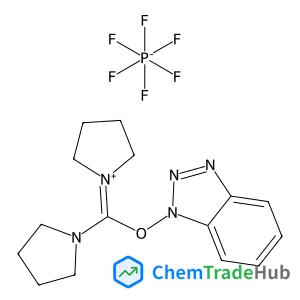
(1H-Benzotriazol-1-yloxy)(di-1-pyrrolidinyl)methylium hexafluorophosphate
CAS Number:
105379-24-6
Molecular Formula:
C15H21F6N5OP
Recommended Suppliers





Disclaimer
This page provides academic journal information for reference and research purposes only. We are not affiliated with any journal publishers and do not handle publication submissions. For publication-related inquiries, please contact the respective journal publishers directly.
If you notice any inaccuracies in the information displayed, please contact us at support@chemtradehub.com. We will promptly review and address your concerns.