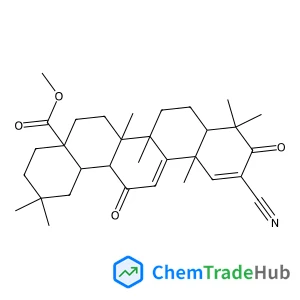
Methyl 2-cyano-3,12-dioxooleana-1,9(11)-dien-28-oate
CAS Number:
218600-53-4
Molecular Formula:
C32H43NO4
Xin Zhou, Wei Quan Tian, PingAn Hu
This work is focused on achieving high performance multilayer InSe field-effect transistors by a systematic experiment study on metal contacts. The high performance can be achieved by choosing an ideal contact metal and adopting a proper thickness of InSe nanosheets. By choosing a proper thickness (33 nm), the performance of multilayer InSe FETs was improved by the following sequence of Al, Ti, Cr and In contacts. The extracted mobility values are 4.7 cm2 V−1 s−1, 27.6 cm2 V−1 s−1, 74 cm2 V−1 s−1 and 162 cm2 V−1 s−1 for Al, Ti, Cr and In, respectively. The on/off ratios are 107–108. The device electronic properties and the interface morphology of the deposition metals/InSe indicate that the contact interface between the metals and InSe plays a significant role in forming low resistance. Our study may pave the way for multilayer InSe applications in nano-electrical and nano-optoelectronic devices.
G. W. Driver, Y. Huang, A. Laaksonen, T. Sparrman, Y.-L. Wang, P.-O. Westlund
DOI: 10.1039/C6CP05801A
Denis S. Grebenkov, Gleb Oshanin
DOI: 10.1039/C6CP06102H
K. E. A. Hooper, H. K. H. Lee, M. J. Newman, S. Meroni, J. Baker, T. M. Watson, W. C. Tsoi
DOI: 10.1039/C6CP05123E
Elham Ashori, Francesc Illas
DOI: 10.1039/C6CP07898B
DOI: 10.1039/C6CP07827C
Kaiqi Wu, Wenfei Li, Lu Yu, Wei Tong, Yue Feng, Shenglong Ling, Longhua Zhang, Xiao Zheng, Maojun Yang
DOI: 10.1039/C6CP08107J
Florent Réal, Paweł Tecmer, André Severo Pereira Gomes, Örs Legeza, Paul W. Ayers, Valérie Vallet
DOI: 10.1039/C6CP05429C
Christel Gervais, Christian Brouder, Nicolas Trcera, Amélie Bordage, Cristina Coelho-Diogo, Pierre Florian, Aydar Rakhmatullin, Lorenzo Paulatto, Michele Lazzeri, Delphine Cabaret
DOI: 10.1039/C6CP08393E
Sergio Giuffrida, Lorenzo Cordone
DOI: 10.1039/C6CP06848K
When handling 4-(2-Furylmethyl)thiomorpholine 1,1-dioxide (CAS: 79206-94-3), it ...
When handling 4-Chloro-N-[2-(4-morpholinyl)ethyl]benzamide (CAS: 71320-77-9), it...
Waste containing this compound (CAS: 62921-74-8) should be handled according to ...
Waste containing (S)-Methyl 2-amino-3-cyclohexylpropanoate should be collected i...
This compound can be synthesized using a multi-step process involving the conjug...
There are several alternatives to (2E)-3-(3,4-Dichlorophenyl)acrylic acid in syn...
Ethyl 6-(2-nitrophenyl)imidazo[2,1-b][1,3]thiazole-3-carboxylate (CAS: 925437-84...
Waste containing 2-(1,3-Thiazol-2-yl)ethanamine (CAS: 18453-07-1) should be coll...
Methyl 5-iodo-2-methylbenzoate can be synthesized through the iodination of meth...
5-Chloro[1,2,4]triazolo[1,5-a]pyridine is commonly synthesized via the condensat...

Physical Chemistry Chemical Physics (PCCP) is an international journal co-owned by 19 physical chemistry and physics societies from around the world. This journal publishes original, cutting-edge research in physical chemistry, chemical physics and biophysical chemistry. To be suitable for publication in PCCP, articles must include significant innovation and/or insight into physical chemistry; this is the most important criterion that reviewers and Editors will judge against when evaluating submissions. The journal has a broad scope and welcomes contributions spanning experiment, theory, computation and data science. Topical coverage includes spectroscopy, dynamics, kinetics, statistical mechanics, thermodynamics, electrochemistry, catalysis, surface science, quantum mechanics, quantum computing and machine learning. Interdisciplinary research areas such as polymers and soft matter, materials, nanoscience, energy, surfaces/interfaces, and biophysical chemistry are welcomed if they demonstrate significant innovation and/or insight into physical chemistry. Joined experimental/theoretical studies are particularly appreciated when complementary and based on up-to-date approaches.