


The control of stereochemistry by the pentafluorosulfanyl group
Literature Information
Publication Date
2018-04-07
DOI
10.1039/C7OB03146G
Impact Factor
3.876
Authors
Paul R. Savoie, Cortney N. von Hahmann, Alexander Penger, Zheng Wei, John T. Welch
View Original
Abstract
The influence of pentafluorosulfanylation on biological activity has been revealed in numerous comparative studies of biologically active compounds, but considerably less is known about the influence of pentafluorosulfanylation on reactivity. Among the distinctive properties of the pentafluorosulfanyl group is the profound dipole moment that results from introduction of this substituent. It has been shown that dipolar effects coupled with the steric demand of the SF5 group may be employed to influence the stereochemistry of reactions, especially those processes with significant charge separation in the transition state. The Staudinger ketene-imine cycloaddition reaction is an ideal platform for investigation of dipolar control of diastereoselectivity by the pentafluorosulfanyl group.
Recommended Journals

European Journal of Wood and Wood Products

Proceedings of the National Academy of Sciences of the United States of America

Molecular Pharmacology

Science

Journal of Heterocyclic Chemistry

Journal of Physics and Chemistry of Solids

Journal of Medicinal Chemistry

Journal of Organometallic Chemistry

Israel Journal of Chemistry

Fibre Chemistry
Related Literature
Cyanide leaching of Au/CeO2: highly active gold clusters for 1,3-butadiene hydrogenation
Y. Guan, E. J. M. Hensen
2009-08-19
Paper
DOI: 10.1039/B909487C
Molecular self-assembly in a model amphiphile system
Lorna Dougan, John L. Finney, Alan K. Soper
2010-06-10
Paper
DOI: 10.1039/C003407J
Depolarisation of rotational orientation and alignment in OH (X2Π) + Xe collisions
Grant Paterson, Sarandis Marinakis, Jacek Kłos, Matthew L. Costen, Kenneth G. McKendrick
2009-07-31
Paper
DOI: 10.1039/B909050A
Franck–Condon simulation of the photoelectron spectrum of AsF2 and the photodetachment spectrum of AsF2− using ab initio calculations: Ionization energy and electron affinity of AsF2
Daniel K. W. Mok, Foo-tim Chau, John M. Dyke
2010-06-08
Paper
DOI: 10.1039/C003688A
Formation and localization of a solvated electron in ground and low-lying excited states of Li(NH3)n and Li(H2O)nclusters: a comparison with Na(NH3)n and Na(H2O)n
Kenro Hashimoto, Kota Daigoku
2009-08-25
Paper
DOI: 10.1039/B907766A
The origin of the large bending enhancement of the reaction of C2H2+ with methane: the effects of bending momentum, ruling out the precursor mechanism, and steps toward “Polanyi rules” for polyatomic reactions
Jianbo Liu, Scott L. Anderson
2009-07-28
Paper
DOI: 10.1039/B908328F
The atomic level structure of the TiO2–NiTi interface
M. Nolan, S. A. M. Tofail
2010-06-15
Paper
DOI: 10.1039/C002562C
Reevaluation of absolute luminescence quantum yields of standard solutions using a spectrometer with an integrating sphere and a back-thinned CCD detector
Kengo Suzuki, Atsushi Kobayashi, Shigeo Kaneko, Kazuyuki Takehira, Toshitada Yoshihara, Hitoshi Ishida, Yoshimi Shiina, Shigero Oishi, Seiji Tobita
2009-09-17
Paper
DOI: 10.1039/B912178A
Inelastic neutron scattering and Raman spectroscopic investigation of l-alanine alaninium nitrate, a homologue of a ferroelectric material
Matthew R. Hudson, Damian G. Allis, Wayne Ouellette, Bruce S. Hudson
2009-08-21
Paper
DOI: 10.1039/B905070A
You might also like
Compound Q&A
How should waste containing N-Methoxy-N-methyl-1,3-thiazole-5-carboxamide (CAS: 898825-89-3) be handled?
Waste containing N-Methoxy-N-methyl-1,3-thiazole-5-carboxamide (CAS: 898825-89-3...
898825-89-3N-Methoxy-N-methyl-1...
Compound Q&A
How should N-(4-Biphenylyl)dibenzo[b,d]furan-4-amine (CAS: 1318338-47-4) be stored?
N-(4-Biphenylyl)dibenzo[b,d]furan-4-amine should be stored in a tightly sealed c...
1318338-47-4N-(4-Biphenylyl)dibe...
Compound Q&A
What is the market or research trend for 3-Acetamido-5-amino-2,4,6-triiodobenzoic acid (CAS: 1713-07-1)?
The market for 3-Acetamido-5-amino-2,4,6-triiodobenzoic acid (CAS: 1713-07-1) is...
1713-07-13-Acetamido-5-amino-...
Compound Q&A
How should Benzyl 2-O-acetyl-3,4,6-tri-O-benzyl-beta-D-galactopyranoside (CAS: 61820-03-9) be stored?
Benzyl 2-O-acetyl-3,4,6-tri-O-benzyl-beta-D-galactopyranoside (CAS: 61820-03-9) ...
61820-03-9Benzyl 2-O-acetyl-3,...
Compound Q&A
What regulatory guidelines apply to 2-Ethylpiperazine dihydrochloride (CAS: 438050-52-3)?
2-Ethylpiperazine dihydrochloride (CAS: 438050-52-3) is regulated under the Glob...
438050-52-32-Ethylpiperazine di...
Compound Q&A
What regulatory guidelines apply to 1,1'-[1,3-Phenylenebis(methylene)]bis(3-methyl-1H-pyrrole-2,5-dione) (CAS: 119462-56-5)?
1,1'-[1,3-Phenylenebis(methylene)]bis(3-methyl-1H-pyrrole-2,5-dione) (CAS: 11946...
119462-56-51,1'-[1,3-Phenyleneb...
Compound Q&A
Are there alternatives to 5-Fluoro-2-(1-pyrrolidinyl)pyridine (CAS: 1287217-79-1) in synthesis?
Several alternatives can be used in the synthesis of 5-Fluoro-2-(1-pyrrolidinyl)...
1287217-79-15-Fluoro-2-(1-pyrrol...
Compound Q&A
What precautions should be taken when handling 1-((2R,3R,4R,5R)-5-((bis(4-methoxyphenyl)(phenyl)methoxy)methyl)-4-hydroxy-3-methoxytetrahydrofuran-2-yl)-5-methylpyrimidine-2,4(1H,3H)-dione (CAS: 153631-19-7)?
Proper personal protective equipment (PPE) must be worn when handling this compo...
153631-19-71-((2R,3R,4R,5R)-5-(...
Compound Q&A
What precautions should be taken when handling 6-Bromoimidazo[1,2-a]pyridin-8-amine (CAS: 676371-00-9)?
When handling 6-Bromoimidazo[1,2-a]pyridin-8-amine, it is important to wear appr...
676371-00-96-Bromoimidazo[1,2-a...
Compound Q&A
Are there alternatives to (2S,4R)-4-(4-Nitrobenzyl)pyrrolidine-2-carboxylic acid hydrochloride (CAS: 1049740-22-8) in synthesis?
Alternatives to (2S,4R)-4-(4-Nitrobenzyl)pyrrolidine-2-carboxylic acid hydrochlo...
1049740-22-8(2S,4R)-4-(4-Nitrobe...
Source Journal
Organic & Biomolecular Chemistry

CiteScore:
3.4
Self-citation Rate:
10.3%
Articles per Year:
1041
Organic & Biomolecular Chemistry (OBC) publishes original and high impact research and reviews in organic chemistry. We welcome research that shows new or significantly improved protocols or methodologies in total synthesis, synthetic methodology or physical and theoretical organic chemistry as well as research that shows a significant advance in the organic chemistry or molecular design aspects of chemical biology, catalysis, supramolecular and macromolecular chemistry, theoretical chemistry, mechanism-oriented physical organic chemistry, medicinal chemistry or natural products. Articles published in the journal should report new work which makes a highly-significant impact in the field. Routine and incremental work is generally not suitable for publication in the journal. More details about key areas of our scope are below. In all cases authors should include in their article clear rationale for why their research has been carried out.
Recommended Compounds



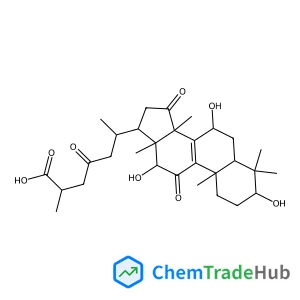
(3beta,7beta,12beta)-3,7,12-Trihydroxy-11,15,23-trioxolanost-8-en-26-oic acid
CAS Number:
98665-22-6
Molecular Formula:
C30H44O8
Recommended Suppliers




Disclaimer
This page provides academic journal information for reference and research purposes only. We are not affiliated with any journal publishers and do not handle publication submissions. For publication-related inquiries, please contact the respective journal publishers directly.
If you notice any inaccuracies in the information displayed, please contact us at support@chemtradehub.com. We will promptly review and address your concerns.