












![4-[(4-Bromophenyl)sulfonyl]thiomorpholine structure](https://static.chemtradehub.com/structs/223/223555-81-5-2d67.webp "4-[(4-Bromophenyl)sulfonyl]thiomorpholine structure")
A quantitative study of the clustering of polycyclic aromatic hydrocarbons at high temperatures
Literature Information
Publication Date
2012-02-15
DOI
10.1039/C2CP23008A
Impact Factor
3.676
Authors
Tim S. Totton, Alston J. Misquitta, Markus Kraft
View Original
Abstract
The clustering of polycyclic aromatic hydrocarbon (PAH) molecules is investigated in the context of soot particle inception and growth using an isotropic potential developed from the benchmark PAHAP potential. This potential is used to estimate equilibrium constants of dimerisation for five representative PAH molecules based on a statistical mechanics model. Molecular dynamics simulations are also performed to study the clustering of homomolecular systems at a range of temperatures. The results from both sets of calculations demonstrate that at flame temperatures pyrene (C16H10) dimerisation cannot be a key step in soot particle formation and that much larger molecules (e.g.circumcoronene, C54H18) are required to form small clusters at flame temperatures. The importance of using accurate descriptions of the intermolecular interactions is demonstrated by comparing results to those calculated with a popular literature potential with an order of magnitude variation in the level of clustering observed. By using an accurate intermolecular potential we are able to show that physical binding of PAH molecules based on van der Waals interactions alone can only be a viable soot inception mechanism if concentrations of large PAH molecules are significantly higher than currently thought.
Related Literature
Generation of a carbon dots/ammonium persulfate redox initiator couple for free radical frontal polymerization
2017-12-21
Paper
DOI: 10.1039/C7PY01969F
Cd2+ coordination: an efficient structuring switch for polypeptide polymers
2018-06-13
Communication
DOI: 10.1039/C8PY00810H
Reversible star assembly of polyolefins using interconversion between boroxine and boronic acid
Ryo Tanaka, Naoki Tonoko, Shin-ichi Kihara, Yuushou Nakayama, Takeshi Shiono
2018-06-12
Paper
DOI: 10.1039/C8PY00519B
Synthesis of enzyme-responsive phosphoramidate dendrimers for cancer drug delivery
Zhen Zhang, Yongcun Zhou, Zhuxian Zhou, Ying Piao, Nagendra Kalva, Xiangrui Liu, Jianbin Tang, Youqing Shen
2017-12-18
Paper
DOI: 10.1039/C7PY01492A
Continuous-flow chemistry for the determination of comonomer reactivity ratios
Marcus H. Reis, Cullen L. G. Davidson, IV, Frank A. Leibfarth
2018-01-05
Paper
DOI: 10.1039/C7PY01938F
A pH-responsive polymer based on dynamic imine bonds as a drug delivery material with pseudo target release behavior
Yangchun Tao, Siwei Liu, Yi Zhang, Zhenguo Chi, Jiarui Xu
2018-01-19
Paper
DOI: 10.1039/C7PY02108A
Temperature-responsive hydrogels via the electrostatic interaction of amphiphilic diblock copolymers with pendant-ion groups
Hye Yun Lee, Seung Hun Park, Jae Ho Kim, Moon Suk Kim
2017-10-17
Paper
DOI: 10.1039/C7PY01460K
Terpyridine-functionalized stimuli-responsive microgels and their assembly through metal–ligand interactions
Jookyeong Lee, Eun Jung Choi, Imre Varga, Sang-Ho Yun, Changsik Song
2018-01-30
Paper
DOI: 10.1039/C8PY00016F
Synthesis of PEVE-b-P(CTFE-alt-EVE) block copolymers by sequential cationic and radical RAFT polymerization
Marc Guerre, Mineto Uchiyama, Gérald Lopez, Bruno Améduri, Masami Kamigaito, Vincent Ladmiral
2017-12-08
Paper
DOI: 10.1039/C7PY01924F
In situ synthesis of diblock copolymer nano-assemblies via dispersion RAFT polymerization induced self-assembly and Ag/copolymer composite nanoparticles thereof
Mengting Tan, Yan Shi, Zhifeng Fu, Wantai Yang
2018-02-05
Paper
DOI: 10.1039/C7PY01905J
You might also like
Compound Q&A
What are the main uses of (3.beta.)-3-Hydroxy-N,N-dimethyl-chol-5-en-24-amide (CAS: 79066-03-8)?
(3.beta.)-3-Hydroxy-N,N-dimethyl-chol-5-en-24-amide (CAS: 79066-03-8) is primari...
79066-03-8(3.beta.)-3-Hydroxy-...
Compound Q&A
What regulatory guidelines apply to 5-(aminomethyl)-2-methoxyphenol (CAS: 89702-89-6)?
5-(Aminomethyl)-2-methoxyphenol (CAS: 89702-89-6) is classified under GHS as a s...
89702-89-65-(aminomethyl)-2-me...
Compound Q&A
What is Thieno[2,3-c]pyridin-7(6H)-one (CAS: 28981-13-7)?
Thieno[2,3-c]pyridin-7(6H)-one (CAS: 28981-13-7) is a heterocyclic organic compo...
28981-13-7Thieno[2,3-c]pyridin...
Compound Q&A
Is 1-[(6-Methoxy-3-pyridinyl)methyl]-4-piperidinamine dihydrochloride (CAS: 1185311-28-7) safe?
1-[(6-Methoxy-3-pyridinyl)methyl]-4-piperidinamine dihydrochloride is generally ...
1185311-28-71-[(6-Methoxy-3-pyri...
Compound Q&A
What regulatory guidelines apply to [(2E)-3-Phenyl-2-propen-1-yl]phosphonic acid (CAS: 146404-58-2)?
[(2E)-3-Phenyl-2-propen-1-yl]phosphonic acid (CAS: 146404-58-2) is regulated und...
146404-58-2[(2E)-3-Phenyl-2-pro...
Compound Q&A
What regulatory guidelines apply to 6-Bromo-7-methoxyquinoline (CAS: 1620515-86-7)?
6-Bromo-7-methoxyquinoline (CAS: 1620515-86-7) falls under the scope of the Glob...
1620515-86-76-Bromo-7-methoxyqui...
Compound Q&A
What industries use (2R)-1-(1-Benzofuran-2-yl)-N-propyl-2-pentanamine (CAS: 260550-89-8)?
This compound is primarily used in the pharmaceutical industry for the developme...
260550-89-8(2R)-1-(1-Benzofuran...
Compound Q&A
What are the main uses of 1-Ethyl-7-[2-methyl-6-(4H-1,2,4-triazol-3-yl)-3-pyridinyl]-3,5-dihydropyrazino[2,3-b]pyrazin-2(1H)-one (CAS: 1228013-15-7)?
1-Ethyl-7-[2-methyl-6-(4H-1,2,4-triazol-3-yl)-3-pyridinyl]-3,5-dihydropyrazino[2...
1228013-15-71-Ethyl-7-[2-methyl-...
Compound Q&A
Are there alternatives to {5-(Acryloylamino)-2-[(dimethylamino)methyl]phenyl}boronic acid (CAS: 1217500-78-1) in synthesis?
Alternative reagents such as 2-[(dimethylamino)methyl]phenylboronic acid or rela...
1217500-78-1{5-(Acryloylamino)-2...
Compound Q&A
What is 3-(Piperidin-4-yloxy)pyridine (CAS: 310881-48-2)?
3-(Piperidin-4-yloxy)pyridine (CAS: 310881-48-2) is an organic compound with the...
310881-48-23-(Piperidin-4-yloxy...
Source Journal
Physical Chemistry Chemical Physics

CiteScore:
5.5
Self-citation Rate:
10.3%
Articles per Year:
3036
Physical Chemistry Chemical Physics (PCCP) is an international journal co-owned by 19 physical chemistry and physics societies from around the world. This journal publishes original, cutting-edge research in physical chemistry, chemical physics and biophysical chemistry. To be suitable for publication in PCCP, articles must include significant innovation and/or insight into physical chemistry; this is the most important criterion that reviewers and Editors will judge against when evaluating submissions. The journal has a broad scope and welcomes contributions spanning experiment, theory, computation and data science. Topical coverage includes spectroscopy, dynamics, kinetics, statistical mechanics, thermodynamics, electrochemistry, catalysis, surface science, quantum mechanics, quantum computing and machine learning. Interdisciplinary research areas such as polymers and soft matter, materials, nanoscience, energy, surfaces/interfaces, and biophysical chemistry are welcomed if they demonstrate significant innovation and/or insight into physical chemistry. Joined experimental/theoretical studies are particularly appreciated when complementary and based on up-to-date approaches.
Recommended Compounds
![Bis(N,N''-dimethylpiperazine)tetra[copper(I) iodide] structure](https://static.chemtradehub.com/structs/140/1401708-91-5-2b86.webp "Bis(N,N''-dimethylpiperazine)tetra[copper(I) iodide] structure")
Bis(N,N''-dimethylpiperazine)tetra[copper(I) iodide]
CAS Number:
1401708-91-5
Molecular Formula:
C12H28Cu4I4N4
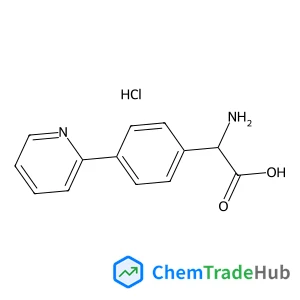
2-Amino-2-(4-(pyridin-2-YL)phenyl)acetic acid hydrochloride
CAS Number:
1135818-89-1
Molecular Formula:
C13H13ClN2O2
Recommended Suppliers






Disclaimer
This page provides academic journal information for reference and research purposes only. We are not affiliated with any journal publishers and do not handle publication submissions. For publication-related inquiries, please contact the respective journal publishers directly.
If you notice any inaccuracies in the information displayed, please contact us at support@chemtradehub.com. We will promptly review and address your concerns.