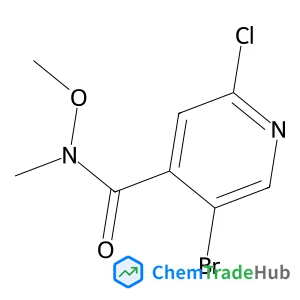
5-Bromo-2-chloro-N-methoxy-N-methylisonicotinamide
CAS Number:
1256790-08-5
Molecular Formula:
C8H8BrClN2O2
Ronen Kreizman, Osip Schwartz, Zvicka Deutsch, Stella Itzhakov, Alla Zak, Sidney R. Cohen, Reshef Tenne, Dan Oron
A synthetic route for preparation of inorganic WS2 nanotube (INT)–colloidal semiconductor quantum dot (QD) hybrid structures is developed, and transient carrier dynamics on these hybrids are studied via transient photoluminescence spectroscopy utilizing several different types of QDs. Measurements reveal efficient resonant energy transfer from the QDs to the INT upon photoexcitation, provided that the QD emission is at a higher energy than the INT direct gap. Charge transfer in the hybrid system, characterized using QDs with band gaps below the INT direct gap, is found to be absent. This is attributed to the presence of an organic barrier layer due to the relatively long-chain organic ligands of the QDs under study. This system, analogous to carbon nanotube–QD hybrids, holds potential for a variety of applications, including photovoltaics, luminescence tagging and optoelectronics.
Jaeeun Song, L. Palanikumar, Yeongkyu Choi, Inhye Kim, Tae-young Heo, Eungjin Ahn, Soo-Hyung Choi, Eunji Lee, Yuji Shibasaki, Ja-Hyoung Ryu
DOI: 10.1039/C7PY01613A
D. L. Morris, T. C. Leeper, C. J. Ziegler
DOI: 10.1039/C8PY00545A
Kyle J. Arrington, John B. Matson
DOI: 10.1039/C7PY01741C
Rodinel Ardeleanu, Andrei I. Dascalu, Dragos Peptanariu, Cristina M. Uritu, Alina Nicolescu, Mihail Barboiu, Mariana Pinteala
DOI: 10.1039/C7PY01256J
Akihiro Kimura, Haruka Hayama, Hassan Nageh, Yue Wang, Naofumi Naga
DOI: 10.1039/C7PY01509G
Yongqi Yang, Jinwen Zheng, Shoukuo Man, Xiaolan Sun, Zesheng An
DOI: 10.1039/C8PY00040A
Lukas Stepien, Robert Grafe, Olga Guskova, Anton Kiriy, Frank Simon, Heiko Reith, Kornelius Nielsch, Gabi Schierning, Deepa Kasinathan
DOI: 10.1039/C8PY00931G
Jookyeong Lee, Eun Jung Choi, Imre Varga, Sang-Ho Yun, Changsik Song
DOI: 10.1039/C8PY00016F
(3.beta.)-3-Hydroxy-N,N-dimethyl-chol-5-en-24-amide (CAS: 79066-03-8) is primari...
5-(Aminomethyl)-2-methoxyphenol (CAS: 89702-89-6) is classified under GHS as a s...
Thieno[2,3-c]pyridin-7(6H)-one (CAS: 28981-13-7) is a heterocyclic organic compo...
1-[(6-Methoxy-3-pyridinyl)methyl]-4-piperidinamine dihydrochloride is generally ...
[(2E)-3-Phenyl-2-propen-1-yl]phosphonic acid (CAS: 146404-58-2) is regulated und...
6-Bromo-7-methoxyquinoline (CAS: 1620515-86-7) falls under the scope of the Glob...
This compound is primarily used in the pharmaceutical industry for the developme...
1-Ethyl-7-[2-methyl-6-(4H-1,2,4-triazol-3-yl)-3-pyridinyl]-3,5-dihydropyrazino[2...
Alternative reagents such as 2-[(dimethylamino)methyl]phenylboronic acid or rela...
3-(Piperidin-4-yloxy)pyridine (CAS: 310881-48-2) is an organic compound with the...

Physical Chemistry Chemical Physics (PCCP) is an international journal co-owned by 19 physical chemistry and physics societies from around the world. This journal publishes original, cutting-edge research in physical chemistry, chemical physics and biophysical chemistry. To be suitable for publication in PCCP, articles must include significant innovation and/or insight into physical chemistry; this is the most important criterion that reviewers and Editors will judge against when evaluating submissions. The journal has a broad scope and welcomes contributions spanning experiment, theory, computation and data science. Topical coverage includes spectroscopy, dynamics, kinetics, statistical mechanics, thermodynamics, electrochemistry, catalysis, surface science, quantum mechanics, quantum computing and machine learning. Interdisciplinary research areas such as polymers and soft matter, materials, nanoscience, energy, surfaces/interfaces, and biophysical chemistry are welcomed if they demonstrate significant innovation and/or insight into physical chemistry. Joined experimental/theoretical studies are particularly appreciated when complementary and based on up-to-date approaches.