












A novel sulfonamide non-classical carbenoid: a mechanistic study for the synthesis of enediynes
Literature Information
Publication Date
2017-11-20
DOI
10.1039/C7OB02437A
Impact Factor
3.876
Authors
Theodore O. P. Hayes, Ben Slater, Richard A. J. Horan, Marc Radigois, Jonathan D. Wilden
View Original
Abstract
Alkynyl sulfonamides undergo sequential 1,4- then 1,2-addition/rearrangement with lithium acetylides to yield enediynes in the absence of any promoters or catalysts. Mechanistic investigations suggest that the reaction proceeds via 1,4-conjugate addition of the nucleophile to the unsaturated system to give a key alkenyl lithium species which is stabilised by an intramolecular coordination effect by a sulfonamide oxygen atom. This species can be considered a vinylidene carbenoid given the carbon atom bears both an anion (as a vinyllithium) and a leaving group (the sulfonamide). The intramolecular coordination effect serves to stabilise the vinyllithium but activates the sulfonamide motif towards nucleophilic attack by a second mole of acetylide. The resulting species can then undergo rearrangement to yield the enediyne framework in a single operation with concomitant loss of aminosulfinate.
Recommended Journals
Related Literature
An unprecedented rhodium-catalysed self-conjugate reduction, cross-coupling tandem reaction of cinnamaldehydes with arylboronic acids
Zhiyong Wang, Gang Zou, Jie Tang
2004-04-14
Communication
DOI: 10.1039/B401511H
Efficient synthesis of a nucleoside-diphospho-exo-glycal displaying time-dependent inactivation of UDP-galactopyranose mutase
Audrey Caravano, Stéphane P. Vincent, Pierre Sinaÿ
2004-04-23
Communication
DOI: 10.1039/B402469A
Zinc–proline catalyzed pathway for the formation of sugars
Jacob Kofoed, Miguel Machuqueiro, Jean-Louis Reymond, Tamis Darbre
2004-05-27
Communication
DOI: 10.1039/B404465G
Poly(vinyl alcohol) star polymers prepared via MADIX/RAFT polymerisation
Martina H. Stenzel, Thomas P. Davis, Christopher Barner-Kowollik
2004-06-02
Communication
DOI: 10.1039/B404763J
Template synthesis of multi-macrocycles by metathesis reaction‡
Myroslav O. Vysotsky, Anca Bogdan, Leyong Wang, Volker Böhmer
2004-04-28
Communication
DOI: 10.1039/B402719A
Desymmetrization of meso-dienyne by asymmetric Pauson–Khand type reaction catalysts
Nakcheol Jeong, Dong Hoon Kim, Jun Hun Choi
2004-04-08
Communication
DOI: 10.1039/B401288G
Sensitivity increase in molecular recognition by decrease of the sensing particle size and by increase of the receptor binding site – a case with chemomechanical polymers
Hans-Jörg Schneider, Liu Tianjun, Nino Lomadze
2004-09-24
Communication
DOI: 10.1039/B409331C
Large scale, templateless, surfactantless route to rapid synthesis of uniform poly(o-phenylenediamine) nanobelts
Xuping Sun, Shaojun Dong, Erkang Wang
2004-04-23
Communication
DOI: 10.1039/B401777C
Thin Pd membrane prepared on macroporous stainless steel tube filter by an in-situ multi-dimensional plating mechanism
Jianhua Tong, Yasuyuki Matsumura
2004-09-20
Communication
DOI: 10.1039/B406975G
LiSr2(NCN)I3: the first empty tetrahedral strontium(ii) entity coordinated by carbodiimide units but without strontium–strontium bonding
Wuping Liao, Jörg von Appen, Richard Dronskowski
2004-09-02
Communication
DOI: 10.1039/B408647C
You might also like
Compound Q&A
What precautions should be taken when handling 2-Chloro-1,2-bis(4-methylphenyl)ethanone (CAS: 71193-32-3)?
When handling 2-Chloro-1,2-bis(4-methylphenyl)ethanone (CAS: 71193-32-3), it is ...
71193-32-32-Chloro-1,2-bis(4-m...
Compound Q&A
What industries use 4-Ethoxy-3-(5-methyl-4-oxo-7-propyl-1,4-dihydroimidazo[5,1-f][1,2,4]triazin-2-yl)benzenesulfonyl chloride (CAS: 224789-26-8)?
4-Ethoxy-3-(5-methyl-4-oxo-7-propyl-1,4-dihydroimidazo[5,1-f][1,2,4]triazin-2-yl...
224789-26-84-Ethoxy-3-(5-methyl...
Compound Q&A
How should Methyl 3-Oxo-4-Androsten-17-Carboxylate (CAS: 2681-55-2) be stored?
Methyl 3-Oxo-4-Androsten-17-Carboxylate (CAS: 2681-55-2) should be stored in a c...
2681-55-2Methyl 3-Oxo-4-Andro...
Compound Q&A
What are the main uses of (R)-3-Amino-4-(3-hexylphenylamino)-4-oxobutylphosphonic acid (CAS: 909725-61-7)?
(R)-3-Amino-4-(3-hexylphenylamino)-4-oxobutylphosphonic acid is primarily used i...
909725-61-7(R)-3-Amino-4-(3-hex...
Compound Q&A
What regulatory guidelines apply to 2-Methyl-2-propanyl 3-amino-3-carbamoyl-1-azetidinecarboxylate (CAS: 1254120-14-3)?
2-Methyl-2-propanyl 3-amino-3-carbamoyl-1-azetidinecarboxylate (CAS: 1254120-14-...
1254120-14-32-Methyl-2-propanyl ...
Compound Q&A
Are there alternatives to (E)-4-(tert-Butoxy)-4-oxobut-2-enoic acid (CAS: 135355-96-3) in synthesis?
There are alternative reagents that can be used in synthesis instead of (E)-4-(t...
135355-96-3(E)-4-(tert-Butoxy)-...
Compound Q&A
What are the physical and chemical properties of [2-(3-Chlorophenyl)-1,3-thiazol-4-yl]methanol (CAS: 121202-20-8)?
[2-(3-Chlorophenyl)-1,3-thiazol-4-yl]methanol (CAS: 121202-20-8) is a crystallin...
121202-20-8[2-(3-Chlorophenyl)-...
Compound Q&A
What is the market or research trend for Methyl (2S)-[(4S)-2,2-dimethyl-1,3-dioxolan-4-yl]{[(4-methylphenyl)sulfonyl]oxy}acetate (CAS: 166249-17-8)?
The market and research trends for Methyl (2S)-[(4S)-2,2-dimethyl-1,3-dioxolan-4...
166249-17-8Methyl (2S)-[(4S)-2,...
Compound Q&A
What is the market or research trend for 1-Bromo-2-isocyanatoethane (CAS: 42865-19-0)?
The market for 1-Bromo-2-isocyanatoethane (CAS: 42865-19-0) is driven by its use...
42865-19-01-Bromo-2-isocyanato...
Compound Q&A
What are the main uses of 4-Nitro-D-phenylalanine hydrochloride (CAS: 147065-06-3)?
4-Nitro-D-phenylalanine hydrochloride (CAS: 147065-06-3) is primarily used in re...
147065-06-34-Nitro-D-phenylalan...
Source Journal
Organic & Biomolecular Chemistry

CiteScore:
3.4
Self-citation Rate:
10.3%
Articles per Year:
1041
Organic & Biomolecular Chemistry (OBC) publishes original and high impact research and reviews in organic chemistry. We welcome research that shows new or significantly improved protocols or methodologies in total synthesis, synthetic methodology or physical and theoretical organic chemistry as well as research that shows a significant advance in the organic chemistry or molecular design aspects of chemical biology, catalysis, supramolecular and macromolecular chemistry, theoretical chemistry, mechanism-oriented physical organic chemistry, medicinal chemistry or natural products. Articles published in the journal should report new work which makes a highly-significant impact in the field. Routine and incremental work is generally not suitable for publication in the journal. More details about key areas of our scope are below. In all cases authors should include in their article clear rationale for why their research has been carried out.
Recommended Compounds
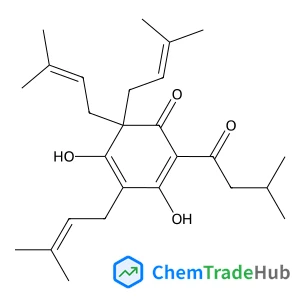
3,5-Dihydroxy-4-(3-methylbutanoyl)-2,6,6-tris(3-methyl-2-buten-1-yl)-2,4-cyclohexadien-1-one
CAS Number:
468-28-0
Molecular Formula:
C26H38O4
![(1R)-3-Bromo-1,7,7-trimethylbicyclo[2.2.1]heptan-2-one structure](https://static.chemtradehub.com/structs/102/10293-06-8-dd8a.webp "(1R)-3-Bromo-1,7,7-trimethylbicyclo[2.2.1]heptan-2-one structure")
(1R)-3-Bromo-1,7,7-trimethylbicyclo[2.2.1]heptan-2-one
CAS Number:
10293-06-8
Molecular Formula:
C10H15BrO
Recommended Suppliers








Disclaimer
This page provides academic journal information for reference and research purposes only. We are not affiliated with any journal publishers and do not handle publication submissions. For publication-related inquiries, please contact the respective journal publishers directly.
If you notice any inaccuracies in the information displayed, please contact us at support@chemtradehub.com. We will promptly review and address your concerns.