













Highly regioselective gold-catalyzed formal hydration of propargylic gem-difluorides
Literature Information
Publication Date
2017-11-13
DOI
10.1039/C7OB02406A
Impact Factor
3.876
Authors
Jean-Denys Hamel, Tatsuru Hayashi, Mélissa Cloutier, Paul R. Savoie, Olivier Thibeault, Meggan Beaudoin, Jean-François Paquin
View Original
Abstract
Herein, we report a highly regioselective gold-catalyzed formal hydration of propargylic gem-difluorides. Not only does this transformation provide access to versatile fluorinated building blocks that were difficult or hardly possible to access beforehand, but it also represents a rare case of a highly regioselective gold-catalyzed hydroalkoxylation of internal alkynes and puts forward the utility of the difluoromethylene unit as a directing group in catalysis.
Related Literature
Oxy-peptide nucleic acid with a pyrrolidine ring that is configurationally optimized for hybridization with DNA
Mizuki Kitamatsu, Masanori Shigeyasu, Tomoyuki Okada, Masahiko Sisido
2004-04-23
Communication
DOI: 10.1039/B401057D
Shape of CeO2nanoparticles using simulated amorphisation and recrystallisation
Thi X. T. Sayle, Stephen C. Parker, Dean C. Sayle
2004-09-21
Communication
DOI: 10.1039/B408752F
Synthesis and unprecedented oxidation of a cationic Sb-analogue of an Arduengo's carbene
Dietrich Gudat, Timo Gans-Eichler, Martin Nieger
2004-09-22
Communication
DOI: 10.1039/B409657F
Fe–Ce–ZSM-5 a new catalyst of outstanding properties in the selective catalytic reduction of NO with NH3
G. Carja, G. Delahay, C. Signorile, B. Coq
2004-05-17
Communication
DOI: 10.1039/B402660H
The first tandem double palladium-catalyzed aminations: synthesis of dipyrido[1,2-a∶3′,2′-d]imidazole and its benzo- and aza-analogues
Kristof T. J. Loones, Bert U. W. Maes, Roger A. Dommisse, Guy L. F. Lemière
2004-09-20
Communication
DOI: 10.1039/B409161B
Halide anion directed assembly of luminescent pseudorotaxanes
David Curiel, Paul D. Beer, Rowena L. Paul, Andrew Cowley, Mark R. Sambrook, Fridrich Szemes
2004-04-22
Communication
DOI: 10.1039/B401900H
Efficient synthesis of a nucleoside-diphospho-exo-glycal displaying time-dependent inactivation of UDP-galactopyranose mutase
Audrey Caravano, Stéphane P. Vincent, Pierre Sinaÿ
2004-04-23
Communication
DOI: 10.1039/B402469A
Encapsulation of gases in the solid state
Alexander V. Leontiev, Dmitry M. Rudkevich
2004-06-01
Communication
DOI: 10.1039/B402997F
Sensitivity increase in molecular recognition by decrease of the sensing particle size and by increase of the receptor binding site – a case with chemomechanical polymers
Hans-Jörg Schneider, Liu Tianjun, Nino Lomadze
2004-09-24
Communication
DOI: 10.1039/B409331C
Olefincopolymerizationvia reversible addition–fragmentation chain transfer
Rajan Venkatesh, Bastiaan B P Staal, Bert Klumperman
2004-05-20
Communication
DOI: 10.1039/B403342F
You might also like
Compound Q&A
What precautions should be taken when handling 2-Chloro-1,2-bis(4-methylphenyl)ethanone (CAS: 71193-32-3)?
When handling 2-Chloro-1,2-bis(4-methylphenyl)ethanone (CAS: 71193-32-3), it is ...
71193-32-32-Chloro-1,2-bis(4-m...
Compound Q&A
What industries use 4-Ethoxy-3-(5-methyl-4-oxo-7-propyl-1,4-dihydroimidazo[5,1-f][1,2,4]triazin-2-yl)benzenesulfonyl chloride (CAS: 224789-26-8)?
4-Ethoxy-3-(5-methyl-4-oxo-7-propyl-1,4-dihydroimidazo[5,1-f][1,2,4]triazin-2-yl...
224789-26-84-Ethoxy-3-(5-methyl...
Compound Q&A
How should Methyl 3-Oxo-4-Androsten-17-Carboxylate (CAS: 2681-55-2) be stored?
Methyl 3-Oxo-4-Androsten-17-Carboxylate (CAS: 2681-55-2) should be stored in a c...
2681-55-2Methyl 3-Oxo-4-Andro...
Compound Q&A
What are the main uses of (R)-3-Amino-4-(3-hexylphenylamino)-4-oxobutylphosphonic acid (CAS: 909725-61-7)?
(R)-3-Amino-4-(3-hexylphenylamino)-4-oxobutylphosphonic acid is primarily used i...
909725-61-7(R)-3-Amino-4-(3-hex...
Compound Q&A
What regulatory guidelines apply to 2-Methyl-2-propanyl 3-amino-3-carbamoyl-1-azetidinecarboxylate (CAS: 1254120-14-3)?
2-Methyl-2-propanyl 3-amino-3-carbamoyl-1-azetidinecarboxylate (CAS: 1254120-14-...
1254120-14-32-Methyl-2-propanyl ...
Compound Q&A
Are there alternatives to (E)-4-(tert-Butoxy)-4-oxobut-2-enoic acid (CAS: 135355-96-3) in synthesis?
There are alternative reagents that can be used in synthesis instead of (E)-4-(t...
135355-96-3(E)-4-(tert-Butoxy)-...
Compound Q&A
What are the physical and chemical properties of [2-(3-Chlorophenyl)-1,3-thiazol-4-yl]methanol (CAS: 121202-20-8)?
[2-(3-Chlorophenyl)-1,3-thiazol-4-yl]methanol (CAS: 121202-20-8) is a crystallin...
121202-20-8[2-(3-Chlorophenyl)-...
Compound Q&A
What is the market or research trend for Methyl (2S)-[(4S)-2,2-dimethyl-1,3-dioxolan-4-yl]{[(4-methylphenyl)sulfonyl]oxy}acetate (CAS: 166249-17-8)?
The market and research trends for Methyl (2S)-[(4S)-2,2-dimethyl-1,3-dioxolan-4...
166249-17-8Methyl (2S)-[(4S)-2,...
Compound Q&A
What is the market or research trend for 1-Bromo-2-isocyanatoethane (CAS: 42865-19-0)?
The market for 1-Bromo-2-isocyanatoethane (CAS: 42865-19-0) is driven by its use...
42865-19-01-Bromo-2-isocyanato...
Compound Q&A
What are the main uses of 4-Nitro-D-phenylalanine hydrochloride (CAS: 147065-06-3)?
4-Nitro-D-phenylalanine hydrochloride (CAS: 147065-06-3) is primarily used in re...
147065-06-34-Nitro-D-phenylalan...
Source Journal
Organic & Biomolecular Chemistry

CiteScore:
3.4
Self-citation Rate:
10.3%
Articles per Year:
1041
Organic & Biomolecular Chemistry (OBC) publishes original and high impact research and reviews in organic chemistry. We welcome research that shows new or significantly improved protocols or methodologies in total synthesis, synthetic methodology or physical and theoretical organic chemistry as well as research that shows a significant advance in the organic chemistry or molecular design aspects of chemical biology, catalysis, supramolecular and macromolecular chemistry, theoretical chemistry, mechanism-oriented physical organic chemistry, medicinal chemistry or natural products. Articles published in the journal should report new work which makes a highly-significant impact in the field. Routine and incremental work is generally not suitable for publication in the journal. More details about key areas of our scope are below. In all cases authors should include in their article clear rationale for why their research has been carried out.
Recommended Compounds
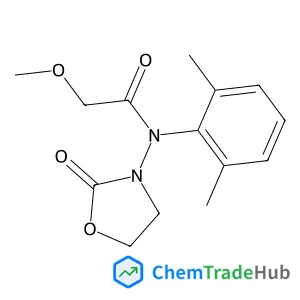
N-(2,6-Dimethylphenyl)-2-methoxy-N-(2-oxo-1,3-oxazolidin-3-yl)acetamide
CAS Number:
77732-09-3
Molecular Formula:
C14H18N2O4
Recommended Suppliers







Disclaimer
This page provides academic journal information for reference and research purposes only. We are not affiliated with any journal publishers and do not handle publication submissions. For publication-related inquiries, please contact the respective journal publishers directly.
If you notice any inaccuracies in the information displayed, please contact us at support@chemtradehub.com. We will promptly review and address your concerns.