












Peramivir analogues bearing hydrophilic side chains exhibit higher activities against H275Y mutant than wild-type influenza virus
Literature Information
Publication Date
2017-11-09
DOI
10.1039/C7OB02374J
Impact Factor
3.876
Authors
Din-Chi Chiu, Tzu-Chen Lin, Wen-I Huang, Ting-Jen Cheng
View Original
Abstract
Peramivir is an effective anti-influenza drug in the clinical treatment of influenza, but its efficacy toward the H275Y mutant is reduced. The previously reported cocrystal structures of inhibitors in the mutant neuraminidase (NA) suggest that the hydrophobic side chain should be at the origin of reduced binding affinity. In contrast, zanamivir having a hydrophilic glycerol side chain still possesses high affinity toward the H275Y NA. We thus designed five peramivir analogues (5–9) carrying hydrophilic glycol or glycerol side chains, and evaluated their roles in anti-influenza activity, especially for the H275Y mutant. The synthetic sequence involves a key step of (3 + 2) cycloaddition reactions between alkenes and nitrile oxides to construct the scaffold of peramivir carrying the desired hydrophilic side chains and other appropriate functional groups. The molecular docking experiments reveal that the hydrophilic side chain can provide extra hydrogen bonding with the translocated Glu-276 residue in the H275Y NA active site. Thus, the H275Y mutant may be even more sensitive than wild-type virus toward the peramivir analogues bearing hydrophilic side chains. Notably, the peramivir analogue bearing a glycerol side chain inhibits the H275Y mutant with an IC50 value of 35 nM, which is better than the WSN virus by 9 fold.
Related Literature
Site-specific oxidative cleavage of DNA by metallosalen–DNA conjugates
Jennifer L. Czlapinski, Terry L. Sheppard
2004-09-24
Communication
DOI: 10.1039/B410493E
Insertion of (E)-(1,2-dihalovinyl)lithium and (2-haloethynyl)lithium into zirconacycles
David Norton, Richard J. Whitby, Ed Griffen
2004-04-23
Communication
DOI: 10.1039/B403337J
First example of the chemical, oxidative cleavage of the C–P bond in aminophosphonate chemistry. The oxidation of 1-amino-1-(3,4-dihydroxyphenyl)methylphosphonic acid by NaIO4
Marcin Drąg, Adam Jezierski, Pawel Kafarski
2004-04-08
Communication
DOI: 10.1039/B401633E
Olefincopolymerizationvia reversible addition–fragmentation chain transfer
Rajan Venkatesh, Bastiaan B P Staal, Bert Klumperman
2004-05-20
Communication
DOI: 10.1039/B403342F
Stereospecific peptide folds. A rationally designed molecular bracelet
Soumendra Rana, Bijoy Kundu, Susheel Durani
2004-09-20
Communication
DOI: 10.1039/B410532J
Template synthesis of multi-macrocycles by metathesis reaction‡
Myroslav O. Vysotsky, Anca Bogdan, Leyong Wang, Volker Böhmer
2004-04-28
Communication
DOI: 10.1039/B402719A
A bidentate borane as colorimetric fluoride ion sensor
Stéphane Solé, François P. Gabbaï
2004-04-28
Communication
DOI: 10.1039/B403596H
The rediscovery of Alfred Werner's second hexol
W. Gregory Jackson, Josephine A. McKeon, Margareta Zehnder, Markus Neuberger, Silvio Fallab
2004-09-06
Communication
DOI: 10.1039/B408277J
Design, synthesis, characterization, and fluorescent studies of the first zinc-quinolate polymer
Amy Meyers, Clint South, Marcus Weck
2004-04-27
Communication
DOI: 10.1039/B402289K
Unprecedented copper-catalyzed asymmetric conjugate addition of organometallic reagents to α,β-unsaturated lactams
Mauro Pineschi, Federica Del Moro, Adriaan J. Minnaard, Ben L. Feringa
2004-04-28
Communication
DOI: 10.1039/B403793F
You might also like
Compound Q&A
What precautions should be taken when handling 2-Chloro-1,2-bis(4-methylphenyl)ethanone (CAS: 71193-32-3)?
When handling 2-Chloro-1,2-bis(4-methylphenyl)ethanone (CAS: 71193-32-3), it is ...
71193-32-32-Chloro-1,2-bis(4-m...
Compound Q&A
What industries use 4-Ethoxy-3-(5-methyl-4-oxo-7-propyl-1,4-dihydroimidazo[5,1-f][1,2,4]triazin-2-yl)benzenesulfonyl chloride (CAS: 224789-26-8)?
4-Ethoxy-3-(5-methyl-4-oxo-7-propyl-1,4-dihydroimidazo[5,1-f][1,2,4]triazin-2-yl...
224789-26-84-Ethoxy-3-(5-methyl...
Compound Q&A
How should Methyl 3-Oxo-4-Androsten-17-Carboxylate (CAS: 2681-55-2) be stored?
Methyl 3-Oxo-4-Androsten-17-Carboxylate (CAS: 2681-55-2) should be stored in a c...
2681-55-2Methyl 3-Oxo-4-Andro...
Compound Q&A
What are the main uses of (R)-3-Amino-4-(3-hexylphenylamino)-4-oxobutylphosphonic acid (CAS: 909725-61-7)?
(R)-3-Amino-4-(3-hexylphenylamino)-4-oxobutylphosphonic acid is primarily used i...
909725-61-7(R)-3-Amino-4-(3-hex...
Compound Q&A
What regulatory guidelines apply to 2-Methyl-2-propanyl 3-amino-3-carbamoyl-1-azetidinecarboxylate (CAS: 1254120-14-3)?
2-Methyl-2-propanyl 3-amino-3-carbamoyl-1-azetidinecarboxylate (CAS: 1254120-14-...
1254120-14-32-Methyl-2-propanyl ...
Compound Q&A
Are there alternatives to (E)-4-(tert-Butoxy)-4-oxobut-2-enoic acid (CAS: 135355-96-3) in synthesis?
There are alternative reagents that can be used in synthesis instead of (E)-4-(t...
135355-96-3(E)-4-(tert-Butoxy)-...
Compound Q&A
What are the physical and chemical properties of [2-(3-Chlorophenyl)-1,3-thiazol-4-yl]methanol (CAS: 121202-20-8)?
[2-(3-Chlorophenyl)-1,3-thiazol-4-yl]methanol (CAS: 121202-20-8) is a crystallin...
121202-20-8[2-(3-Chlorophenyl)-...
Compound Q&A
What is the market or research trend for Methyl (2S)-[(4S)-2,2-dimethyl-1,3-dioxolan-4-yl]{[(4-methylphenyl)sulfonyl]oxy}acetate (CAS: 166249-17-8)?
The market and research trends for Methyl (2S)-[(4S)-2,2-dimethyl-1,3-dioxolan-4...
166249-17-8Methyl (2S)-[(4S)-2,...
Compound Q&A
What is the market or research trend for 1-Bromo-2-isocyanatoethane (CAS: 42865-19-0)?
The market for 1-Bromo-2-isocyanatoethane (CAS: 42865-19-0) is driven by its use...
42865-19-01-Bromo-2-isocyanato...
Compound Q&A
What are the main uses of 4-Nitro-D-phenylalanine hydrochloride (CAS: 147065-06-3)?
4-Nitro-D-phenylalanine hydrochloride (CAS: 147065-06-3) is primarily used in re...
147065-06-34-Nitro-D-phenylalan...
Source Journal
Organic & Biomolecular Chemistry

CiteScore:
3.4
Self-citation Rate:
10.3%
Articles per Year:
1041
Organic & Biomolecular Chemistry (OBC) publishes original and high impact research and reviews in organic chemistry. We welcome research that shows new or significantly improved protocols or methodologies in total synthesis, synthetic methodology or physical and theoretical organic chemistry as well as research that shows a significant advance in the organic chemistry or molecular design aspects of chemical biology, catalysis, supramolecular and macromolecular chemistry, theoretical chemistry, mechanism-oriented physical organic chemistry, medicinal chemistry or natural products. Articles published in the journal should report new work which makes a highly-significant impact in the field. Routine and incremental work is generally not suitable for publication in the journal. More details about key areas of our scope are below. In all cases authors should include in their article clear rationale for why their research has been carried out.
Recommended Compounds
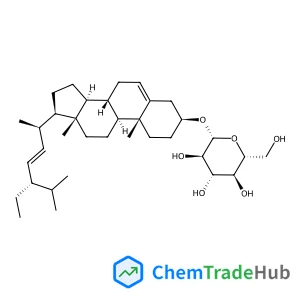
(3beta,22E)-Stigmasta-5,22-dien-3-yl beta-D-glucopyranoside
CAS Number:
19716-26-8
Molecular Formula:
C35H58O6
Recommended Suppliers




Disclaimer
This page provides academic journal information for reference and research purposes only. We are not affiliated with any journal publishers and do not handle publication submissions. For publication-related inquiries, please contact the respective journal publishers directly.
If you notice any inaccuracies in the information displayed, please contact us at support@chemtradehub.com. We will promptly review and address your concerns.