












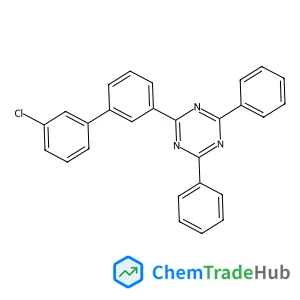
2-(3'-Chlorobiphenyl-3-yl)-4,6-diphenyl-1,3,5-triazine
CAS Number:
1443049-83-9
Molecular Formula:
C27H18ClN3
M. Xu, R. Galindo-Murillo, T. E. Cheatham, III., R. M. Franzini
Bioorthogonal dissociative reactions boast diverse potential applications in chemical biology and drug delivery. The reaction of benzonorbornadienes with tetrazines to release amines from carbamate leaving groups was recently introduced as a bioorthogonal bond-cleavage reaction. The present study aimed at investigating the scope of leaving groups that are compatible with benzonorbornadienes. Synthesis of several benzonorbornadienes with different releasable groups is reported, and the reaction of these molecules with tetrazine was found to be rapid and afforded high release yields. The tetrazine-induced release of molecules proceeds in a cascade of steps including inverse-electron demand cycloaddition and cycloreversion reactions that form unstable isoindoles/isobenzofuran intermediates and spontaneously eliminate a leaving group of interest. In the case of oxygen-bridged BNBDs at room temperature, we observed the formation of an unproductive byproduct.
Thomas M. Schmid, Giambattista Consiglio
DOI: 10.1039/B407843H
Min Wu, Yoshiaki Yuguchi, Takako Kumagai, Takashi Endo, Takahiro Hirotsu
DOI: 10.1039/B400289J
Narcis Avarvari, Marc Fourmigué
DOI: 10.1039/B403168G
Luke T. Higham, Ulf P. Kreher, Roger J. Mulder, Christopher R. Strauss, Janet L. Scott
DOI: 10.1039/B408814J
Dietrich Gudat, Timo Gans-Eichler, Martin Nieger
DOI: 10.1039/B409657F
Nikolaï G. Naumov, Stéphane Cordier, Christiane Perrin
DOI: 10.1039/B400668B
Takumi Konno, Masafumi Usami, Masakazu Hirotsu, Takashi Yoshimura, Tatsuya Kawamoto
DOI: 10.1039/B404512B
Mizuki Kitamatsu, Masanori Shigeyasu, Tomoyuki Okada, Masahiko Sisido
DOI: 10.1039/B401057D
Thomas Devic, Patrick Batail, Narcis Avarvari
DOI: 10.1039/B404482G
Jonathan L. Sessler, G. Dan Pantos, Yuri A. Ustynyuk
DOI: 10.1039/B403665D
When handling 2-Chloro-1,2-bis(4-methylphenyl)ethanone (CAS: 71193-32-3), it is ...
4-Ethoxy-3-(5-methyl-4-oxo-7-propyl-1,4-dihydroimidazo[5,1-f][1,2,4]triazin-2-yl...
Methyl 3-Oxo-4-Androsten-17-Carboxylate (CAS: 2681-55-2) should be stored in a c...
(R)-3-Amino-4-(3-hexylphenylamino)-4-oxobutylphosphonic acid is primarily used i...
2-Methyl-2-propanyl 3-amino-3-carbamoyl-1-azetidinecarboxylate (CAS: 1254120-14-...
There are alternative reagents that can be used in synthesis instead of (E)-4-(t...
[2-(3-Chlorophenyl)-1,3-thiazol-4-yl]methanol (CAS: 121202-20-8) is a crystallin...
The market and research trends for Methyl (2S)-[(4S)-2,2-dimethyl-1,3-dioxolan-4...
The market for 1-Bromo-2-isocyanatoethane (CAS: 42865-19-0) is driven by its use...
4-Nitro-D-phenylalanine hydrochloride (CAS: 147065-06-3) is primarily used in re...

Organic & Biomolecular Chemistry (OBC) publishes original and high impact research and reviews in organic chemistry. We welcome research that shows new or significantly improved protocols or methodologies in total synthesis, synthetic methodology or physical and theoretical organic chemistry as well as research that shows a significant advance in the organic chemistry or molecular design aspects of chemical biology, catalysis, supramolecular and macromolecular chemistry, theoretical chemistry, mechanism-oriented physical organic chemistry, medicinal chemistry or natural products. Articles published in the journal should report new work which makes a highly-significant impact in the field. Routine and incremental work is generally not suitable for publication in the journal. More details about key areas of our scope are below. In all cases authors should include in their article clear rationale for why their research has been carried out.
![2-Hydroxy-4-[({[(4-methylphenyl)sulfonyl]oxy}acetyl)amino]benzoic acid structure](https://static.chemtradehub.com/structs/501/501919-59-1-579f.webp "2-Hydroxy-4-[({[(4-methylphenyl)sulfonyl]oxy}acetyl)amino]benzoic acid structure")






