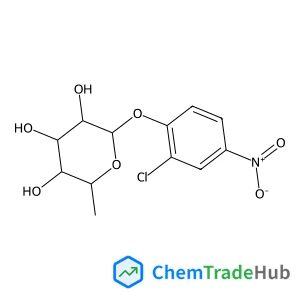
2-Chloro-4-nitrophenyl 6-deoxy-alpha-L-galactopyranoside
CAS Number:
157843-41-9
Molecular Formula:
C12H14ClNO7
Fengmin Guo, Qiang Li
Owing to the unique physical properties of a fluorine atom, incorporating fluoro-modifications into nucleic acids offers striking biophysical and biochemical features, and thus significantly extends the breadth and depth of biological applications of nucleic acids. In this review, fluoro-modified nucleic acids that have been synthesized through either solid phase synthesis or the enzymatic approach are briefly summarised, followed by a section describing their biomedical applications in nucleic acid-based therapeutics, 18F PET imaging and mechanistic studies of DNA modifying enzymes. In the last part, the utility of 19F NMR and MRI for probing the structure, dynamics and molecular interactions of fluorinated nucleic acids is reviewed.
Tomoko Matsuda, Kazunori Watanabe, Tadao Harada, Kaoru Nakamura, Yoshitaka Arita, Yukihiro Misumi, Shinichiro Ichikawa, Takao Ikariya
DOI: 10.1039/B406882C
Mark J. Sarsfield, Andrew D. Sutton, Iain May, Gordon H. John, Clint Sharrad, Madeleine Helliwell
DOI: 10.1039/B404424J
Xiao-Yan Yu, Lin-Hong Weng
DOI: 10.1039/B404443F
Thea Welzel, Wolfgang Meyer-Zaika, Matthias Epple
DOI: 10.1039/B402521K
Min Wu, Yoshiaki Yuguchi, Takako Kumagai, Takashi Endo, Takahiro Hirotsu
DOI: 10.1039/B400289J
Isabelle Gener, Philippe Ayrault, Michel Guisnet
DOI: 10.1039/B409964H
Paul A. Midgley
DOI: 10.1039/B315513G
Francis D'Souza, Suresh Gadde, Melvin E. Zandler, Mitsunari Itou, Yasuyuki Araki, Osamu Ito
DOI: 10.1039/B407985J
Junfeng Geng, David A. Jefferson, Brian F. G. Johnson
DOI: 10.1039/B406227B
Tomoka Yamaguchi, Yukinari Sunatsuki, Masaaki Kojima, Haruo Akashi, Masanobu Tsuchimoto, Nazzareno Re, Shutaro Osa, Naohide Matsumoto
DOI: 10.1039/B401033G
When handling 2-Chloro-1,2-bis(4-methylphenyl)ethanone (CAS: 71193-32-3), it is ...
4-Ethoxy-3-(5-methyl-4-oxo-7-propyl-1,4-dihydroimidazo[5,1-f][1,2,4]triazin-2-yl...
Methyl 3-Oxo-4-Androsten-17-Carboxylate (CAS: 2681-55-2) should be stored in a c...
(R)-3-Amino-4-(3-hexylphenylamino)-4-oxobutylphosphonic acid is primarily used i...
2-Methyl-2-propanyl 3-amino-3-carbamoyl-1-azetidinecarboxylate (CAS: 1254120-14-...
There are alternative reagents that can be used in synthesis instead of (E)-4-(t...
[2-(3-Chlorophenyl)-1,3-thiazol-4-yl]methanol (CAS: 121202-20-8) is a crystallin...
The market and research trends for Methyl (2S)-[(4S)-2,2-dimethyl-1,3-dioxolan-4...
The market for 1-Bromo-2-isocyanatoethane (CAS: 42865-19-0) is driven by its use...
4-Nitro-D-phenylalanine hydrochloride (CAS: 147065-06-3) is primarily used in re...

Organic & Biomolecular Chemistry (OBC) publishes original and high impact research and reviews in organic chemistry. We welcome research that shows new or significantly improved protocols or methodologies in total synthesis, synthetic methodology or physical and theoretical organic chemistry as well as research that shows a significant advance in the organic chemistry or molecular design aspects of chemical biology, catalysis, supramolecular and macromolecular chemistry, theoretical chemistry, mechanism-oriented physical organic chemistry, medicinal chemistry or natural products. Articles published in the journal should report new work which makes a highly-significant impact in the field. Routine and incremental work is generally not suitable for publication in the journal. More details about key areas of our scope are below. In all cases authors should include in their article clear rationale for why their research has been carried out.
![2-Hydroxy-4-[({[(4-methylphenyl)sulfonyl]oxy}acetyl)amino]benzoic acid structure](https://static.chemtradehub.com/structs/501/501919-59-1-579f.webp "2-Hydroxy-4-[({[(4-methylphenyl)sulfonyl]oxy}acetyl)amino]benzoic acid structure")