












On the physics of both surface overcharging and charge reversal at heterophase interfaces
Literature Information
Publication Date
2018-01-04
DOI
10.1039/C7CP08117K
Impact Factor
3.676
Authors
Zhi-Yong Wang, Pengli Zhang, Zengwei Ma
View Original
Abstract
The conventional paradigm for characterizing surface overcharging and charge reversal is based on the so-called Stern layer, in which surface dissociation reaction and specific chemical adsorption are assumed to take place. In this article, a series of Monte Carlo simulations have been applied to obtain useful insights into the underlying physics responsible for these two kinds of anomalous phenomena at the interface of two dielectrics, with special emphasis on the case of divalent counterions that are more relevant in natural and biological environments. At a weakly charged surface, it is found that independent of the type of surface charge distribution and the dielectric response of the solution, the overcharging event is universally driven by the ion size-asymmetric effect. Exceptionally, the overcharging still persists when the surface is highly charged but is only restricted to the case of discrete surface charge in a relatively low dielectric medium. As compared to the adsorption onto the homogeneously smeared charge surface that has the same average affinity for counterions, on the other hand, charge reversal under the action of a dielectric response can be substantially enhanced in the discrete surface charge representation due to strong association of counterions with interfacial groups, and the degree of enhancement depends in a nontrivial way on the reduction of the medium dielectric constant and the steric effects of finite ion size. Rather interestingly, the charge reversal is of high relevance to the overcharging of interfaces because the overwhelming interfacial association forces the coions closer to the surface due to their smaller size than the counterions. Upon the addition of a monovalent salt to the solution, the interfacial association with divalent counterions makes surface overcharging and charge reversal widely unaffected, in contrast to the prevailing notion that screening of surface charge of a homogeneous nature is determined by the competitive effects between size-exclusion effects and energetic contributions. Overall, the present work highlights that the complex interplay between the electrostatic and steric interactions should be coupled to the realistic character of surface charge to establish a faithful description of the overcharging and charge reversal at heterophase interfaces.
Related Literature
Enhanced electromagnon excitations in Nd-doped BiFeO3 nanoparticles near morphotropic phase boundaries
Yuan Zhang, Yi Zhang, Quan Guo, Dongwen Zhang, Shuaizhi Zheng, Ming Feng, Xiangli Zhong, Congbing Tan, Zhihui Lu, Jinbin Wang, Pengfei Hou, Yichun Zhou, Jianmin Yuan
2019-09-16
Paper
DOI: 10.1039/C9CP04194J
Novel inorganic aromatic mixed-valent superalkali electride CaN3Ca: an alkaline-earth-based high-sensitivity multi-state nonlinear optical molecular switch
Yin-Feng Wang, Tian Qin, Jia-Min Tang, Yan-Jiao Liu, Miao Xie, Jia Li, Jiangen Huang, Zhi-Ru Li
2020-02-19
Paper
DOI: 10.1039/C9CP06848A
Mechanism of photochromic transformations and photodegradation of an asymmetrical 2,3-diarylcyclopentenone
Artem B. Smolentsev, Ilya M. Magin, Vladimir V. Vyazovkin, Marina V. Parkhats, Anton V. Yadykov, Valerii Z. Shirinian
2020-02-06
Paper
DOI: 10.1039/C9CP05744G
Correction: A hexagonal Ni6 cluster protected by 2-phenylethanethiol for catalytic conversion of toluene to benzaldehyde
Anthony M. S. Pembere, Chaonan Cui, Rajini Anumula, Haiming Wu, Pan An, Tongling Liang, Zhixun Luo
2020-02-28
Correction
DOI: 10.1039/D0CP90052D
Identification of oxygen diffusion mechanisms in Nd1−xAExBaInO4−x/2 (AE = Ca, Sr, Ba) compounds through molecular dynamics
Chenyi Li, Hichem Dammak, Guilhem Dezanneau
2019-09-04
Paper
DOI: 10.1039/C9CP03048D
Comparison study of carbon clusters formation during thermal decomposition of 1,3,5-triamino-2,4,6-trinitrobenzene and benzotrifuroxan: a ReaxFF based sequential molecular dynamics simulation
Xuefeng Zhao, Xinping Long, Xiaogan Dai, Kaili Zhang, Ming Li, Feng Guo, Zhiqiang Qiao, Yushi Wen
2020-01-22
Paper
DOI: 10.1039/C9CP05734J
Adsorption of H2 on amorphous solid water studied with molecular dynamics simulations
Germán Molpeceres, Johannes Kästner
2020-03-19
Paper
DOI: 10.1039/D0CP00250J
You might also like
Compound Q&A
Is 6-(3-Fluorophenyl)picolinic acid (CAS: 887982-40-3) safe?
6-(3-Fluorophenyl)picolinic acid is generally considered safe for laboratory use...
887982-40-36-(3-Fluorophenyl)pi...
Compound Q&A
What industries use (3R)-3-Pyrrolidinol (CAS: 2799-21-5)?
(3R)-3-Pyrrolidinol is used in the pharmaceutical industry as a precursor for dr...
2799-21-5(3R)-3-Pyrrolidinol
Compound Q&A
What precautions should be taken when handling (4R,5R)-4,5-Diethoxycarbonyl-2,2-dimethyldioxolane (CAS: 59779-75-8)?
When handling (4R,5R)-4,5-Diethoxycarbonyl-2,2-dimethyldioxolane (CAS: 59779-75-...
59779-75-8(4R,5R)-4,5-Diethoxy...
Compound Q&A
How is 1-(6-Chloroimidazo[1,2-b]pyridazin-3-yl)ethanone (CAS: 90734-71-7) typically synthesized?
1-(6-Chloroimidazo[1,2-b]pyridazin-3-yl)ethanone is often synthesized via a mult...
90734-71-71-(6-Chloroimidazo[1...
Compound Q&A
What is the market or research trend for N-Ethyl-3,4-dimethylbenzylamine (CAS: 39180-83-1)?
The market for N-Ethyl-3,4-dimethylbenzylamine (CAS: 39180-83-1) remains steady,...
39180-83-1N-Ethyl-3,4-dimethyl...
Compound Q&A
What is Tert-butyl 3-(pyrrolidin-1-yl)azetidine-1-carboxylate (CAS: 1019008-21-9)?
Tert-butyl 3-(pyrrolidin-1-yl)azetidine-1-carboxylate is a chemical compound wit...
1019008-21-9Tert-butyl 3-(pyrrol...
Compound Q&A
What regulatory guidelines apply to 1-Bromo-3-chloro-2,4-dimethoxybenzene (CAS: 1228956-93-1)?
1-Bromo-3-chloro-2,4-dimethoxybenzene (CAS: 1228956-93-1) falls under the classi...
1228956-93-11-Bromo-3-chloro-2,4...
Compound Q&A
Is 8-Bromo-2-methyl-3,4-dihydroisoquinolin-1(2H)-one (CAS: 1368622-07-4) safe?
The safety of 8-Bromo-2-methyl-3,4-dihydroisoquinolin-1(2H)-one (CAS: 1368622-07...
1368622-07-48-Bromo-2-methyl-3,4...
Compound Q&A
Is Benzyl [(3S)-2,6-dioxo-3-piperidinyl]carbamate (CAS: 22785-43-9) safe?
Benzyl [(3S)-2,6-dioxo-3-piperidinyl]carbamate is generally safe when handled wi...
22785-43-9Benzyl [(3S)-2,6-dio...
Compound Q&A
How should 1-{[4-(4,4,5,5-Tetramethyl-1,3,2-dioxaborolan-2-yl)phenyl]sulfonyl}pyrrolidine (CAS: 928657-21-0) be stored?
1-{[4-(4,4,5,5-Tetramethyl-1,3,2-dioxaborolan-2-yl)phenyl]sulfonyl}pyrrolidine s...
928657-21-01-{[4-(4,4,5,5-Tetra...
Source Journal
Physical Chemistry Chemical Physics

CiteScore:
5.5
Self-citation Rate:
10.3%
Articles per Year:
3036
Physical Chemistry Chemical Physics (PCCP) is an international journal co-owned by 19 physical chemistry and physics societies from around the world. This journal publishes original, cutting-edge research in physical chemistry, chemical physics and biophysical chemistry. To be suitable for publication in PCCP, articles must include significant innovation and/or insight into physical chemistry; this is the most important criterion that reviewers and Editors will judge against when evaluating submissions. The journal has a broad scope and welcomes contributions spanning experiment, theory, computation and data science. Topical coverage includes spectroscopy, dynamics, kinetics, statistical mechanics, thermodynamics, electrochemistry, catalysis, surface science, quantum mechanics, quantum computing and machine learning. Interdisciplinary research areas such as polymers and soft matter, materials, nanoscience, energy, surfaces/interfaces, and biophysical chemistry are welcomed if they demonstrate significant innovation and/or insight into physical chemistry. Joined experimental/theoretical studies are particularly appreciated when complementary and based on up-to-date approaches.
Recommended Compounds
![(2E)-4-[(1R,2S,8R,19S,21R)-14-Hydroxy-11-isopropenyl-8,23,23-trimethyl-5-(3-methyl-2-buten-1-yl)-16,20-dioxo-3,7,22-trioxaheptacyclo[17.4.1.1~8,12~.0~2,17~.0~2,21~.0~4,15~.0~6,13~]pentacosa-4(15),5,13
,17-tetraen-21-yl]-2-methyl-2-butenoic acid structure](https://static.chemtradehub.com/structs/173/173867-04-4-d2d3.webp "(2E)-4-[(1R,2S,8R,19S,21R)-14-Hydroxy-11-isopropenyl-8,23,23-trimethyl-5-(3-methyl-2-buten-1-yl)-16,20-dioxo-3,7,22-trioxaheptacyclo[17.4.1.1~8,12~.0~2,17~.0~2,21~.0~4,15~.0~6,13~]pentacosa-4(15),5,13
,17-tetraen-21-yl]-2-methyl-2-butenoic acid structure")
![2-[({[(2-Methyl-2-propanyl)oxy]carbonyl}amino)methyl]isonicotinic acid structure](https://static.chemtradehub.com/structs/473/473924-63-9-973b.webp "2-[({[(2-Methyl-2-propanyl)oxy]carbonyl}amino)methyl]isonicotinic acid structure")
2-[({[(2-Methyl-2-propanyl)oxy]carbonyl}amino)methyl]isonicotinic acid
CAS Number:
473924-63-9
Molecular Formula:
C12H16N2O4
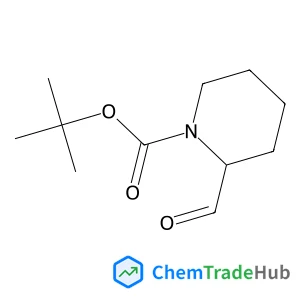
2-Methyl-2-propanyl (2R)-2-formyl-1-piperidinecarboxylate
CAS Number:
134526-69-5
Molecular Formula:
C11H19NO3
Recommended Suppliers






Disclaimer
This page provides academic journal information for reference and research purposes only. We are not affiliated with any journal publishers and do not handle publication submissions. For publication-related inquiries, please contact the respective journal publishers directly.
If you notice any inaccuracies in the information displayed, please contact us at support@chemtradehub.com. We will promptly review and address your concerns.