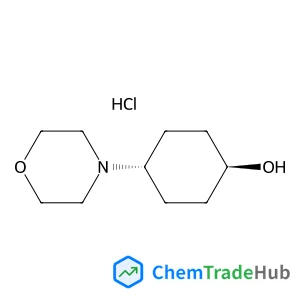
trans-4-(4-Morpholinyl)cyclohexanol hydrochloride (1:1)
CAS Number:
1588441-09-1
Molecular Formula:
C10H20ClNO2
Joseline A. Houwman, Adrie H. Westphal, Carlo P. M. van Mierlo
Flavodoxins have a protein topology that can be traced back to the universal ancestor of the three kingdoms of life. Proteins with this type of architecture tend to temporarily misfold during unassisted folding to their native state and form intermediates. Several of these intermediate species are molten globules (MGs), which are characterized by a substantial amount of secondary structure, yet without the tertiary side-chain packing of natively folded proteins. An off-pathway MG is formed at physiological ionic strength in the case of the F44Y variant of Azotobacter vinelandii apoflavodoxin (i.e., flavodoxin without flavin mononucleotide (FMN)). Here, we show that at this condition actually two folding species of this apoprotein co-exist at equilibrium. These species were detected by using a combination of FMN fluorescence quenching upon cofactor binding to the apoprotein and of polarized time-resolved tryptophan fluorescence spectroscopy. Besides the off-pathway MG, we observe the simultaneous presence of an on-pathway folding intermediate, which is native-like. Presence of concurrent intermediates at physiological ionic strength enables future exploration of how aspects of the cellular environment, like for example involvement of chaperones, affect these species.
J. M. G. Sarraguça, A. A. C. C. Pais
DOI: 10.1039/B606087K
Andrew P. Abbott, Glen Capper, Katy J. McKenzie, Andrew Glidle, Karl S. Ryder
DOI: 10.1039/B607763N
Cunshun Huang, Sridhar A. Lahankar, Myung Hwa Kim, Bailin Zhang, Arthur G. Suits
DOI: 10.1039/B612324D
Antonio Carvalho, Gus Hancock, Mark Saunders
DOI: 10.1039/B607882F
Samuel Rentsch, Ramon Pericet-Camara, Georg Papastavrou, Michal Borkovec
DOI: 10.1039/B602145J
George Firanescu, Dana Hermsdorf, Roman Ueberschaer, Ruth Signorell
DOI: 10.1039/B608433H
Alex B. F. Martinson, James E. McGarrah, Mohammed O. K. Parpia, Joseph T. Hupp
DOI: 10.1039/B610566A
Paul Nissenson, Christopher J. H. Knox, Barbara J. Finlayson-Pitts, Leon F. Phillips, Donald Dabdub
DOI: 10.1039/B609219E
Ethyl 4-chlorothieno[2,3-b]pyridine-5-carboxylate (CAS: 59713-58-5) can be synth...
5-Methyl-1H-indole-3-carbaldehyde (CAS: 52562-50-2) is subject to various regula...
(1,3-Dimethyl-2,4-dioxo-1,2,3,4-tetrahydro-5-pyrimidinyl)boronic acid is a white...
Waste containing Sulfocostunolide A (CAS: 1016983-51-9) should be handled with c...
When handling Murraxocin (CAS: 88478-44-8), ensure proper personal protective eq...
Formvar (CAS: 63148-64-1) is an alkyd resin characterized by a high molecular we...
(S)-4-benzyl-2-((benzyloxy)methyl)morpholine is generally safe when handled with...
Methyl 1-(5-bromo-2-pyrimidinyl)cyclopropanecarboxylate (CAS: 1447607-69-3) is p...
2-Methyl-1-phenyl-1-propanamine hydrochloride (CAS: 24290-47-9) is generally con...
3-(4-Bromophenyl)-2-methylpropanoic acid is synthesized through a multi-step pro...

Physical Chemistry Chemical Physics (PCCP) is an international journal co-owned by 19 physical chemistry and physics societies from around the world. This journal publishes original, cutting-edge research in physical chemistry, chemical physics and biophysical chemistry. To be suitable for publication in PCCP, articles must include significant innovation and/or insight into physical chemistry; this is the most important criterion that reviewers and Editors will judge against when evaluating submissions. The journal has a broad scope and welcomes contributions spanning experiment, theory, computation and data science. Topical coverage includes spectroscopy, dynamics, kinetics, statistical mechanics, thermodynamics, electrochemistry, catalysis, surface science, quantum mechanics, quantum computing and machine learning. Interdisciplinary research areas such as polymers and soft matter, materials, nanoscience, energy, surfaces/interfaces, and biophysical chemistry are welcomed if they demonstrate significant innovation and/or insight into physical chemistry. Joined experimental/theoretical studies are particularly appreciated when complementary and based on up-to-date approaches.
![2-(Methylsulfonyl)-2,4,5,6-tetrahydropyrrolo[3,4-c]pyrazole structure](https://static.chemtradehub.com/structs/122/1226781-80-1-09d5.webp "2-(Methylsulfonyl)-2,4,5,6-tetrahydropyrrolo[3,4-c]pyrazole structure")
![2-Methyl-2-propanyl 1,6-diazaspiro[3.4]octane-6-carboxylate structure](https://static.chemtradehub.com/structs/115/1158749-79-1-81ee.webp "2-Methyl-2-propanyl 1,6-diazaspiro[3.4]octane-6-carboxylate structure")