











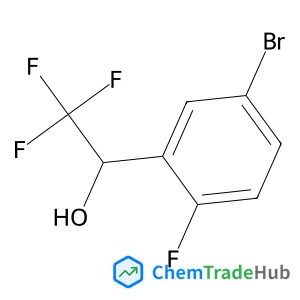
1-(5-Bromo-2-fluorophenyl)-2,2,2-trifluoroethanol
CAS Number:
1039827-16-1
Molecular Formula:
C8H5BrF4O
Andrey G. Cherstvy, Ralf Metzler
Proteins are capable of locating specific targets on DNA by employing a facilitated diffusion process with intermittent 1D and 3D search steps. Gene colocalisation and coregulation—i.e. the spatial proximity of two communicating genes—is one factor capable of accelerating the target search process along the DNA. We perform Monte Carlo computer simulations and demonstrate the benefits of gene colocalisation for minimising the search time in a model DNA–protein system. We use a simple diffusion model to mimic the search for targets by proteins, produced initially in bursts of multiple proteins and performing the first-passage search on the DNA chain. The behaviour of the mean first-passage times to the target is studied as a function of distance between the initial position of proteins and the DNA target position, as well as versus the concentration of proteins. We also examine the properties of bursty target search kinetics for varying physical–chemical protein–DNA binding affinity. Our findings underline the relevance of colocalisation of production and binding sites for protein search inside biological cells.
Shitao Wang, Jihai Shang, Chaoxian Yan, Wenbo Wang, Chengshan Yuan, Hao-Li Zhang, Xiangfeng Shao
DOI: 10.1039/C8QO01220B
Maksim A. Boichenko, Olga A. Ivanova, Ivan A. Andreev, Alexey O. Chagarovskiy, Irina I. Levina, Victor B. Rybakov, Dmitriy A. Skvortsov
DOI: 10.1039/C8QO00742J
Yunpeng Chen, Yunfan Yang, Yu Zhao, Shixing Liu, Yongqing Li
DOI: 10.1039/C8QO01111G
Minming Wu, Jiadong Zhou, Yinqi Luo, Nan Zheng, Cong Wang, Linlin Liu, Zengqi Xie, Yuguang Ma
DOI: 10.1039/C8QO00934A
Yanan Wang, Min Jiang, Jin-Tao Liu
DOI: 10.1039/C5QO00044K
Hongming Jin, Zhengbo Zhu, Ning Jin, Jin Xie, Yixiang Cheng
DOI: 10.1039/C4QO00329B
Thomas Lebleu, Jacques Maddaluno, Julien Legros
DOI: 10.1039/C4QO00342J
N. Kodiah Beyeh, Sandip Bhowmik, Fangfang Pan, K. Rissanen
DOI: 10.1039/C4QO00326H
Sachin Bhausaheb Wagh, Pankaj Sharma, Manoj D. Patil, Rai-Shung Liu
DOI: 10.1039/C8QO01175C
Jia-Li Liu, Ze-Fan Zhu
DOI: 10.1039/C8QO01143E
2-(2-Chloroacetamido)-3-phenylpropanoic acid (CAS: 7765-11-9) is generally consi...
2-(Benzyloxy)-5-bromobenzoic acid can be handled safely if appropriate precautio...
(4-Methyl-1,2,5-oxadiazol-3-yl)methanamine hydrochloride is a chemical compound ...
2-(5-Hexylthiophen-2-yl)-4,4,5,5-tetramethyl-1,3,2-dioxaborolane (CAS: 917985-54...
While 4-(8-Methyl-9H-1,3-dioxolo[4,5-h][2,3]benzodiazepin-5-yl)benzenamine (CAS:...
The market for tert-butyl 3-hydroxy-4,5,7,8-tetrahydro-2H-pyrazolo[3,4-d]azepine...
Waste containing 3,5-Diamino-1H-pyrazole-4-carbonitrile (CAS: 6844-58-2) should ...
(6-Fluoro-3-pyridinyl)boronic acid can be synthesized through the reaction of 6-...
Dibenzyl carbonimidoylbiscarbamate (CAS: 10065-79-9) finds applications in vario...
The market for (beta,beta,2,3,4,5,6-~2~H_7_)Phenylalanine (CAS: 74228-83-4) is g...

Physical Chemistry Chemical Physics (PCCP) is an international journal co-owned by 19 physical chemistry and physics societies from around the world. This journal publishes original, cutting-edge research in physical chemistry, chemical physics and biophysical chemistry. To be suitable for publication in PCCP, articles must include significant innovation and/or insight into physical chemistry; this is the most important criterion that reviewers and Editors will judge against when evaluating submissions. The journal has a broad scope and welcomes contributions spanning experiment, theory, computation and data science. Topical coverage includes spectroscopy, dynamics, kinetics, statistical mechanics, thermodynamics, electrochemistry, catalysis, surface science, quantum mechanics, quantum computing and machine learning. Interdisciplinary research areas such as polymers and soft matter, materials, nanoscience, energy, surfaces/interfaces, and biophysical chemistry are welcomed if they demonstrate significant innovation and/or insight into physical chemistry. Joined experimental/theoretical studies are particularly appreciated when complementary and based on up-to-date approaches.
![2-[(E)-(2-Methoxyphenyl)diazenyl]-3-oxo-N-(2-oxo-2,3-dihydro-1H-benzimidazol-5-yl)butanamide structure](https://static.chemtradehub.com/structs/821/82199-12-0-f1d0.webp "2-[(E)-(2-Methoxyphenyl)diazenyl]-3-oxo-N-(2-oxo-2,3-dihydro-1H-benzimidazol-5-yl)butanamide structure")
![Ethyl thieno[3,2-f]quinoline-2-carboxylate structure](https://static.chemtradehub.com/structs/299/29948-26-3-f62b.webp "Ethyl thieno[3,2-f]quinoline-2-carboxylate structure")



