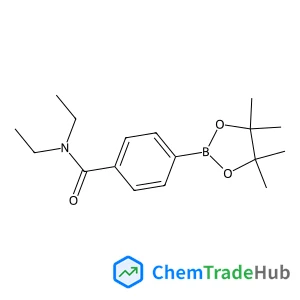
N,N-Diethyl-4-(4,4,5,5-tetramethyl-1,3,2-dioxaborolan-2-yl)benzamide
CAS Number:
325142-99-2
Molecular Formula:
C17H26BNO3
Y. N. Kalugina, A. Faure, A. van der Avoird, K. Walker, F. Lique
Collisions between H2O and CO play a crucial role in the gaseous component of comets and protoplanetary disks. We present here a five-dimensional potential energy surface (PES) for the H2O–CO collisional complex. Ab initio calculations were carried out using the explicitly-correlated closed-shell single- and double-excitation coupled cluster approach with the non-iterative perturbative treatment of triple excitations [CCSD(T)-F12a] method with the augmented correlation-consistent aug-cc-pVTZ basis sets. The most stable configuration of the complex, where the carbon atom of CO is pointing towards the OH bond of water, has a binding energy De = 646.1 cm−1. The end-over-end rotational constant of the H2O–CO complex was extracted from bound state calculations and it was found to be B0 = 0.0916 cm−1, in excellent agreement with experimental measurements. Finally, cross sections for the rotational excitation of CO by H2O are computed for s-wave (J = 0) scattering at the full close-coupling level of theory. These results will serve as a benchmark for future studies.
Seong Nam, David C. Ware
DOI: 10.1039/C8OB00957K
Pei-Qian Wu, Yi-Fan Yu, Ye Zhao, Chun-Xue Yu, De-Juan Zhi, Feng-Ming Qi
DOI: 10.1039/C8OB02319K
Martin Liebold, Eugen Sharikow, Elisabeth Seikel, Lukas Trombach, Klaus Harms, Petr Zimcik, Veronika Novakova, Ralf Tonner, Jörg Sundermeyer
DOI: 10.1039/C8OB01705K
Ranjan Kumar Acharyya, Samik Nanda
DOI: 10.1039/C8OB01328D
Changduo Pan, Zhenkun Yang, Du Gao, Jin-Tao Yu
DOI: 10.1039/C8OB01329B
Keisuke Tanaka, Yoichi Miyamoto, Takumi Okuda, Tatsuro Kasai, Kentaro Onodera, Masahiro Oka, Yoshihiro Yoneda
DOI: 10.1039/C8OB90140F
Qinghe Gao, Yakun Wang, Qianqian Wang, Yanping Zhu, Zhaomin Liu, Jixia Zhang
DOI: 10.1039/C8OB02230E
Samanth Reddy Kedika
DOI: 10.1039/C8OB01406J
This compound is mainly used as an intermediate in the synthesis of antipsychoti...
Waste containing 1-(D-Ribofuranosyl)-1,4-dihydro-3-pyridinecarboxamide (CAS: 191...
2-Methyl-2-propanyl 3-bromo-3-(hydroxymethyl)-1-azetidinecarboxylate (CAS: 20079...
N-(4-Chloro-2-pyridinyl)acetamide (CAS: 245056-66-0) is a chemical compound with...
5-Chloro-2-hydroxybenzoic acid, also known as 5-chlorosalicylic acid, is an arom...
When handling 1,1-Dichloro-1-fluoroethane (CAS: 1717-00-6), it is important to u...
Fmoc-(2S,3R)-3-phenylpyrrolidine-2-carboxylic acid is a white crystalline solid ...
4-Amino-5-bromo-2-pyridinecarboxylic acid is primarily used as a precursor in th...
Handling this compound should be done with personal protective equipment (PPE) i...
When handling 8-bromo-2,2-dimethyl-3,4-dihydro-2H-1,4-benzoxazin-3-one, use prop...

Physical Chemistry Chemical Physics (PCCP) is an international journal co-owned by 19 physical chemistry and physics societies from around the world. This journal publishes original, cutting-edge research in physical chemistry, chemical physics and biophysical chemistry. To be suitable for publication in PCCP, articles must include significant innovation and/or insight into physical chemistry; this is the most important criterion that reviewers and Editors will judge against when evaluating submissions. The journal has a broad scope and welcomes contributions spanning experiment, theory, computation and data science. Topical coverage includes spectroscopy, dynamics, kinetics, statistical mechanics, thermodynamics, electrochemistry, catalysis, surface science, quantum mechanics, quantum computing and machine learning. Interdisciplinary research areas such as polymers and soft matter, materials, nanoscience, energy, surfaces/interfaces, and biophysical chemistry are welcomed if they demonstrate significant innovation and/or insight into physical chemistry. Joined experimental/theoretical studies are particularly appreciated when complementary and based on up-to-date approaches.