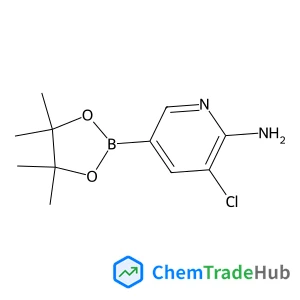
3-Chloro-5-(4,4,5,5-tetramethyl-1,3,2-dioxaborolan-2-yl)-2-pyridinamine
CAS Number:
1032758-99-8
Molecular Formula:
C11H16BClN2O2
M. Umar Farooq, Imran Khan, Jisang Hong
We explored the electronic and magnetic properties of two-dimensional manganese di-halides (MnY2, Y = I, Br, Cl) and hydrogenated systems (MnHY2). The pristine MnY2 monolayers had a very weak magnetic exchange interaction and we found degenerated magnetic states between ferromagnetic and antiferromagnetic states although the Mn had a high magnetic moment of 5 μB with a finite band gap. However, we found that the electronic band structure and magnetic properties could be significantly altered by functionalization with hydrogen atoms because the degeneracy in the pristine MnY2 structure was broken and the FM ground state was obtained in all MnHY2 systems. We obtained a negative spin polarization in the H atom and the magnetic moment of the Mn atom decreased from 5 μB to 4 μB. However, this negative polarization played a pivotal role in inducing a FM ground state in the MnHY2 systems. Furthermore, the asymmetric spin dependent bang gap in MnHY2 was also greatly enhanced due to this hydrogenation as compared with that in the pristine MnY2 systems. This finding suggests that the hydrogenated MnHY2 can be used as a potential ferromagnetic semiconductor for spintronics.

Mini-Reviews in Medicinal Chemistry

Molecular Diversity

Nature Reviews Drug Discovery

Journal of Medical Biochemistry

Foundations of Chemistry

Advanced Engineering Materials

Lab on a Chip

Journal of Enzyme inhibition and Medicinal Chemistry

Photochemical & Photobiological Sciences

Environmental Toxicology and Pharmacology
Chi-Chiu Ko, Wai Han Lam, Vivian Wing-Wah Yam
DOI: 10.1039/B810585E
Rosa Arrigo, Michael Hävecker, Robert Schlögl, Dang Sheng Su
DOI: 10.1039/B812769G
Wei-Chuan Fang, Wei-Lee Fang
DOI: 10.1039/B809253B
Kévin M. Joly, Claire Wilson, Alexander J. Blake, James H. R. Tucker, Christopher J. Moody
DOI: 10.1039/B808045C
Cailin Wang, Wei Zhang, Shenci Lu, Jingfei Wu, Zongjun Shi
DOI: 10.1039/B808854C
Makoto Harada, Tetsuo Okada
DOI: 10.1039/B810997D
Abu Bin Imran, Takahiro Seki, Toshiyuki Kataoka, Masatoshi Kidowaki, Kohzo Ito, Yukikazu Takeoka
DOI: 10.1039/B810290B
Rodrigo Cristiano, Hugo Gallardo, Adailton J. Bortoluzzi, Ivan H. Bechtold, Carlos E. M. Campos, Ricardo L. Longo
DOI: 10.1039/B810680K
Kentaro Katayama, Shinya Tsukiji
DOI: 10.1039/B812058G
Ryohei Tsuda, Koichi Kodama, Takeshi Ueki, Hisashi Kokubo, Shin-ichiro Imabayashi, Masayoshi Watanabe
DOI: 10.1039/B810127B
This compound is mainly used as an intermediate in the synthesis of antipsychoti...
Waste containing 1-(D-Ribofuranosyl)-1,4-dihydro-3-pyridinecarboxamide (CAS: 191...
2-Methyl-2-propanyl 3-bromo-3-(hydroxymethyl)-1-azetidinecarboxylate (CAS: 20079...
N-(4-Chloro-2-pyridinyl)acetamide (CAS: 245056-66-0) is a chemical compound with...
5-Chloro-2-hydroxybenzoic acid, also known as 5-chlorosalicylic acid, is an arom...
When handling 1,1-Dichloro-1-fluoroethane (CAS: 1717-00-6), it is important to u...
Fmoc-(2S,3R)-3-phenylpyrrolidine-2-carboxylic acid is a white crystalline solid ...
4-Amino-5-bromo-2-pyridinecarboxylic acid is primarily used as a precursor in th...
Handling this compound should be done with personal protective equipment (PPE) i...
When handling 8-bromo-2,2-dimethyl-3,4-dihydro-2H-1,4-benzoxazin-3-one, use prop...

Physical Chemistry Chemical Physics (PCCP) is an international journal co-owned by 19 physical chemistry and physics societies from around the world. This journal publishes original, cutting-edge research in physical chemistry, chemical physics and biophysical chemistry. To be suitable for publication in PCCP, articles must include significant innovation and/or insight into physical chemistry; this is the most important criterion that reviewers and Editors will judge against when evaluating submissions. The journal has a broad scope and welcomes contributions spanning experiment, theory, computation and data science. Topical coverage includes spectroscopy, dynamics, kinetics, statistical mechanics, thermodynamics, electrochemistry, catalysis, surface science, quantum mechanics, quantum computing and machine learning. Interdisciplinary research areas such as polymers and soft matter, materials, nanoscience, energy, surfaces/interfaces, and biophysical chemistry are welcomed if they demonstrate significant innovation and/or insight into physical chemistry. Joined experimental/theoretical studies are particularly appreciated when complementary and based on up-to-date approaches.
![Pyrazolo[1,5-a]pyridine-3-carbothioamide structure](https://static.chemtradehub.com/structs/885/885275-44-5-aae0.webp "Pyrazolo[1,5-a]pyridine-3-carbothioamide structure")