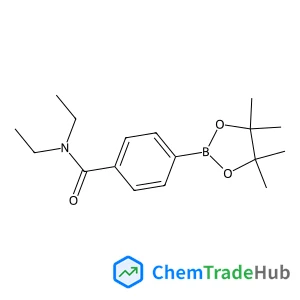
N,N-Diethyl-4-(4,4,5,5-tetramethyl-1,3,2-dioxaborolan-2-yl)benzamide
CAS Number:
325142-99-2
Molecular Formula:
C17H26BNO3
Wei-Chuan Fang, Wei-Lee Fang
V2O5 nanofilms (NFs) uniformly distributed on N-doped carbon nanotubes (CNTs) exhibit significantly stable capacitive performance; the synthesized composites are promising as an instantaneous power supply in consumer electronics or electrical vehicles.
Fabien Pascale, Philippe D’Arco, Roberto Dovesi
DOI: 10.1039/D1CP03816H
Yongzhen Jiang, Wenxu Zou, Yadong Li, Yingxiang Cai
DOI: 10.1039/D1CP03340A
J. K. Wenderott, Ban Xuan Dong
DOI: 10.1039/D1CP02476K
Zhen-zhen Fu, Sheng-jie Guo, Chen-xi Li, Ke Wang, Qin Zhang, Qiang Fu
DOI: 10.1039/D1CP03893A
Mei-Chin Pang, Monica Marinescu, Huizhi Wang, Gregory Offer
DOI: 10.1039/D1CP00909E
Zhe Tang, Haiyun Han, Junxia Ding, Panwang Zhou
DOI: 10.1039/D1CP03546K
Hans F. Wardenga, Katharina N. S. Schuldt, Stephan Waldow, Roger A. De Souza, Andreas Klein
DOI: 10.1039/D1CP03776E
Anne P. Rasmussen, Elisabeth Gruber, Ricky Teiwes, Mordechai Sheves, Lars H. Andersen
DOI: 10.1039/D1CP04501F
Delu Gao, Dunyou Wang
DOI: 10.1039/D1CP04212B
Krishna Gopal Chattaraj, Sandip Paul
DOI: 10.1039/D1CP03695E
This compound is mainly used as an intermediate in the synthesis of antipsychoti...
Waste containing 1-(D-Ribofuranosyl)-1,4-dihydro-3-pyridinecarboxamide (CAS: 191...
2-Methyl-2-propanyl 3-bromo-3-(hydroxymethyl)-1-azetidinecarboxylate (CAS: 20079...
N-(4-Chloro-2-pyridinyl)acetamide (CAS: 245056-66-0) is a chemical compound with...
5-Chloro-2-hydroxybenzoic acid, also known as 5-chlorosalicylic acid, is an arom...
When handling 1,1-Dichloro-1-fluoroethane (CAS: 1717-00-6), it is important to u...
Fmoc-(2S,3R)-3-phenylpyrrolidine-2-carboxylic acid is a white crystalline solid ...
4-Amino-5-bromo-2-pyridinecarboxylic acid is primarily used as a precursor in th...
Handling this compound should be done with personal protective equipment (PPE) i...
When handling 8-bromo-2,2-dimethyl-3,4-dihydro-2H-1,4-benzoxazin-3-one, use prop...

ChemComm publishes urgent research which is of outstanding significance and interest to experts in the field, while also appealing to the journal’s broad chemistry readership. Our communication format is ideally suited to short, urgent studies that are of such importance that they require accelerated publication. Our scope covers all topics in chemistry, and research at the interface of chemistry and other disciplines (such as materials science, nanoscience, physics, engineering and biology) where there is a significant novelty in the chemistry aspects. Major topic areas covered include: Analytical Chemistry Catalysis Chemical Biology and medicinal chemistry Computational Chemistry and Machine Learning Energy and sustainable chemistry Environmental Chemistry Green Chemistry Inorganic Chemistry Materials Chemistry Nanoscience Organic Chemistry Physical Chemistry Polymer Chemistry Supramolecular Chemistry
![6-Benzyl-4,5,6,7-tetrahydro-1H-pyrazolo[3,4-c]pyridin-3(2H)-one structure](https://static.chemtradehub.com/structs/909/909187-64-0-f54f.webp "6-Benzyl-4,5,6,7-tetrahydro-1H-pyrazolo[3,4-c]pyridin-3(2H)-one structure")