












Superlinear amplification of the first hyperpolarizability of linear aggregates of DANS molecules
Literature Information
Publication Date
2017-08-23
DOI
10.1039/C7CP04732K
Impact Factor
3.676
Authors
Somananda Sanyal, Cristina Sissa, Francesca Terenziani, Swapan K. Pati, Anna Painelli
View Original
Abstract
A bottom-up modelling strategy is adopted to discuss the linear and nonlinear optical spectra of a prototypical push–pull dye, 4-dimethylamino-4′-nitrostilbene (DANS), in different environments, from solutions to linear aggregates, fully accounting for the molecular polarity and polarizability. In particular, we demonstrate a large amplification of the first hyperpolarizability of linear aggregates with a superlinear dependence on the aggregate size. Results are discussed with reference to recent experiments for DANS molecules aligned inside single-wall carbon nanotubes, leading to a complete and internally consistent description of the observed spectral properties in terms of ∼7 aligned molecules, reducing by an order of magnitude the size of the aggregate estimated in the hypothesis of linear amplification, as expected for non-interacting molecules. This has important implications for material design: it is possible to obtain a large amplification of the first hyperpolarizability by aligning just a few DANS molecules (or more generally, a few polar dyes showing normal solvatochromism) without the need to grow large ordered systems.
Related Literature
Aromatic diselenide crosslinkers to enhance the reprocessability and self-healing of polyurethane thermosets
Xiaowei An, Robert H. Aguirresarobe, Lourdes Irusta, Fernando Ruipérez, Jon M. Matxain, Xiangqiang Pan, Nora Aramburu, Jian Zhu
2017-05-22
Paper
DOI: 10.1039/C7PY00448F
Synthesis of molecularly imprinted polymers by photo-iniferter polymerization under visible light
Mariano J. Garcia-Soto, Karsten Haupt, Carlo Gonzato
2017-07-20
Paper
DOI: 10.1039/C7PY01113J
A carboxylic azo monomer and its homopolymer: synthesis, self-organization and fluorescence behaviour in solution
Hao Ren, Dong Chen, Yan Shi, Haifeng Yu, Zhifeng Fu
2014-09-09
Paper
DOI: 10.1039/C4PY01062K
Metallo-supramolecular hydrogels based on amphiphilic polymers bearing a hydrophobic Schiff base ligand with rapid self-healing and multi-stimuli responsive properties
Liuyan Tang, Xiuli Chen, Lei Wang, Jinqing Qu
2017-07-07
Paper
DOI: 10.1039/C7PY00739F
Effect of trehalose polymer regioisomers on protein stabilization
M. Jane Strouse
2017-07-03
Paper
DOI: 10.1039/C7PY00700K
Injectable cationic hydrogels with high antibacterial activity and low toxicity
Hong Du, Xuxia Yao, Xiaodong Li, Zhiquan Shen
2016-08-17
Communication
DOI: 10.1039/C6PY01346E
Correction: Transition from smectic nanofibers to smectic vesicles in the self-assemblies of PEG-b-liquid crystal polycarbonates
Lu Zhou, Dapeng Zhang, Sabrina Hocine, Alessia Pilone, Sylvain Trépout, Sergio Marco, Christophe M. Thomas, Jia Guo
2017-08-11
Correction
DOI: 10.1039/C7PY90126G
Poly(glycerol sebacate) nanoparticles for encapsulation of hydrophobic anti-cancer drugs
Benoit Louage, Liesa Tack, Yadong Wang, Bruno G. De Geest
2017-01-31
Paper
DOI: 10.1039/C6PY02192A
Thermoresponsivity of polymer solution derived from a self-attractive urea unit and a self-repulsive lipophilic ion unit
Shogo Amemori, Kazuya Iseda, Shizuka Anan, Toshikazu Ono
2017-06-12
Paper
DOI: 10.1039/C7PY00591A
You might also like
Compound Q&A
What are the main uses of 4-Nitrophenyl phosphate disodium salt hexahydrate (CAS: 333338-18-4)?
4-Nitrophenyl phosphate disodium salt hexahydrate is primarily used as a substra...
333338-18-44-Nitrophenyl phosph...
Compound Q&A
What are the main uses of 2-(Trifluoromethyl)-1,3-oxazole-4-carboxylic Acid (CAS: 1060816-01-4)?
2-(Trifluoromethyl)-1,3-oxazole-4-carboxylic Acid (CAS: 1060816-01-4) is widely ...
1060816-01-42-(Trifluoromethyl)-...
Compound Q&A
How should 2-Fluoro-4-biphenylcarboxylic acid (CAS: 137045-30-8) be stored?
2-Fluoro-4-biphenylcarboxylic acid should be stored in a cool, dry place at room...
137045-30-82-Fluoro-4-biphenylc...
Compound Q&A
What industries use Prednisolone-21-Carboxylic Acid (CAS: 61549-70-0)?
Prednisolone-21-Carboxylic Acid is primarily used in the pharmaceutical industry...
61549-70-0Prednisolone-21-Carb...
Compound Q&A
How should 4-(Hydrazinomethyl)-1,2,3-benzenetriol (CAS: 3614-72-0) be stored?
4-(Hydrazinomethyl)-1,2,3-benzenetriol (CAS: 3614-72-0) should be stored in a co...
3614-72-04-(Hydrazinomethyl)-...
Compound Q&A
What industries use 4-Amino-1-methyl-1H-pyrazole-5-carboxylic acid hydrochloride (CAS: 92534-70-8)?
4-Amino-1-methyl-1H-pyrazole-5-carboxylic acid hydrochloride (CAS: 92534-70-8) i...
92534-70-84-Amino-1-methyl-1H-...
Compound Q&A
What regulatory guidelines apply to dehydropachymic acid (CAS: 77012-31-8)?
Dehydropachymic acid (CAS: 77012-31-8) is regulated by various agencies. It fall...
77012-31-8Dehydropachymic acid
Compound Q&A
What is the market or research trend for 6-[(2,2-Dimethylpropanoyl)amino]nicotinic acid (CAS: 898561-66-5)?
The market and research trends for 6-[(2,2-Dimethylpropanoyl)amino]nicotinic aci...
898561-66-56-[(2,2-Dimethylprop...
Compound Q&A
How should 1,10-Phenanthroline-2,9-dicarbaldehyde (CAS: 57709-62-3) be stored?
1,10-Phenanthroline-2,9-dicarbaldehyde should be stored in a cool, dry place awa...
57709-62-31,10-Phenanthroline-...
Compound Q&A
How is 5-Carbamoyl-11-oxo-10,11-dihydro-5H-dibenzo[b,f]azepin-10-yl acetate (CAS: 113952-21-9) typically synthesized?
5-Carbamoyl-11-oxo-10,11-dihydro-5H-dibenzo[b,f]azepin-10-yl acetate can be synt...
113952-21-95-Carbamoyl-11-oxo-1...
Source Journal
Physical Chemistry Chemical Physics

CiteScore:
5.5
Self-citation Rate:
10.3%
Articles per Year:
3036
Physical Chemistry Chemical Physics (PCCP) is an international journal co-owned by 19 physical chemistry and physics societies from around the world. This journal publishes original, cutting-edge research in physical chemistry, chemical physics and biophysical chemistry. To be suitable for publication in PCCP, articles must include significant innovation and/or insight into physical chemistry; this is the most important criterion that reviewers and Editors will judge against when evaluating submissions. The journal has a broad scope and welcomes contributions spanning experiment, theory, computation and data science. Topical coverage includes spectroscopy, dynamics, kinetics, statistical mechanics, thermodynamics, electrochemistry, catalysis, surface science, quantum mechanics, quantum computing and machine learning. Interdisciplinary research areas such as polymers and soft matter, materials, nanoscience, energy, surfaces/interfaces, and biophysical chemistry are welcomed if they demonstrate significant innovation and/or insight into physical chemistry. Joined experimental/theoretical studies are particularly appreciated when complementary and based on up-to-date approaches.
Recommended Compounds
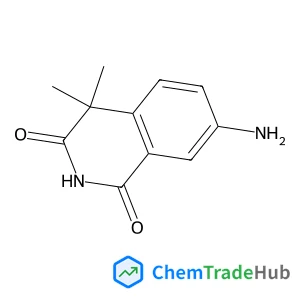
1,3(2H,4H)-Isoquinolinedione, 7-amino-4,4-dimethyl-
CAS Number:
14576-22-8
Molecular Formula:
C11H12N2O2
![(2E)-3-(3-Chlorophenyl)-N-{2-[4-(methylsulfonyl)-1-piperazinyl]-2-oxoethyl}acrylamide structure](https://static.chemtradehub.com/structs/250/2505001-54-5-c1e9.webp "(2E)-3-(3-Chlorophenyl)-N-{2-[4-(methylsulfonyl)-1-piperazinyl]-2-oxoethyl}acrylamide structure")
(2E)-3-(3-Chlorophenyl)-N-{2-[4-(methylsulfonyl)-1-piperazinyl]-2-oxoethyl}acrylamide
CAS Number:
2505001-54-5
Molecular Formula:
C16H20ClN3O4S
Recommended Suppliers


Disclaimer
This page provides academic journal information for reference and research purposes only. We are not affiliated with any journal publishers and do not handle publication submissions. For publication-related inquiries, please contact the respective journal publishers directly.
If you notice any inaccuracies in the information displayed, please contact us at support@chemtradehub.com. We will promptly review and address your concerns.