












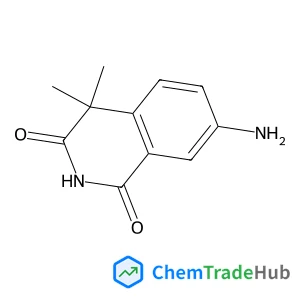
1,3(2H,4H)-Isoquinolinedione, 7-amino-4,4-dimethyl-
CAS Number:
14576-22-8
Molecular Formula:
C11H12N2O2
Arka Bandyopadhyay, Atanu Nandy, Arunava Chakrabarti, Debnarayan Jana
Tetragonal graphene (T-graphene) is a theoretically proposed dynamically stable, metallic allotrope of graphene. In this theoretical investigation, a tight binding (TB) model is used to unravel the metal to semiconductor transition of this 2D sheet under the influence of an external magnetic flux. In addition, the environment under which the sheet exposes an appreciable direct band gap of 1.41 ± 0.01 eV is examined. Similarly, the electronic band structure of the narrowest armchair T-graphene nanoribbon (NATGNR) also gets modified with different combinations of magnetic fluxes through the elementary rings. The band tuning parameters are critically identified for both systems. It is observed that the induced band gaps vary remarkably with the tuning parameters. We have also introduced an exact analytical approach to address the band structure of the NATGNR in the absence of any magnetic flux. Finally, the optical properties of the sheet and NATGNR are also critically analysed for both parallel and perpendicular polarizations with the help of density functional theory (DFT). Our study predicts that this material and its nanoribbons can be used in optoelectronic devices.
Karol Erfurt, Anna Chrobok, Andrzej Zięba
DOI: 10.1039/C7PY01046J
Xiaowei An, Robert H. Aguirresarobe, Lourdes Irusta, Fernando Ruipérez, Jon M. Matxain, Xiangqiang Pan, Nora Aramburu, Jian Zhu
DOI: 10.1039/C7PY00448F
Liuyan Tang, Xiuli Chen, Lei Wang, Jinqing Qu
DOI: 10.1039/C7PY00739F
Changkui Fu, Zixuan Huang, Craig J. Hawker, Graeme Moad, Jiangtao Xu, Cyrille Boyer
DOI: 10.1039/C7PY00713B
Yi Pan, Zhaohui Zheng, Xiaobin Ding
DOI: 10.1039/C7PY00904F
Emma R. L. Brisson, Zeyun Xiao, Lucas Levin, George V. Franks, Luke A. Connal
DOI: 10.1039/C5PY01915J
Wei Zhu, Zheng-Dong Ding, Xuan Wang, Tao Li, Rui Shen, Yunxing Li, Zaijun Li, Xuehong Ren, Zhi-Guo Gu
DOI: 10.1039/C7PY00876G
Lu Zhou, Dapeng Zhang, Sabrina Hocine, Alessia Pilone, Sylvain Trépout, Sergio Marco, Christophe M. Thomas, Jia Guo
DOI: 10.1039/C7PY90126G
4-Nitrophenyl phosphate disodium salt hexahydrate is primarily used as a substra...
2-(Trifluoromethyl)-1,3-oxazole-4-carboxylic Acid (CAS: 1060816-01-4) is widely ...
2-Fluoro-4-biphenylcarboxylic acid should be stored in a cool, dry place at room...
Prednisolone-21-Carboxylic Acid is primarily used in the pharmaceutical industry...
4-(Hydrazinomethyl)-1,2,3-benzenetriol (CAS: 3614-72-0) should be stored in a co...
4-Amino-1-methyl-1H-pyrazole-5-carboxylic acid hydrochloride (CAS: 92534-70-8) i...
Dehydropachymic acid (CAS: 77012-31-8) is regulated by various agencies. It fall...
The market and research trends for 6-[(2,2-Dimethylpropanoyl)amino]nicotinic aci...
1,10-Phenanthroline-2,9-dicarbaldehyde should be stored in a cool, dry place awa...
5-Carbamoyl-11-oxo-10,11-dihydro-5H-dibenzo[b,f]azepin-10-yl acetate can be synt...

Physical Chemistry Chemical Physics (PCCP) is an international journal co-owned by 19 physical chemistry and physics societies from around the world. This journal publishes original, cutting-edge research in physical chemistry, chemical physics and biophysical chemistry. To be suitable for publication in PCCP, articles must include significant innovation and/or insight into physical chemistry; this is the most important criterion that reviewers and Editors will judge against when evaluating submissions. The journal has a broad scope and welcomes contributions spanning experiment, theory, computation and data science. Topical coverage includes spectroscopy, dynamics, kinetics, statistical mechanics, thermodynamics, electrochemistry, catalysis, surface science, quantum mechanics, quantum computing and machine learning. Interdisciplinary research areas such as polymers and soft matter, materials, nanoscience, energy, surfaces/interfaces, and biophysical chemistry are welcomed if they demonstrate significant innovation and/or insight into physical chemistry. Joined experimental/theoretical studies are particularly appreciated when complementary and based on up-to-date approaches.

![N-[2-(4-Hydroxyphenoxy)-4-nitrophenyl]methanesulfonamide structure](https://static.chemtradehub.com/structs/109/109032-22-6-7c88.webp "N-[2-(4-Hydroxyphenoxy)-4-nitrophenyl]methanesulfonamide structure")




