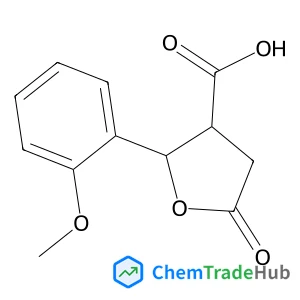
trans-2-(2-Methoxyphenyl)-5-oxotetrahydrofuran-3-carboxylic acid
CAS Number:
99226-02-5
Molecular Formula:
C12H12O5
Mathias Glassner, Jana Falkenhagen, Christopher Barner-Kowollik
We report the systematic investigation of a recently introduced one-pot radical transformation of methacrylate and acrylate-type polymers prepared via reversible addition fragmentation chain transfer (RAFT) polymerization into hydroxyl functional polymers. The simple reaction procedure involves stirring a solution of the RAFT functional polymer and an azo-initiator in tetrahydrofuran at elevated temperatures (T = 60 °C) in the presence of ambient air. Subsequent reduction of the formed hydroperoxide functional polymers to hydroxyl functional polymers is achieved in a one-pot procedure using triphenylphosphine. Polymers investigated in the current study are poly(methyl acrylate) (pMA), poly(butyl acrylate) (pBA), poly(isobornyl acrylate) (piBoA) and poly(tert-butyl acrylate) (ptBA) carrying a dithiobenzoate or phenyldithioacetate end terminius as well as a symmetrical trithiocarbonate mid chain function. Quantitative conversion into the hydroperoxyl and hydroxyl terminated product is observed when trithiocarbonate functional polymers are employed. In the case of dithiobenzoate and phenyldithioacetate functional acrylic polymers, some minor side products due to the oxidation of the RAFT end-group are generated. Size exclusion chromatography (SEC) and size exclusion chromatography–electrospray mass spectrometry (SEC-ESI-MS) were employed to monitor the progress of the reaction and to investigate the proposed reaction mechanism for the model polymers. When trithiocarbonate functional polymers are employed in the transformation reaction, the SEC analysis shows a bisection of the initial Mn. Collision induced dissociation (CID) MS experiments of the intermediate reaction products were conducted to gain in-depth information about the chemical structure. The new backbone linked hydroxyl group provides a versatile anchor for chemical end-group conversions and conjugation reactions with RAFT prepared polymers, alleviating problems with the rather limited ability of the dithioester end-group to undergo non-radical transformations.
Deepak Ojha, Amalendu Chandra
DOI: 10.1039/C8CP07121G
Mário R. G. Marques, Jakob Wolff, Conrad Steigemann, Miguel A. L. Marques
DOI: 10.1039/C8CP05771K
Jörg Baz, Christoph Held, Jürgen Pleiss, Niels Hansen
DOI: 10.1039/C9CP00036D
Noelia Faginas-Lago, Thierry Leininger, Stefano Evangelisti
DOI: 10.1039/C8CP07159D
Xiaoguang Li, Jinlong Yang
DOI: 10.1039/C8CP07091A
Zonghao Shen, John A. Kilner, Stephen J. Skinner
DOI: 10.1039/C8CP02797H
Xiran Cheng, Ziyun Wang, Yu Mao, P. Hu
DOI: 10.1039/C8CP06224B
Miao Yu, Yixin Chen, Zi-Le Wang
DOI: 10.1039/C8CP07859A
Jonas Warneke, Szymon Z. Konieczka, Gao-Lei Hou, Edoardo Aprà, Christoph Kerpen, Fabian Keppner, Thomas C. Schäfer, Michael Deckert, Zheng Yang, Eric J. Bylaska, Grant E. Johnson, Julia Laskin, Xue-Bin Wang, Maik Finze
DOI: 10.1039/C8CP05313H
6-(3-Fluorophenyl)picolinic acid is generally considered safe for laboratory use...
(3R)-3-Pyrrolidinol is used in the pharmaceutical industry as a precursor for dr...
When handling (4R,5R)-4,5-Diethoxycarbonyl-2,2-dimethyldioxolane (CAS: 59779-75-...
1-(6-Chloroimidazo[1,2-b]pyridazin-3-yl)ethanone is often synthesized via a mult...
The market for N-Ethyl-3,4-dimethylbenzylamine (CAS: 39180-83-1) remains steady,...
Tert-butyl 3-(pyrrolidin-1-yl)azetidine-1-carboxylate is a chemical compound wit...
1-Bromo-3-chloro-2,4-dimethoxybenzene (CAS: 1228956-93-1) falls under the classi...
The safety of 8-Bromo-2-methyl-3,4-dihydroisoquinolin-1(2H)-one (CAS: 1368622-07...
Benzyl [(3S)-2,6-dioxo-3-piperidinyl]carbamate is generally safe when handled wi...
1-{[4-(4,4,5,5-Tetramethyl-1,3,2-dioxaborolan-2-yl)phenyl]sulfonyl}pyrrolidine s...

Polymer Chemistry welcomes submissions in all areas of polymer science that have a strong focus on macromolecular chemistry. Manuscripts may cover a broad range of fields, yet no direct application focus is required.
![2-[({[(2-Methyl-2-propanyl)oxy]carbonyl}amino)methyl]isonicotinic acid structure](https://static.chemtradehub.com/structs/473/473924-63-9-973b.webp "2-[({[(2-Methyl-2-propanyl)oxy]carbonyl}amino)methyl]isonicotinic acid structure")
![(2E)-4-[(1R,2S,8R,19S,21R)-14-Hydroxy-11-isopropenyl-8,23,23-trimethyl-5-(3-methyl-2-buten-1-yl)-16,20-dioxo-3,7,22-trioxaheptacyclo[17.4.1.1~8,12~.0~2,17~.0~2,21~.0~4,15~.0~6,13~]pentacosa-4(15),5,13
,17-tetraen-21-yl]-2-methyl-2-butenoic acid structure](https://static.chemtradehub.com/structs/173/173867-04-4-d2d3.webp "(2E)-4-[(1R,2S,8R,19S,21R)-14-Hydroxy-11-isopropenyl-8,23,23-trimethyl-5-(3-methyl-2-buten-1-yl)-16,20-dioxo-3,7,22-trioxaheptacyclo[17.4.1.1~8,12~.0~2,17~.0~2,21~.0~4,15~.0~6,13~]pentacosa-4(15),5,13
,17-tetraen-21-yl]-2-methyl-2-butenoic acid structure")