












Synthesis and fluorescence properties of hyperbranched poly(amidoamine)s with high density tertiary nitrogen
Literature Information
Publication Date
2010-09-21
DOI
10.1039/C0PY00194E
Impact Factor
5.582
Authors
Miaojun Ding
View Original
Abstract
Hyperbranched poly(amidoamine)s with high density tertiary nitrogen (HPAMAMs-OH) were prepared via the two-step reactions. Firstly, hyperbranched poly(amidoamine)s (HPAMAMs) were synthesized by Michael addition of 1-(2-aminoethyl) piperazine (AEPZ) and methyl acrylate (MA) and then alkylation of the residual amino protons of hyperbranched poly(amidoamine)s (HPAMAMs) with propylene oxide (PO) in ethanol was performed. The fluorescence properties of HPAMAMs and HPAMAMs-OH were investigated. It was found that the fluorescence intensity of the polymers increased correspondingly with the increasing of the tertiary nitrogen in the molecular structure. The tertiary nitrogen with lone pair electrons inside the molecular structure played an important role in the photoluminescence. The complex with nano gold encapsulated in the interior of the HPAMAMs-OH presented greatly enhanced emission. Those results show that the nano gold may be used to adjust the fluorescence properties of HPAMAMs-OH and may extend potential applications of HPAMAMs-OH and gold nanoparticles.
Related Literature
The role of the dihedral angle and excited cation states in ionization and dissociation of mono-halogenated biphenyls; a combined experimental and theoretical coupled cluster study
Michael Barclay, Ragnar Bjornsson, Maicol Cipriani, Andreas Terfort, D. Howard Fairbrother, Oddur Ingólfsson
2019-02-01
Paper
DOI: 10.1039/C8CP07785A
Catalytic CO oxidation on B-doped and BN co-doped penta-graphene: a computational study
Ranganathan Krishnan, Shiuan-Yau Wu, Hsin-Tsung Chen
2018-09-20
Paper
DOI: 10.1039/C8CP04745F
Bismuth oxysulfide film electrodes with giant incident photon-to-current conversion efficiency: the dynamics of properties with deposition time
Evgeny A. Bondarenko, Eugene A. Streltsov, Alexander V. Mazanik, Anatoly I. Kulak, Vytautas Grivickas, Patrik Ščajev, Ekaterina V. Skorb
2018-06-22
Paper
DOI: 10.1039/C8CP03225D
Rotational (de)-excitation of linear C3O by collision with He
Fehmi Khadri, Kamel Hammami
2019-01-29
Paper
DOI: 10.1039/C8CP07409G
A computational study on the electrified Pt(111) surface by the cluster model
2019-02-28
Paper
DOI: 10.1039/C8CP07241H
The role of solvation models on the computed absorption and emission spectra: the case of fireflies oxyluciferin
Cristina García-Iriepa, Madjid Zemmouche, Isabelle Navizet
2019-02-04
Paper
DOI: 10.1039/C8CP07352J
A honeycomb-like monolayer of HfO2 and the calculation of static dielectric constant eliminating the effect of vacuum spacing
Junhui Weng, Shang-Peng Gao
2018-09-17
Paper
DOI: 10.1039/C8CP04743J
UPS and UV spectroscopies combined to position the energy levels of TiO2 anatase and rutile nanopowders
Clément Maheu, Luis Cardenas, Eric Puzenat, Pavel Afanasiev, Christophe Geantet
2018-09-17
Paper
DOI: 10.1039/C8CP04614J
Fundamental limitations of the time-dependent Stokes shift for investigating protein hydration dynamics
Esther Heid
2019-02-01
Paper
DOI: 10.1039/C8CP07623E
You might also like
Compound Q&A
Is 6-(3-Fluorophenyl)picolinic acid (CAS: 887982-40-3) safe?
6-(3-Fluorophenyl)picolinic acid is generally considered safe for laboratory use...
887982-40-36-(3-Fluorophenyl)pi...
Compound Q&A
What industries use (3R)-3-Pyrrolidinol (CAS: 2799-21-5)?
(3R)-3-Pyrrolidinol is used in the pharmaceutical industry as a precursor for dr...
2799-21-5(3R)-3-Pyrrolidinol
Compound Q&A
What precautions should be taken when handling (4R,5R)-4,5-Diethoxycarbonyl-2,2-dimethyldioxolane (CAS: 59779-75-8)?
When handling (4R,5R)-4,5-Diethoxycarbonyl-2,2-dimethyldioxolane (CAS: 59779-75-...
59779-75-8(4R,5R)-4,5-Diethoxy...
Compound Q&A
How is 1-(6-Chloroimidazo[1,2-b]pyridazin-3-yl)ethanone (CAS: 90734-71-7) typically synthesized?
1-(6-Chloroimidazo[1,2-b]pyridazin-3-yl)ethanone is often synthesized via a mult...
90734-71-71-(6-Chloroimidazo[1...
Compound Q&A
What is the market or research trend for N-Ethyl-3,4-dimethylbenzylamine (CAS: 39180-83-1)?
The market for N-Ethyl-3,4-dimethylbenzylamine (CAS: 39180-83-1) remains steady,...
39180-83-1N-Ethyl-3,4-dimethyl...
Compound Q&A
What is Tert-butyl 3-(pyrrolidin-1-yl)azetidine-1-carboxylate (CAS: 1019008-21-9)?
Tert-butyl 3-(pyrrolidin-1-yl)azetidine-1-carboxylate is a chemical compound wit...
1019008-21-9Tert-butyl 3-(pyrrol...
Compound Q&A
What regulatory guidelines apply to 1-Bromo-3-chloro-2,4-dimethoxybenzene (CAS: 1228956-93-1)?
1-Bromo-3-chloro-2,4-dimethoxybenzene (CAS: 1228956-93-1) falls under the classi...
1228956-93-11-Bromo-3-chloro-2,4...
Compound Q&A
Is 8-Bromo-2-methyl-3,4-dihydroisoquinolin-1(2H)-one (CAS: 1368622-07-4) safe?
The safety of 8-Bromo-2-methyl-3,4-dihydroisoquinolin-1(2H)-one (CAS: 1368622-07...
1368622-07-48-Bromo-2-methyl-3,4...
Compound Q&A
Is Benzyl [(3S)-2,6-dioxo-3-piperidinyl]carbamate (CAS: 22785-43-9) safe?
Benzyl [(3S)-2,6-dioxo-3-piperidinyl]carbamate is generally safe when handled wi...
22785-43-9Benzyl [(3S)-2,6-dio...
Compound Q&A
How should 1-{[4-(4,4,5,5-Tetramethyl-1,3,2-dioxaborolan-2-yl)phenyl]sulfonyl}pyrrolidine (CAS: 928657-21-0) be stored?
1-{[4-(4,4,5,5-Tetramethyl-1,3,2-dioxaborolan-2-yl)phenyl]sulfonyl}pyrrolidine s...
928657-21-01-{[4-(4,4,5,5-Tetra...
Source Journal
Polymer Chemistry

CiteScore:
8.6
Self-citation Rate:
7.3%
Articles per Year:
457
Polymer Chemistry welcomes submissions in all areas of polymer science that have a strong focus on macromolecular chemistry. Manuscripts may cover a broad range of fields, yet no direct application focus is required.
Recommended Compounds
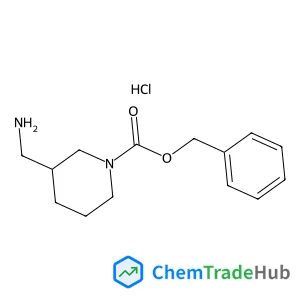
Benzyl 3-(aminomethyl)piperidine-1-carboxylate hydrochloride
CAS Number:
1186663-23-9
Molecular Formula:
C14H21ClN2O2
Recommended Suppliers





Disclaimer
This page provides academic journal information for reference and research purposes only. We are not affiliated with any journal publishers and do not handle publication submissions. For publication-related inquiries, please contact the respective journal publishers directly.
If you notice any inaccuracies in the information displayed, please contact us at support@chemtradehub.com. We will promptly review and address your concerns.