












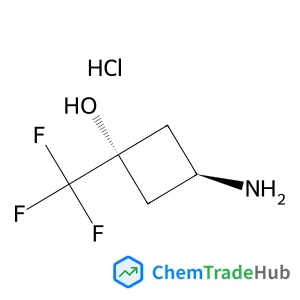
cis-3-Amino-1-(trifluoromethyl)cyclobutanol hydrochloride (1:1)
CAS Number:
1408075-16-0
Molecular Formula:
C5H9ClF3NO
Trinh Thi Ly, Ganbat Duvjir, Taewon Min, Jinho Byun, Taehoon Kim, Mahmoud M. Saad, Nguyen Thi Minh Hai, Sunglae Cho, Jaekwang Lee, Jungdae Kim
Recently, layered chalcogenide alloys (LCAs) have been extensively investigated for use in various practical applications by selectively controlling the amount of foreign components. However, the alloying behavior of layered chalcogenides has been rarely explored at the atomistic level. Here, we study the microstructural evolution of SnSe1−xSx alloys on the atomic scale by combining scanning tunneling microscopy (STM) measurements with first-principles density functional theory (DFT) calculations. STM topographic images suggest that S atoms substituted in SnSe1−xSx are not randomly distributed, but tend to form local SnS clusters. The degree of S atom alloying was quantitatively estimated to be about 60% from STM images, indicating that homo-atoms (S–S) are a preferred arrangement over hetero-atoms (S–Se). Our DFT calculations further confirmed that the mixing energy of random SnSe1−xSx alloys showed positive behavior over the whole S composition range considered. This result suggests that SnSe1−xSx has a tendency toward local phase segregation into SnSe and SnS rather than random alloys. We expect our atomistic study on the alloying behavior to provide important insight for fabricating optimal SnSe1−xSx alloys with high thermoelectric properties.
Yuping Zhao, Guiqiang He, Weihong Guo, Lili Bao, Meijun Yi, Yongkuan Gong, Shiping Zhang
DOI: 10.1039/C6PY00845C
Chi Ching Lau, Mustafa Kemal Bayazit, Junwang Tang
DOI: 10.1039/C7PY00862G
Shogo Amemori, Kazuya Iseda, Shizuka Anan, Toshikazu Ono
DOI: 10.1039/C7PY00591A
Gianpiero Lazzari, Patrick Couvreur, Simona Mura
DOI: 10.1039/C7PY00559H
Mengxia Gao, Bin Chen, Yinan Wang, Wenjun Zhou, Wallace W. H. Wong, Trevor A. Smith, Zujin Zhao
DOI: 10.1039/C7PY00564D
Peng-Yun Li, Jia-Min Li, Lian-Wei Li, Xiao-Dong Ye, Wei-Dong He
DOI: 10.1039/C7PY00551B
4-Nitrophenyl phosphate disodium salt hexahydrate is primarily used as a substra...
2-(Trifluoromethyl)-1,3-oxazole-4-carboxylic Acid (CAS: 1060816-01-4) is widely ...
2-Fluoro-4-biphenylcarboxylic acid should be stored in a cool, dry place at room...
Prednisolone-21-Carboxylic Acid is primarily used in the pharmaceutical industry...
4-(Hydrazinomethyl)-1,2,3-benzenetriol (CAS: 3614-72-0) should be stored in a co...
4-Amino-1-methyl-1H-pyrazole-5-carboxylic acid hydrochloride (CAS: 92534-70-8) i...
Dehydropachymic acid (CAS: 77012-31-8) is regulated by various agencies. It fall...
The market and research trends for 6-[(2,2-Dimethylpropanoyl)amino]nicotinic aci...
1,10-Phenanthroline-2,9-dicarbaldehyde should be stored in a cool, dry place awa...
5-Carbamoyl-11-oxo-10,11-dihydro-5H-dibenzo[b,f]azepin-10-yl acetate can be synt...

Physical Chemistry Chemical Physics (PCCP) is an international journal co-owned by 19 physical chemistry and physics societies from around the world. This journal publishes original, cutting-edge research in physical chemistry, chemical physics and biophysical chemistry. To be suitable for publication in PCCP, articles must include significant innovation and/or insight into physical chemistry; this is the most important criterion that reviewers and Editors will judge against when evaluating submissions. The journal has a broad scope and welcomes contributions spanning experiment, theory, computation and data science. Topical coverage includes spectroscopy, dynamics, kinetics, statistical mechanics, thermodynamics, electrochemistry, catalysis, surface science, quantum mechanics, quantum computing and machine learning. Interdisciplinary research areas such as polymers and soft matter, materials, nanoscience, energy, surfaces/interfaces, and biophysical chemistry are welcomed if they demonstrate significant innovation and/or insight into physical chemistry. Joined experimental/theoretical studies are particularly appreciated when complementary and based on up-to-date approaches.
![S-[2,3-Bis(palmitoyloxy)propyl]-N-[(9H-fluoren-9-ylmethoxy)(hydroxy)methylene]cysteine structure](https://static.chemtradehub.com/structs/210/210532-98-2-f6a7.webp "S-[2,3-Bis(palmitoyloxy)propyl]-N-[(9H-fluoren-9-ylmethoxy)(hydroxy)methylene]cysteine structure")
![1-[(4-Methylphenyl)sulfonyl]-3-(4,4,5,5-tetramethyl-1,3,2-dioxaborolan-2-yl)-1H-pyrrolo[2,3-b]pyridine-5-carbonitrile structure](https://static.chemtradehub.com/structs/143/1434747-57-5-fc0d.webp "1-[(4-Methylphenyl)sulfonyl]-3-(4,4,5,5-tetramethyl-1,3,2-dioxaborolan-2-yl)-1H-pyrrolo[2,3-b]pyridine-5-carbonitrile structure")




