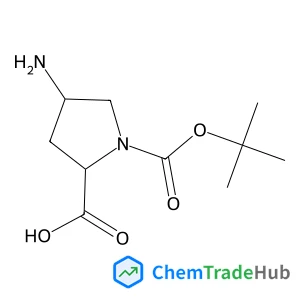
(2R,4R)-1-Boc-4-Aminopyrrolidine-2-carboxylic acid
CAS Number:
132622-98-1
Molecular Formula:
C10H18N2O4
Abeer A. Alzahrani, Annette H. Erbse, Christopher N. Bowman
Here, several distinct approaches for photoinitiation and subsequent utilization of the Copper catalyzed azide–alkyne cycloaddition (CuAAC) reaction are developed. In particular, Cu(II)–ligand complexes were synthesized that enabled direct photoreduction of the Cu(II). The sequential and orthogonal nature of the photo-CuAAC reaction and a chain-growth acrylate homopolymerization were demonstrated and used to form branched polymer structures. The efficiency of the photo-initiated Cu(II) complexes in regard to their ability to initiate the CuAAC reaction was examined by reacting a variety of amino-functional ligands with Cu(II) halides to form complexes capable of forming Cu(I) upon light irradiation. When irradiated with 365 nm light, the ligand donates an electron to Cu(II) to reduce it to Cu(I) which subsequently initiates the azide–alkyne cycloaddition (i.e., photo-CuAAC) reaction with exquisite spatiotemporal control. Aliphatic amine ligands were found to be the most efficient ligands in promoting photoreduction of Cu(II) and stabilizing Cu(I), once formed. Among the aliphatic amines studied, tertiary amines such as triethylamine (TEA), tetramethylethylenediamine (TMDA), N,N,N′,N′′,N′′-pentamethyldiethylenetriamine (PMDTA), and hexamethylenetetramine (HMTETA) were found to be the most effective. In addition, the Cu(II)–amine complexes were insensitive to oxygen, indicating that the catalytic Cu(I) is largely prevented from re-oxidation by complexation with the amine ligand and/or the triazole. The reaction kinetics were accelerated by increasing the PMDETA : Cu(II) ratio with a ratio of ligand to Cu(II) of 4 : 1 yielding the maximum conversion in the shortest time.
Christoph Herfurth, Paula Malo de Molina, Christoph Wieland, Sarah Rogers, Michael Gradzielski
DOI: 10.1039/C2PY20126G
Christophe Detrembleur, Yasmine Piette, Marie Hurtgen, Christine Jérôme, Jacques Lalevée, Antoine Debuigne
DOI: 10.1039/C1PY00443C
Nathan R. B. Boase, Idriss Blakey, Kristofer J. Thurecht
DOI: 10.1039/C2PY20132A
Rebecca J. Williams, Rachel K. O'Reilly, Andrew P. Dove
DOI: 10.1039/C2PY20213A
Maribel Hernández-Guerrero, Martina H. Stenzel
DOI: 10.1039/C1PY00219H
Hung-Ju Yen, Guey-Sheng Liou
DOI: 10.1039/C1PY00346A
Yi Zhang, Mingming Ding, Lijuan Zhou, Hong Tan, Jiehua Li, Huining Xiao, Jianshu Li, James Snow
DOI: 10.1039/C2PY00558A
Yukiya Kitayama, Hirotaka Moribe, Kazuya Kishida
DOI: 10.1039/C2PY20105D
When considering alternatives to 1-(4-Chlorophenyl)-N-hydroxymethanimine (CAS: 3...
This compound should be stored in a cool, dry place away from direct sunlight. I...
3-(4-Bromophenyl)-5-(2-fluorophenyl)-1,2,4-oxadiazole is synthesized through a m...
5-Chloro-2-(4-chlorophenyl)-4-methyl-6-[3-(1-piperidinyl)propoxy]pyrimidine (CAS...
2-Chloro-4-(difluoromethoxy)pyridine is used in the pharmaceutical industry for ...
3-Chloro-6-methylpyridazine (CAS: 1121-79-5) is classified under the Globally Ha...
Several alternatives can be used in the synthesis of Methyl 4,5-dimethyl-2-nitro...
Alternatives to (2E,2'E)-3,3'-(1,4-Phenylene)bisacrylaldehyde include other acry...
3-Amino-5-chloropyridin-2-ol hydrochloride is an organic compound with the CAS n...
When handling 6,7-Difluoro-2,3-dihydro-4H-chromen-4-one, it is essential to wear...

Polymer Chemistry welcomes submissions in all areas of polymer science that have a strong focus on macromolecular chemistry. Manuscripts may cover a broad range of fields, yet no direct application focus is required.
![6-Bromo-2,3-dihydro-1H-pyrido[2,3-b][1,4]oxazine structure](https://static.chemtradehub.com/structs/120/1203499-17-5-b4d1.webp "6-Bromo-2,3-dihydro-1H-pyrido[2,3-b][1,4]oxazine structure")