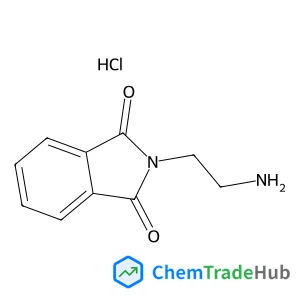
2-(2-Aminoethyl)-1H-isoindole-1,3(2H)-dione hydrochloride (1:1)
CAS Number:
30250-67-0
Molecular Formula:
C10H11ClN2O2
Xinyu Wang, Jingchao Zhang, Yue Chen, Paddy K. L. Chan
The interfacial thermal transport across graphene and an organic semiconductor, dinaphtho[2,3-b:2′,3′-f]thieno[3,2-b]thiophene (DNTT), is investigated using molecular dynamics simulations. The average thermal boundary resistance (TBR) of graphene and DNTT is 4.88 ± 0.12 × 10⁻⁸ m2 K W−1 at 300 K. We find that TBR of a graphene–DNTT heterostructure possesses as high as 83.4% reduction after the hydrogenation of graphene. Moreover, as the graphene vacancy increases from 0% to 6%, the TBR drops up to 39.6%. The reduction of TBR is mainly attributed to the coupling enhancement of graphene and DNTT phonons as evaluated from the phonon density of states. On the other hand, TBR keeps a constant value while the vacancy in the DNTT layer increases. The TBR would decrease when the temperature and coupling strength increase. These findings provide a useful guideline for the thermal management of the graphene-based organic electronic devices, especially the large area transistor arrays or sensors.
Qing-Zhu Li, Jun-Long Li, Bin Zhang, Zhen Dai, Ke Xie, Rong Zeng, Liang Zou, Xiang Zhang
DOI: 10.1039/D1QO01543E
Xiao Yi, Yirui Chen, An Huang, Dingguo Song, Jiaying He, Fei Ling, Weihui Zhong
DOI: 10.1039/D1QO01443A
Zhichao Chen, Hong Zhang, Shu-Feng Zhou, Xiuling Cui
DOI: 10.1039/D1QO01540K
Jixing Lai, Juan Yang, Chen Yang, René Csuk, Baoan Song, Shengkun Li
DOI: 10.1039/D1QO01510A
Xiu Yang, Wei-Dong Meng, Xiu-Hua Xu, Yangen Huang
DOI: 10.1039/D1QO01170G
Lufeng Ouyang, Zhigeng Lin, Shiqi Li, Baoyin Chen, Jidan Liu, Wen-Jing Shi, Liyao Zheng
DOI: 10.1039/D1QO01242H
Xiao-Yu Zhang, Song Yang, Yin Wei
DOI: 10.1039/C8OB01765D
Na Luo, Zhen-Wei Sun, Xing-Xin Xu, Xiao-Qiang Hu, Feng-Cheng Jia
DOI: 10.1039/D1QO01280K
Viktoria Kahlert, Oliver Ohlenschläger, Jelena Melesina, Christian Lücke
DOI: 10.1039/C8OB00980E
(1R,3S)-1,3-Cyclopentanediol finds applications in various industries. In the ph...
When handling N'-[4-(Dimethylamino)phenyl]-N,N-dimethyl-1,4-benzenediamine, it i...
There are several alternatives to 5-(2,4-Difluorophenyl)-2-methoxypyrimidine in ...
1-(3-Methoxyphenoxy)propan-2-ol (CAS: 382141-68-6) must comply with the Globally...
Tetrodotoxin Citrate is extremely dangerous and should be handled with extreme c...
2-Methyl-2-propanyl [(1R,3S)-3-hydroxycyclopentyl]carbamate (CAS: 225641-84-9) i...
Waste containing 4-(2-Hydroxyhexafluoroisopropyl)Benzoic Acid (CAS: 16261-80-6) ...
2-Methyl-2-proanyl {(2S)-1-[(benzyloxy)amino]-3-hydroxy-3-methyl-1-oxo-2-butanyl...
Benzeneethanamine, α-ethyl-, hydrochloride (1:1) is an organic compound with the...
In the synthesis of compounds similar to 3-{(E)-[4-(Dimethylamino)phenyl]diazeny...

Physical Chemistry Chemical Physics (PCCP) is an international journal co-owned by 19 physical chemistry and physics societies from around the world. This journal publishes original, cutting-edge research in physical chemistry, chemical physics and biophysical chemistry. To be suitable for publication in PCCP, articles must include significant innovation and/or insight into physical chemistry; this is the most important criterion that reviewers and Editors will judge against when evaluating submissions. The journal has a broad scope and welcomes contributions spanning experiment, theory, computation and data science. Topical coverage includes spectroscopy, dynamics, kinetics, statistical mechanics, thermodynamics, electrochemistry, catalysis, surface science, quantum mechanics, quantum computing and machine learning. Interdisciplinary research areas such as polymers and soft matter, materials, nanoscience, energy, surfaces/interfaces, and biophysical chemistry are welcomed if they demonstrate significant innovation and/or insight into physical chemistry. Joined experimental/theoretical studies are particularly appreciated when complementary and based on up-to-date approaches.