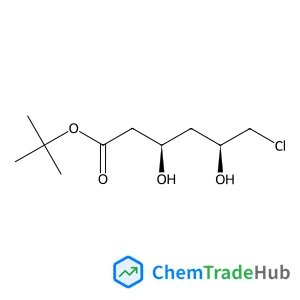
2-Methyl-2-propanyl (3R,5S)-6-chloro-3,5-dihydroxyhexanoate
CAS Number:
154026-93-4
Molecular Formula:
C10H19ClO4
Taku Matsuoka, Laurent Baumes, Naonobu Katada, Abhijit Chatterjee, German Sastre
The database of prospective zeolites (http://www.hypotheticalzeolites.net) has been screened in search of feasible zeolites with the condition of having at least one strong Brønsted site. Several criteria of zeolite feasibility have been tested using energetic and structural concepts, allowing a fast elimination of unsuitable candidates. Based on improved definitions to count and enumerate rings in zeolites, Brønsted acidity has been assessed in a fast albeit inaccurate way, by calculating a structural descriptor related to ammonia desorption energy. In each zeolite, the value of this descriptor was calculated for all the possible centres where a Brønsted acid site can be located. Ranking each zeolite through the value of the strongest candidate acid site allowed obtaining a selection of potentially strong acid zeolites. With further selection criteria, a final short list of 12 structures was obtained, where accurate calculations using periodic DFT indicate that 6 of them must contain a Brønsted site of very strong acidity.

Biocatalysis and Biotransformation

Bioorganic & Medicinal Chemistry

Polycyclic Aromatic Compounds

Critical Reviews in Solid State and Materials Sciences

Acta Metallurgica Sinica-English Letters

NDT & E International

Herald of the Russian Academy of Sciences

Cellulose

Main Group Chemistry

Journal of the Indian Institute of Science
Shaofa Sun, Donghui Guo, Fangyi Li
DOI: 10.1039/D1QO01661J
Li-Wen Sun, Zi-Lun Yu, Xin-Long Luo, Mengtao Ma, Zhi-Liang Shen, Xue-Qiang Chu
DOI: 10.1039/D1QO01439K
Bhavani Shankar Chinta, Harikrishna Sanapa, Kamala Prasad Vasikarla, Beeraiah Baire
DOI: 10.1039/C8OB00434J
Thomas Toupy, Christopher Kune, Kristof Van Hecke, Loïc Quinton, Jean-Christophe M. Monbaliu
DOI: 10.1039/D1QO01564H
Chaochao Zhang, Lin Cheng, Gaopan Dong, Guangxi Han, Xingye Yang, Chunchao Tang, Xiang Li, Yubin Zhou, Lupei Du
DOI: 10.1039/C8OB01192C
Xiaoyu Xing, Yan Zhao
DOI: 10.1039/C8OB00786A
Xiu Yang, Wei-Dong Meng, Xiu-Hua Xu, Yangen Huang
DOI: 10.1039/D1QO01170G
Olga Bakulina, Dmitry Dar'in, Mikhail Krasavin
DOI: 10.1039/C8OB00768C
Xintao Gu, Yin Wei
DOI: 10.1039/D1QO01373D
Viktoria Kahlert, Oliver Ohlenschläger, Jelena Melesina, Christian Lücke
DOI: 10.1039/C8OB00980E
(1R,3S)-1,3-Cyclopentanediol finds applications in various industries. In the ph...
When handling N'-[4-(Dimethylamino)phenyl]-N,N-dimethyl-1,4-benzenediamine, it i...
There are several alternatives to 5-(2,4-Difluorophenyl)-2-methoxypyrimidine in ...
1-(3-Methoxyphenoxy)propan-2-ol (CAS: 382141-68-6) must comply with the Globally...
Tetrodotoxin Citrate is extremely dangerous and should be handled with extreme c...
2-Methyl-2-propanyl [(1R,3S)-3-hydroxycyclopentyl]carbamate (CAS: 225641-84-9) i...
Waste containing 4-(2-Hydroxyhexafluoroisopropyl)Benzoic Acid (CAS: 16261-80-6) ...
2-Methyl-2-proanyl {(2S)-1-[(benzyloxy)amino]-3-hydroxy-3-methyl-1-oxo-2-butanyl...
Benzeneethanamine, α-ethyl-, hydrochloride (1:1) is an organic compound with the...
In the synthesis of compounds similar to 3-{(E)-[4-(Dimethylamino)phenyl]diazeny...

Physical Chemistry Chemical Physics (PCCP) is an international journal co-owned by 19 physical chemistry and physics societies from around the world. This journal publishes original, cutting-edge research in physical chemistry, chemical physics and biophysical chemistry. To be suitable for publication in PCCP, articles must include significant innovation and/or insight into physical chemistry; this is the most important criterion that reviewers and Editors will judge against when evaluating submissions. The journal has a broad scope and welcomes contributions spanning experiment, theory, computation and data science. Topical coverage includes spectroscopy, dynamics, kinetics, statistical mechanics, thermodynamics, electrochemistry, catalysis, surface science, quantum mechanics, quantum computing and machine learning. Interdisciplinary research areas such as polymers and soft matter, materials, nanoscience, energy, surfaces/interfaces, and biophysical chemistry are welcomed if they demonstrate significant innovation and/or insight into physical chemistry. Joined experimental/theoretical studies are particularly appreciated when complementary and based on up-to-date approaches.