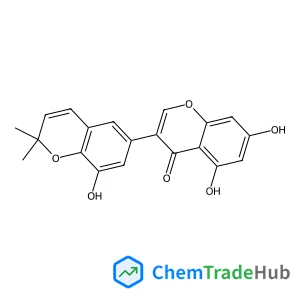
5,7,8'-Trihydroxy-2',2'-dimethyl-2'H,4H-3,6'-bichromen-4-one
CAS Number:
129280-33-7
Molecular Formula:
C20H16O6
Chaochao Zhang, Lin Cheng, Gaopan Dong, Guangxi Han, Xingye Yang, Chunchao Tang, Xiang Li, Yubin Zhou, Lupei Du
To develop a photoactivatable bioluminescence imaging technique, a set of high and efficient photoactivatable substrates for Renilla luciferase has been well designed and synthesized. Surprisingly, all of them could release the free luciferin that presented robust bioluminescent signals ex vivo and in living animals after UV irradiation at 365 nm.
Mi Feng, Ming Jiang
DOI: 10.1039/D3SU00248A
Luciane Maria Colla, Christian Oliveira Reinehr, Paola Gouvêa Manfredini, Vítor Augusto Farina Cavanhi, Jorge Alberto Vieira Costa
DOI: 10.1039/D3FB00077J
Afroza Sultana, Shuji Adachi, Hidefumi Yoshii
DOI: 10.1039/D3FB00099K
Kanika Miglani, Saumya Singh, Devendra Pratap Singh, Meena Krishania
DOI: 10.1039/D3FB00100H
Jenni Tienaho, Hanna Brännström, Risto Korpinen, Juha-Matti Pihlava, Jarkko Hellström, Paula Jylhä, Jaana Liimatainen, Veikko Möttönen, Jyri Maunuksela, Petri Kilpeläinen
DOI: 10.1039/D3SU00255A
Cheng-Wei Lin, Zhiyin Yang, Ailun Huang, Xueying Chang, Chenxiang Wang, Fan Yang, Chen Wei, Markus Thiel, Yuto Katsuyama, Lihua Jin
DOI: 10.1039/D3LF00194F
(1R,3S)-1,3-Cyclopentanediol finds applications in various industries. In the ph...
When handling N'-[4-(Dimethylamino)phenyl]-N,N-dimethyl-1,4-benzenediamine, it i...
There are several alternatives to 5-(2,4-Difluorophenyl)-2-methoxypyrimidine in ...
1-(3-Methoxyphenoxy)propan-2-ol (CAS: 382141-68-6) must comply with the Globally...
Tetrodotoxin Citrate is extremely dangerous and should be handled with extreme c...
2-Methyl-2-propanyl [(1R,3S)-3-hydroxycyclopentyl]carbamate (CAS: 225641-84-9) i...
Waste containing 4-(2-Hydroxyhexafluoroisopropyl)Benzoic Acid (CAS: 16261-80-6) ...
2-Methyl-2-proanyl {(2S)-1-[(benzyloxy)amino]-3-hydroxy-3-methyl-1-oxo-2-butanyl...
Benzeneethanamine, α-ethyl-, hydrochloride (1:1) is an organic compound with the...
In the synthesis of compounds similar to 3-{(E)-[4-(Dimethylamino)phenyl]diazeny...

Organic & Biomolecular Chemistry (OBC) publishes original and high impact research and reviews in organic chemistry. We welcome research that shows new or significantly improved protocols or methodologies in total synthesis, synthetic methodology or physical and theoretical organic chemistry as well as research that shows a significant advance in the organic chemistry or molecular design aspects of chemical biology, catalysis, supramolecular and macromolecular chemistry, theoretical chemistry, mechanism-oriented physical organic chemistry, medicinal chemistry or natural products. Articles published in the journal should report new work which makes a highly-significant impact in the field. Routine and incremental work is generally not suitable for publication in the journal. More details about key areas of our scope are below. In all cases authors should include in their article clear rationale for why their research has been carried out.

![N-[(1S,2R,4S)-2-Amino-4-(dimethylcarbamoyl)cyclohexyl]-N'-(5-chloro-2-pyridinyl)ethanediamide structure](https://static.chemtradehub.com/structs/480/480452-37-7-0898.webp "N-[(1S,2R,4S)-2-Amino-4-(dimethylcarbamoyl)cyclohexyl]-N'-(5-chloro-2-pyridinyl)ethanediamide structure")