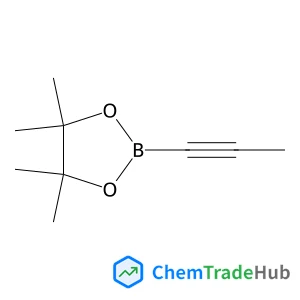
4,4,5,5-Tetramethyl-2-(1-propyn-1-YL)-1,3,2-dioxaborolane
CAS Number:
347389-75-7
Molecular Formula:
C9H15BO2
Zhiqiang Shen, Huilin Ye, Martin Kröger, Ying Li
A core–polyethylene glycol–lipid shell (CPLS) nanoparticle consists of an inorganic core coated with polyethylene glycol (PEG) polymers, surrounded by a lipid bilayer shell. It can be self-assembled from a PEGylated core with surface-tethered PEG chains, where all the distal ends are covalently bonded to lipid molecules. Upon adding free lipids, a complete lipid bilayer shell can be formed on the surface driven by the hydrophobic nature of lipid tails, leading to the formation of a CPLS nanoparticle. The stability of CPLS nanoparticles in shear flow has been systematically studied through large scale dissipative particle dynamics simulations. CPLS nanoparticles demonstrate higher stability and less deformation in shear flow, compared with lipid vesicles. Burst leakage of drug molecules inside lipid vesicles and CPLS NPs can be induced by the large pores at their tips. These pores are initiated by the maximum stress in the waist region. It further grows along with the tank-treading motion of vesicles or CPLS NPs in shear flow. However, due to the constraints applied by PEG polymers, CPLS NPs are less deformed than vesicles with comparable size under the same flow conditions. Thus, the less deformed CPLS NPs express a smaller maximum stress at waists, demonstrating higher stability. Pore formation at waists, evolving into large pores on vesicles, leads to the burst leakage of drug molecules and complete rupture of vesicles. In contrast, although similar drug leakage in CPLS nanoparticles can occur at high shear rates, pores initiated at moderate shear rates tend to be short-lived and close due to the constraints mediated by PEG polymers. This kind of ‘self-healing’ capability can be observed over a wide range of shear rates for CPLS nanoparticles. Our results suggest self-assembled CPLS nanoparticles to exhibit high stability during blood circulation without rapid drug leakage. These features make CPLS nanoparticles candidates for a promising drug delivery platform.

Journal of Natural Medicines

Chemistry Education Research and Practice

Russian Journal of Applied Chemistry

Russian Journal of Organic Chemistry

Russian Journal of Bioorganic Chemistry

Current Opinion in Solid State & Materials Science

Russian Journal of Coordination Chemistry

Nature Medicine

Drug Discovery Today

Current Opinion in Colloid & Interface Science
Cinzia Chiappe, Christian Silvio Pomelli
DOI: 10.1039/C2CP43074F
Laura Prati, Alberto Villa, Andrew R. Lupini, Gabriel M. Veith
DOI: 10.1039/C2CP23405J
Veronique Trappe
DOI: 10.1039/C2CP22558A
Karan Bobuatong, Sangita Karanjit, Hidehiro Sakurai
DOI: 10.1039/C2CP23446G
Vaida Arcisauskaite, Stefan Knecht, Stephan P. A. Sauer, Lars Hemmingsen
DOI: 10.1039/C2CP23080A
Christiane Hackel, Tatyana Zinkevich, Peter Belton, Anja Achilles, Detlef Reichert
DOI: 10.1039/C2CP23098D
Yoshitaka Aoki, Akihisa Harada, Aiko Nakao, Toyoki Kunitake, Hiroki Habazaki
DOI: 10.1039/C2CP23821G
Martin Makosch, Christiane Kartusch, Jacinto Sá, Renata Bessa Duarte, Kristina Kvashnina, Pieter Glatzel, Daniel L. A. Fernandes, Maarten Nachtegaal, Jakub Szlachetko, Bobby Neuhold, Konrad Hungerbühler
DOI: 10.1039/C1CP21933B
Eimer M. Tuite, David B. Rose, Patricia M. Ennis, John M. Kelly
DOI: 10.1039/C2CP23597H
2-Methylbenzene-1,4-diamine dihydrochloride (CAS: 615-45-2) should be stored in ...
(1S,4S)-2,5-Diazabicyclo[2.2.1]heptane dihydrobromide is generally considered sa...
(6-Chloropyridazin-3-YL)methanamine finds applications in the pharmaceutical ind...
2-Fluoro-3-methylphenol is primarily used in the synthesis of pharmaceuticals, p...
When handling 3-Methoxy-4-nitrobenzonitrile, it is important to wear appropriate...
When handling 1,3-Oxazolo[4,5-b]pyridine-2(3H)-thione (CAS: 211949-57-4), it is ...
4-Ethynylbenzamide (CAS: 90347-86-7) falls under various regulatory guidelines i...
3-(2-Ethylphenyl)-2-thioxo-4-imidazolidinone is primarily used as an intermediat...
(2-Fluoro-6-methoxyphenyl)acetic acid, also known as 4-fluoro-3-methoxybenzoic a...
Market trends for 2-[4-(Hydroxymethyl)phenoxy]ethanol (CAS: 102196-18-9) indicat...

Physical Chemistry Chemical Physics (PCCP) is an international journal co-owned by 19 physical chemistry and physics societies from around the world. This journal publishes original, cutting-edge research in physical chemistry, chemical physics and biophysical chemistry. To be suitable for publication in PCCP, articles must include significant innovation and/or insight into physical chemistry; this is the most important criterion that reviewers and Editors will judge against when evaluating submissions. The journal has a broad scope and welcomes contributions spanning experiment, theory, computation and data science. Topical coverage includes spectroscopy, dynamics, kinetics, statistical mechanics, thermodynamics, electrochemistry, catalysis, surface science, quantum mechanics, quantum computing and machine learning. Interdisciplinary research areas such as polymers and soft matter, materials, nanoscience, energy, surfaces/interfaces, and biophysical chemistry are welcomed if they demonstrate significant innovation and/or insight into physical chemistry. Joined experimental/theoretical studies are particularly appreciated when complementary and based on up-to-date approaches.
![trans-2-{[(Tert-butoxy)carbonyl]amino}cyclobutane-1-carboxylic acid structure](https://static.chemtradehub.com/structs/951/951173-25-4-27cd.webp "trans-2-{[(Tert-butoxy)carbonyl]amino}cyclobutane-1-carboxylic acid structure")