













Understanding iridium oxide nanoparticle surface sites by their interaction with catechol
Literature Information
Publication Date
2017-05-24
DOI
10.1039/C7CP01516J
Impact Factor
3.676
Authors
Maxime Fournier, Dalvin D. Méndez-Hernández, Chengchen Guo, Thomas A. Moore, Ana L. Moore, Devens Gust, Jeffery L. Yarger
View Original
Abstract
Iridium oxide (IrOx) is one of the best water splitting electrocatalysts, but its active site details are not well known. As with all heterogeneous catalysts, a strategy for counting the number of active sites is not clear, and understanding their nature and structure is remarkably difficult. In this work, we performed a combined study using optical spectroscopy, magnetic resonance and electrochemistry to characterize the interaction of IrOx nanoparticles (NPs) with a probe molecule, catechol. The catalyst is heterogeneous given that the substrate is in a different phase, but behaves as a homogeneous catalyst from the point of view of electrochemistry since it remains in colloidal suspension. We find two types of binding sites: centers A which bind catechol irreversibly making up 21% of the surface, and centers B which bind catechol reversibly making up 79% of the surface. UV-vis absorption spectroscopy shows that the A sites are responsible for the characteristic blue color of the NPs. Electrochemical experiments indicate that the B sites are catalytically active and we give the number of active sites per nanoparticle. We conclude by performing a survey of ligands used in solar cell architectures and show which ones bind well to the surface and which ones inhibit the catalytic activity when doing so, presenting quantitative guidelines for the correct handling of IrOx nanoparticles during their incorporation into multifunctional solar energy harvesting architectures. We suggest ligands binding on the surface oxygen atoms allow for large bound ligand densities with no detrimental effect on the catalytic activity.
Related Literature
Sustainable route to methyl-9-hydroxononanoate (polymer precursor) by oxidative cleavage of fatty acid methyl ester from rapeseed oil
Kévin Louis, Laurence Vivier, Jean-Marc Clacens, Markus Brandhorst, Jean-Luc Dubois, Karine De Oliveira Vigier, Yannick Pouilloux
2013-10-04
Communication
DOI: 10.1039/C3GC41491D
Fibrous polyaniline@manganese oxide nanocomposites as supercapacitor electrode materials and cathode catalysts for improved power production in microbial fuel cells
Sajid Ali Ansari, Nazish Parveen, Thi Hiep Han, Mohammad Omaish Ansari, Moo Hwan Cho
2016-03-11
Paper
DOI: 10.1039/C6CP00159A
Porous nanoMoC@graphite shell derived from a MOFs-directed strategy: an efficient electrocatalyst for the hydrogen evolution reaction
Zhangping Shi, Yangxia Wang, Huanlei Lin, Hongbin Zhang, Meikun Shen, Songhai Xie, Yahong Zhang, Qingsheng Gao, Yi Tang
2016-03-17
Paper
DOI: 10.1039/C6TA01900E
How the number of fitting points for the slope of the mean-square displacement influences the experimentally determined particle size distribution from single-particle tracking
Dominique Ernst, Jürgen Köhler
2013-02-04
Communication
DOI: 10.1039/C3CP44391D
A theoretical study of the reactions of parent and substituted Criegee intermediates with water and the water dimer
Andrew B. Ryzhkov, Parisa A. Ariya
2004-09-02
Paper
DOI: 10.1039/B408414D
Encapsulating nanoscale zero-valent iron with a soluble Mg(OH)2 shell for improved mobility and controlled reactivity release
Yi-bo Hu, Xiao-yan Li
2017-11-30
Paper
DOI: 10.1039/C7TA08605A
Near-infrared light-responsive, diselenide containing core-cross-linked micelles prepared by the Diels–Alder click reaction for photocontrollable drug release application
Sabrina Aufar Salma, Dong Woo Kim, Cuong Minh Quoc Le, Byung-Hyun Ahn, Gun-Do Kim, Kwon Taek Lim
2018-09-06
Paper
DOI: 10.1039/C8PY00961A
An assessment of nanosponges for intravenous and oral drug delivery of BCS class IV drugs: Drug delivery kinetics and solubilization
Kelly A. Gilmore
2014-04-01
Communication
DOI: 10.1039/C4PY00207E
A DFT study of furan hydrogenation and ring opening on Pd(111)
Shengguang Wang, Vassili Vorotnikov, Dionisios G. Vlachos
2013-08-20
Paper
DOI: 10.1039/C3GC41183D
You might also like
Compound Q&A
Are there alternatives to 1-(4-Chlorophenyl)-N-hydroxymethanimine (CAS: 3848-36-0) in synthesis?
When considering alternatives to 1-(4-Chlorophenyl)-N-hydroxymethanimine (CAS: 3...
3848-36-01-(4-Chlorophenyl)-N...
Compound Q&A
How should (1R,9S,10S,12S,14E,16S,19R,20R,21S,22R)-3,9,21-Trihydroxy-5,10,12,14,16,20,22-heptamethyl-23,24-dioxatetracyclo[17.3.1.1~6,9~.0~2,7~]tetracosa-2,5,7,14-tetraen-4-one (CAS: 183202-73-5) be stored?
This compound should be stored in a cool, dry place away from direct sunlight. I...
183202-73-5(1R,9S,10S,12S,14E,1...
Compound Q&A
How is 3-(4-Bromophenyl)-5-(2-fluorophenyl)-1,2,4-oxadiazole (CAS: 419553-16-5) typically synthesized?
3-(4-Bromophenyl)-5-(2-fluorophenyl)-1,2,4-oxadiazole is synthesized through a m...
419553-16-53-(4-Bromophenyl)-5-...
Compound Q&A
How is 5-Chloro-2-(4-chlorophenyl)-4-methyl-6-[3-(1-piperidinyl)propoxy]pyrimidine (CAS: 1639220-19-1) typically synthesized?
5-Chloro-2-(4-chlorophenyl)-4-methyl-6-[3-(1-piperidinyl)propoxy]pyrimidine (CAS...
1639220-19-15-Chloro-2-(4-chloro...
Compound Q&A
What industries use 2-Chloro-4-(difluoromethoxy)pyridine (CAS: 1206978-15-5)?
2-Chloro-4-(difluoromethoxy)pyridine is used in the pharmaceutical industry for ...
1206978-15-52-Chloro-4-(difluoro...
Compound Q&A
What regulatory guidelines apply to 3-Chloro-6-methylpyridazine (CAS: 1121-79-5)?
3-Chloro-6-methylpyridazine (CAS: 1121-79-5) is classified under the Globally Ha...
1121-79-53-Chloro-6-methylpyr...
Compound Q&A
Are there alternatives to Methyl 4,5-dimethyl-2-nitrobenzoate in synthesis?
Several alternatives can be used in the synthesis of Methyl 4,5-dimethyl-2-nitro...
90922-74-0Methyl 4,5-dimethyl-...
Compound Q&A
Are there alternatives to (2E,2'E)-3,3'-(1,4-Phenylene)bisacrylaldehyde in synthesis?
Alternatives to (2E,2'E)-3,3'-(1,4-Phenylene)bisacrylaldehyde include other acry...
63405-68-5(2E,2'E)-3,3'-(1,4-P...
Compound Q&A
What is 3-Amino-5-chloropyridin-2-ol hydrochloride (CAS: 1261906-29-9)?
3-Amino-5-chloropyridin-2-ol hydrochloride is an organic compound with the CAS n...
1261906-29-93-Amino-5-chloropyri...
Compound Q&A
What precautions should be taken when handling 6,7-Difluoro-2,3-dihydro-4H-chromen-4-one (CAS: 1092349-93-3)?
When handling 6,7-Difluoro-2,3-dihydro-4H-chromen-4-one, it is essential to wear...
1092349-93-36,7-Difluoro-2,3-dih...
Source Journal
Physical Chemistry Chemical Physics

CiteScore:
5.5
Self-citation Rate:
10.3%
Articles per Year:
3036
Physical Chemistry Chemical Physics (PCCP) is an international journal co-owned by 19 physical chemistry and physics societies from around the world. This journal publishes original, cutting-edge research in physical chemistry, chemical physics and biophysical chemistry. To be suitable for publication in PCCP, articles must include significant innovation and/or insight into physical chemistry; this is the most important criterion that reviewers and Editors will judge against when evaluating submissions. The journal has a broad scope and welcomes contributions spanning experiment, theory, computation and data science. Topical coverage includes spectroscopy, dynamics, kinetics, statistical mechanics, thermodynamics, electrochemistry, catalysis, surface science, quantum mechanics, quantum computing and machine learning. Interdisciplinary research areas such as polymers and soft matter, materials, nanoscience, energy, surfaces/interfaces, and biophysical chemistry are welcomed if they demonstrate significant innovation and/or insight into physical chemistry. Joined experimental/theoretical studies are particularly appreciated when complementary and based on up-to-date approaches.
Recommended Compounds
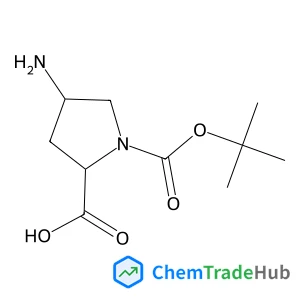
(2R,4R)-1-Boc-4-Aminopyrrolidine-2-carboxylic acid
CAS Number:
132622-98-1
Molecular Formula:
C10H18N2O4
Recommended Suppliers





Disclaimer
This page provides academic journal information for reference and research purposes only. We are not affiliated with any journal publishers and do not handle publication submissions. For publication-related inquiries, please contact the respective journal publishers directly.
If you notice any inaccuracies in the information displayed, please contact us at support@chemtradehub.com. We will promptly review and address your concerns.