


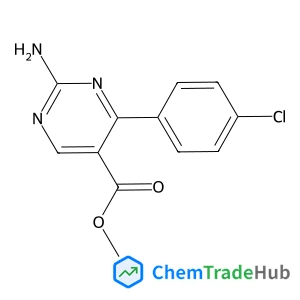
Methyl 2-amino-4-(4-chlorophenyl)-5-pyrimidinecarboxylate
CAS Number:
1133115-56-6
Molecular Formula:
C12H10ClN3O2
J. Kóňa, H. Tokiwa
Golgi α-mannosidase II (GM) is a pharmaceutical target for the design of inhibitors with anticancer activity. The known potent GM inhibitors undergo complex interactions with Zn2+ ions and the active-site amino acids, many of which contain ionisable functional groups. Herein, the physical insight into the ligand⋯receptor interactions has been provided based on energy decomposition techniques: SAPT (symmetry adapted perturbation theory) and FMO-PIEDA (fragment molecular orbital-pair interaction energy decomposition analysis) for a large GM active-site cluster. Protonation-dependent molecular recognition in Golgi α-mannosidase was demonstrated for five inhibitors, mannose, and its transition state. Zn2+ ion and Asp472 induce the key interactions with the deprotonated inhibitors (bearing an amino group in the neutral state), followed by Asp92 and Asp341. This interaction pattern is consistent for all the studied inhibitors and is similar to the interaction pattern of the enzyme native substrate – mannose. The interactions with Zn2+ ion become repulsive for the protonated states of the inhibitors (bearing an amino group with +1 charge) and the mannosyl transition state. The importance of Asp92 and Asp204 considerably increases, while the interactions with Asp472 and Asp341 are slightly modified. The interaction pattern for the protonated ligands seems to have an oxocarbenium transition state-like character, rather than a Michaelis complex of GM. The electrostatic interactions with amino acids coordinating zinc ion are of key importance for both the neutral and protonated states of the inhibitors. The ligand's diol group has a dual role as an electron donor, coordinating zinc ion, and as an electron acceptor, interacting with Asp92 and Asp472 via strong hydrogen bonds. This interaction pattern is an essential structural feature of the potent GM inhibitors, which is consistent with the experimental findings. Based on the calculations, either the protonated or deprotonated state of the ligand may be the active form of the GM inhibitor, exhibiting different interacting patterns.

Journal of Natural Medicines

Russian Journal of Organic Chemistry

Russian Journal of General Chemistry

New Journal of Chemistry

Russian Journal of Bioorganic Chemistry

Journal of Saudi Chemical Society

Russian Chemical Bulletin

Current Opinion in Colloid & Interface Science

Crystallography Reports

Russian Journal of Applied Chemistry
Eric C. Tyo, Melanie Nöβler, Sabine Rabe, Christopher L. Harmon, Roland Mitrić, A. W. Castleman, Jr.
DOI: 10.1039/C2CP23243J
Alberto Baggioli, Orlando Crescenzi, Martin J. Field, Franca Castiglione, Guido Raos
DOI: 10.1039/C2CP43021E
Piet Van Leuven, Valentina Cantatore, Maurizio Persico
DOI: 10.1039/C2CP23128J
Maxim V. Fedorov, R. M. Lynden-Bell
DOI: 10.1039/C2CP22730D
Ewelina Mikolajska, Søren B. Rasmussen, Anna E. Lewandowska, Miguel A. Bañares
DOI: 10.1039/C1CP22608H
Simon Wiktorowski, Georg M. Fischer, Martin J. Winterhalder, Ewald Daltrozzo, Andreas Zumbusch
DOI: 10.1039/C2CP23330D
Peter John Love, Alán Aspuru-Guzik
DOI: 10.1039/C2CP42695A
F. Lufrano, V. Baglio, O. Di Blasi, P. Staiti, V. Antonucci, A. S. Aricò
DOI: 10.1039/C2CP23477G
2-Methylbenzene-1,4-diamine dihydrochloride (CAS: 615-45-2) should be stored in ...
(1S,4S)-2,5-Diazabicyclo[2.2.1]heptane dihydrobromide is generally considered sa...
(6-Chloropyridazin-3-YL)methanamine finds applications in the pharmaceutical ind...
2-Fluoro-3-methylphenol is primarily used in the synthesis of pharmaceuticals, p...
When handling 3-Methoxy-4-nitrobenzonitrile, it is important to wear appropriate...
When handling 1,3-Oxazolo[4,5-b]pyridine-2(3H)-thione (CAS: 211949-57-4), it is ...
4-Ethynylbenzamide (CAS: 90347-86-7) falls under various regulatory guidelines i...
3-(2-Ethylphenyl)-2-thioxo-4-imidazolidinone is primarily used as an intermediat...
(2-Fluoro-6-methoxyphenyl)acetic acid, also known as 4-fluoro-3-methoxybenzoic a...
Market trends for 2-[4-(Hydroxymethyl)phenoxy]ethanol (CAS: 102196-18-9) indicat...

Physical Chemistry Chemical Physics (PCCP) is an international journal co-owned by 19 physical chemistry and physics societies from around the world. This journal publishes original, cutting-edge research in physical chemistry, chemical physics and biophysical chemistry. To be suitable for publication in PCCP, articles must include significant innovation and/or insight into physical chemistry; this is the most important criterion that reviewers and Editors will judge against when evaluating submissions. The journal has a broad scope and welcomes contributions spanning experiment, theory, computation and data science. Topical coverage includes spectroscopy, dynamics, kinetics, statistical mechanics, thermodynamics, electrochemistry, catalysis, surface science, quantum mechanics, quantum computing and machine learning. Interdisciplinary research areas such as polymers and soft matter, materials, nanoscience, energy, surfaces/interfaces, and biophysical chemistry are welcomed if they demonstrate significant innovation and/or insight into physical chemistry. Joined experimental/theoretical studies are particularly appreciated when complementary and based on up-to-date approaches.


![(1R,6R)-6-({[(2-Methyl-2-propanyl)oxy]carbonyl}amino)-3-cyclohexene-1-carboxylic acid structure](https://static.chemtradehub.com/structs/865/865689-24-3-5fef.webp "(1R,6R)-6-({[(2-Methyl-2-propanyl)oxy]carbonyl}amino)-3-cyclohexene-1-carboxylic acid structure")




