













The effect of Sr(OH)2 on the hydrogen storage properties of the Mg(NH2)2–2LiH system
Literature Information
Publication Date
2017-03-01
DOI
10.1039/C7CP00748E
Impact Factor
3.676
Authors
Hujun Cao, Han Wang, Claudio Pistidda, Chiara Milanese, Weijin Zhang, Anna-Lisa Chaudhary, Antonio Santoru, Sebastiano Garroni, Jozef Bednarcik, Hanns-Peter Liermann, Ping Chen, Thomas Klassen, Martin Dornheim
View Original
Abstract
The doping effect of Sr(OH)2 on the Mg(NH2)2–2LiH system is investigated considering different amounts of added Sr(OH)2 in the range of 0.05 to 0.2 mol. Experimental results show that both the thermodynamic and the kinetic properties of Mg(NH2)2–2LiH are influenced by the presence of Sr(OH)2. The addition of 0.1 mol Sr(OH)2 leads to a decrease in both the dehydrogenation onset and peak temperatures of ca. 70 and 13 °C, respectively, and an acceleration in the de/re-hydrogenation rates of one time at 150 °C compared to Mg(NH2)2–2LiH alone. Based on differential scanning calorimetry (DSC) analysis, the overall reaction enthalpy of the 0.1 Sr(OH)2-doped sample is calculated to be 44 kJ per mol-H2 and there are two absorption events occurring in the doped sample instead of one in the pristine sample. For the applied experimental conditions, according to the in situ synchrotron radiation powder X-ray diffraction (SR-PXD) and Fourier Transform Infrared spectroscopy (FT-IR) analysis, the reaction mechanism has been finally defined: Sr(OH)2, Mg(NH2)2 and LiH react with each other to form SrO, MgO and LiNH2 during ball milling. After heating, SrO interacts with Mg(NH2)2 producing MgO and Sr(NH2)2. Then Mg(NH2)2, LiNH2 and Sr(NH2)2 react with LiH to produce Li2NH, SrNH, Li2Mg(NH)2 and Li2Mg2(NH)3 in traces. After re-hydrogenation, LiSrH3, LiH and LiNH2 are formed along with amorphous Mg(NH2)2. The reasons for the improved kinetics are: (a) during dehydrogenation, the in situ formation of SrNH appears to increase the interfacial contacts between Mg(NH2)2 and LiH and also weakens the N–H bond of Mg(NH2)2; (b) during absorption, the formation of LiSrH3 at around 150 °C could be the key factor for improving the hydrogenation properties.
Related Literature
A degradable cross-linked polymer containing dynamic covalent selenide bond
Weihong Lu, Xiangqiang Pan, Zhengbiao Zhang, Jian Zhu, Nianchen Zhou, Xiulin Zhu
2017-06-01
Paper
DOI: 10.1039/C7PY00719A
Opportunities for dual RDRP agents in synthesizing novel polymeric materials
Samuel Pearson, Claude St Thomas, Ramiro Guerrero-Santos, Franck D'Agosto
2017-04-24
Review Article
DOI: 10.1039/C7PY00344G
Poly(acrylamide-homocysteine thiolactone) as a synthetic platform for the preparation of polymeric ionic liquids by post ring-opening-orthogonal modifications
Silvia Montolio, Oleksandr Zagorodko, Raúl Porcar, M. Isabel Burguete, Santiago V. Luis, Heikki Tenhu
2017-07-19
Paper
DOI: 10.1039/C7PY01067B
Sustainable polyvinyl acetals from bioaromatic aldehydes
Mayra Rostagno, Steven Shen, Ion Ghiviriga, Stephen A. Miller
2017-03-24
Paper
DOI: 10.1039/C7PY00205J
Correction: Thermoresponsive gels directly obtained via visible light-mediated polymerization-induced self-assembly with oxygen tolerance
Kaixuan Ren
2017-06-05
Correction
DOI: 10.1039/C7PY90088K
The hydrolytic behavior of N,N′-(dimethylamino)ethyl acrylate-functionalized polymeric stars
Marianne S. Rolph, Anaïs Pitto-Barry, Rachel K. O'Reilly
2017-03-17
Paper
DOI: 10.1039/C7PY00219J
Simultaneous enhancement of performance and insensitivity to active layer thickness for OPVs by functionalizing π-spacer's side chain
Fagui He, Jidong Zhang
2016-07-13
Paper
DOI: 10.1039/C6PY00920D
Photoresponsive liquid crystalline polymer single-chain nanoparticles
Weizheng Fan, Xia Tong, Guo Li, Yue Zhao
2017-05-09
Paper
DOI: 10.1039/C7PY00668C
You might also like
Compound Q&A
What are the main uses of 4-Nitrophenyl phosphate disodium salt hexahydrate (CAS: 333338-18-4)?
4-Nitrophenyl phosphate disodium salt hexahydrate is primarily used as a substra...
333338-18-44-Nitrophenyl phosph...
Compound Q&A
What are the main uses of 2-(Trifluoromethyl)-1,3-oxazole-4-carboxylic Acid (CAS: 1060816-01-4)?
2-(Trifluoromethyl)-1,3-oxazole-4-carboxylic Acid (CAS: 1060816-01-4) is widely ...
1060816-01-42-(Trifluoromethyl)-...
Compound Q&A
How should 2-Fluoro-4-biphenylcarboxylic acid (CAS: 137045-30-8) be stored?
2-Fluoro-4-biphenylcarboxylic acid should be stored in a cool, dry place at room...
137045-30-82-Fluoro-4-biphenylc...
Compound Q&A
What industries use Prednisolone-21-Carboxylic Acid (CAS: 61549-70-0)?
Prednisolone-21-Carboxylic Acid is primarily used in the pharmaceutical industry...
61549-70-0Prednisolone-21-Carb...
Compound Q&A
How should 4-(Hydrazinomethyl)-1,2,3-benzenetriol (CAS: 3614-72-0) be stored?
4-(Hydrazinomethyl)-1,2,3-benzenetriol (CAS: 3614-72-0) should be stored in a co...
3614-72-04-(Hydrazinomethyl)-...
Compound Q&A
What industries use 4-Amino-1-methyl-1H-pyrazole-5-carboxylic acid hydrochloride (CAS: 92534-70-8)?
4-Amino-1-methyl-1H-pyrazole-5-carboxylic acid hydrochloride (CAS: 92534-70-8) i...
92534-70-84-Amino-1-methyl-1H-...
Compound Q&A
What regulatory guidelines apply to dehydropachymic acid (CAS: 77012-31-8)?
Dehydropachymic acid (CAS: 77012-31-8) is regulated by various agencies. It fall...
77012-31-8Dehydropachymic acid
Compound Q&A
What is the market or research trend for 6-[(2,2-Dimethylpropanoyl)amino]nicotinic acid (CAS: 898561-66-5)?
The market and research trends for 6-[(2,2-Dimethylpropanoyl)amino]nicotinic aci...
898561-66-56-[(2,2-Dimethylprop...
Compound Q&A
How should 1,10-Phenanthroline-2,9-dicarbaldehyde (CAS: 57709-62-3) be stored?
1,10-Phenanthroline-2,9-dicarbaldehyde should be stored in a cool, dry place awa...
57709-62-31,10-Phenanthroline-...
Compound Q&A
How is 5-Carbamoyl-11-oxo-10,11-dihydro-5H-dibenzo[b,f]azepin-10-yl acetate (CAS: 113952-21-9) typically synthesized?
5-Carbamoyl-11-oxo-10,11-dihydro-5H-dibenzo[b,f]azepin-10-yl acetate can be synt...
113952-21-95-Carbamoyl-11-oxo-1...
Source Journal
Physical Chemistry Chemical Physics

CiteScore:
5.5
Self-citation Rate:
10.3%
Articles per Year:
3036
Physical Chemistry Chemical Physics (PCCP) is an international journal co-owned by 19 physical chemistry and physics societies from around the world. This journal publishes original, cutting-edge research in physical chemistry, chemical physics and biophysical chemistry. To be suitable for publication in PCCP, articles must include significant innovation and/or insight into physical chemistry; this is the most important criterion that reviewers and Editors will judge against when evaluating submissions. The journal has a broad scope and welcomes contributions spanning experiment, theory, computation and data science. Topical coverage includes spectroscopy, dynamics, kinetics, statistical mechanics, thermodynamics, electrochemistry, catalysis, surface science, quantum mechanics, quantum computing and machine learning. Interdisciplinary research areas such as polymers and soft matter, materials, nanoscience, energy, surfaces/interfaces, and biophysical chemistry are welcomed if they demonstrate significant innovation and/or insight into physical chemistry. Joined experimental/theoretical studies are particularly appreciated when complementary and based on up-to-date approaches.
Recommended Compounds
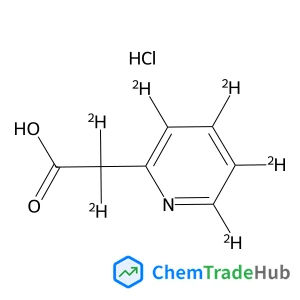
2,2-dideuterio-2-(3,4,5,6-tetradeuterio-2-pyridyl)acetic acid;hydrochloride
CAS Number:
1329799-67-8
Molecular Formula:
C7H2ClD6NO2

Recommended Suppliers





Disclaimer
This page provides academic journal information for reference and research purposes only. We are not affiliated with any journal publishers and do not handle publication submissions. For publication-related inquiries, please contact the respective journal publishers directly.
If you notice any inaccuracies in the information displayed, please contact us at support@chemtradehub.com. We will promptly review and address your concerns.