












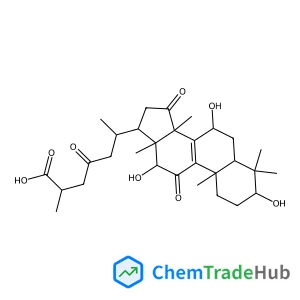
(3beta,7beta,12beta)-3,7,12-Trihydroxy-11,15,23-trioxolanost-8-en-26-oic acid
CAS Number:
98665-22-6
Molecular Formula:
C30H44O8
Ander Camiruaga, Imanol Usabiaga, Aran Insausti, José A. Fernández
Sugars are small carbohydrates which play numerous roles in living organisms such as storage of energy or as structural components. Modifications of specific sites within the glycan chain can modulate a carbohydrate's overall biological function as it happens with nucleic acids and proteins. Hence, identifying discrete carbohydrate modifications and understanding their biological effects is essential. A study of such processes requires of a deep knowledge of the interaction mechanism at the molecular level. Here, we use a combination of laser spectroscopy in jets and quantum mechanical calculations to characterize the interaction between phenyl-β-D-glucopyranoside and N-methylacetamide as a model to understand the interaction between a sugar and a peptide bond. The most stable structure of the molecular aggregate shows that the main interaction between the peptide fragment and the sugar proceeds via a CO⋯H–O2 hydrogen bond. A second conformer was also found, in which the peptide establishes a CO⋯H–O6 hydrogen bond with the hydroxymethyl substituent of the sugar unit. All the conformers present an additional interaction point with the aromatic ring. This particular preference of the peptide for the hydroxyl close to the aromatic ring could explain why glycogenin uses tyrosine in order to convert glucose into glycogen by exposing the O4H hydroxyl group for the other glucoses for the polymerization to take place.
Murad J. Y. Tayebjee, Raphaël G. C. R. Clady, Timothy W. Schmidt
DOI: 10.1039/C3CP52609G
Chia-Shing Wu, Szu-Wen Fang, Yun Chen
DOI: 10.1039/C3CP52087K
Chang-Lyoul Lee, Shinuk Cho, Seung-Hwan Oh, Seung-Hyeon Moon, Ahmed Elbarbary
DOI: 10.1039/C3CP52151F
Harry L. Tuller, Melanie Kuhn, Guido Ciampi, William Higgins, Kanai S. Shah
DOI: 10.1039/C3CP51043C
Chunlei Wang, Fanning Meng, Mingxing Wu, Xiao Lin, Tonghua Wang, Jieshan Qiu, Tingli Ma
DOI: 10.1039/C3CP52525B
Minqiang Hou, Jianling Zhang, Buxing Han, Qingqing Mei, Hui Ning, Dezhong Yang
DOI: 10.1039/C3CP44670K
Dima Vingurt, David Fuks, Miron V. Landau, Roxana Vidruk, Moti Herskowitz
DOI: 10.1039/C3CP51086G
Chuanlang Zhan, Xunlei Ding, Shanlin Zhang, Xin Zhang, Huiying Liu, Lili Chen, Yishi Wu, Hongbing Fu, Shenggui He, Yan Huang, Jiannian Yao
DOI: 10.1039/C3CP51268A
Waste containing N-Methoxy-N-methyl-1,3-thiazole-5-carboxamide (CAS: 898825-89-3...
N-(4-Biphenylyl)dibenzo[b,d]furan-4-amine should be stored in a tightly sealed c...
The market for 3-Acetamido-5-amino-2,4,6-triiodobenzoic acid (CAS: 1713-07-1) is...
Benzyl 2-O-acetyl-3,4,6-tri-O-benzyl-beta-D-galactopyranoside (CAS: 61820-03-9) ...
2-Ethylpiperazine dihydrochloride (CAS: 438050-52-3) is regulated under the Glob...
1,1'-[1,3-Phenylenebis(methylene)]bis(3-methyl-1H-pyrrole-2,5-dione) (CAS: 11946...
Several alternatives can be used in the synthesis of 5-Fluoro-2-(1-pyrrolidinyl)...
Proper personal protective equipment (PPE) must be worn when handling this compo...
When handling 6-Bromoimidazo[1,2-a]pyridin-8-amine, it is important to wear appr...
Alternatives to (2S,4R)-4-(4-Nitrobenzyl)pyrrolidine-2-carboxylic acid hydrochlo...

Physical Chemistry Chemical Physics (PCCP) is an international journal co-owned by 19 physical chemistry and physics societies from around the world. This journal publishes original, cutting-edge research in physical chemistry, chemical physics and biophysical chemistry. To be suitable for publication in PCCP, articles must include significant innovation and/or insight into physical chemistry; this is the most important criterion that reviewers and Editors will judge against when evaluating submissions. The journal has a broad scope and welcomes contributions spanning experiment, theory, computation and data science. Topical coverage includes spectroscopy, dynamics, kinetics, statistical mechanics, thermodynamics, electrochemistry, catalysis, surface science, quantum mechanics, quantum computing and machine learning. Interdisciplinary research areas such as polymers and soft matter, materials, nanoscience, energy, surfaces/interfaces, and biophysical chemistry are welcomed if they demonstrate significant innovation and/or insight into physical chemistry. Joined experimental/theoretical studies are particularly appreciated when complementary and based on up-to-date approaches.

![N-[(Benzyloxy)carbonyl]serine structure](https://static.chemtradehub.com/structs/276/2768-56-1-77f7.webp "N-[(Benzyloxy)carbonyl]serine structure")



