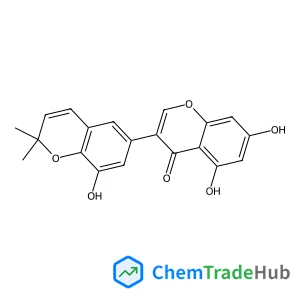
5,7,8'-Trihydroxy-2',2'-dimethyl-2'H,4H-3,6'-bichromen-4-one
CAS Number:
129280-33-7
Molecular Formula:
C20H16O6
Aurellia Galliot, Adrià Gil, Maria José Calhorda
The effects of oxygen in positions 4,7 and 5,6 of phenanthroline when this ligand intercalates between guanine–cytosine and adenine–thymine DNA base pairs (GC/CG and AT/TA) have been studied at the M06-2X/6-31+G(d,p) level of calculation. We focused on the changes in the structure, stabilization and energy contributions in the analysis of the interaction. The obtained trends in stabilization are explained by a model including repulsive Pauli (ΔEPauli) contributions, and attractive dispersion (ΔEdisp), orbital (ΔEorb) and electrostatic (ΔEelstat) contributions to energy. When no solvation is considered, the intrinsic ΔEelstat contribution results are crucial for the stabilization of the system. However, the inclusion of the solvation energy ΔEsolv can reverse the final stability trend of the systems becoming, thus, the driving force of the process. Therefore, the solvent will have a relevant influence in the potential cytotoxicity of the intercalation drugs.
Chang You, Tingting Yuan, Yanzhen Huang, Chao Pi, Yangjie Wu, Xiuling Cui
DOI: 10.1039/C8OB01108G
Xiu Yang, Wei-Dong Meng, Xiu-Hua Xu, Yangen Huang
DOI: 10.1039/D1QO01170G
Wenzheng Zhang, Guangyang Xu, Lin Qiu, Jiangtao Sun
DOI: 10.1039/C8OB00826D
Xiaolong Zhu, Xuan Li, Enjie Zhu, Qirong Deng, Xiuyan Song, Jian Lv
DOI: 10.1039/D1QO01570B
Yabo Deng, Yongzhen Li, Yalan Wang, Shuo Sun, Sichao Ma, Pengfei Jia, Wenguang Li, Kairong Wang, Wenjin Yan
DOI: 10.1039/D1QO01392K
Qing-Yan Wu, Qing-Qiang Min, Gui-Zhen Ao
DOI: 10.1039/C8OB01641K
Ida M. B. Knudsen, Christinne Hedberg, Daisuke Ide, Anne Brinkø, Espen Z. Eikeland, Atsushi Kato, Henrik H. Jensen
DOI: 10.1039/C8OB01433G
Gérard Audran, Mitchell T. Blyth, Michelle L. Coote, Georg Gescheidt, Micael Hardy, Jeffrey Havot, Maxence Holzritter, Samuel Jacoutot, Jean-Patrick Joly, Sylvain R. A. Marque, Tataye Moussounda Moussounda Koumba, Dmytro Neshchadin, Enzo Vaiedelich
DOI: 10.1039/D1QO01276B
Qing-Zhu Li, Jun-Long Li, Bin Zhang, Zhen Dai, Ke Xie, Rong Zeng, Liang Zou, Xiang Zhang
DOI: 10.1039/D1QO01543E
Jian Huang, Wei Chen, Jiazhi Liang, Qin Yang, Zhihong Deng, Zhibin Song, Yiyuan Peng
DOI: 10.1039/D1QO01186C
(1R,3S)-1,3-Cyclopentanediol finds applications in various industries. In the ph...
When handling N'-[4-(Dimethylamino)phenyl]-N,N-dimethyl-1,4-benzenediamine, it i...
There are several alternatives to 5-(2,4-Difluorophenyl)-2-methoxypyrimidine in ...
1-(3-Methoxyphenoxy)propan-2-ol (CAS: 382141-68-6) must comply with the Globally...
Tetrodotoxin Citrate is extremely dangerous and should be handled with extreme c...
2-Methyl-2-propanyl [(1R,3S)-3-hydroxycyclopentyl]carbamate (CAS: 225641-84-9) i...
Waste containing 4-(2-Hydroxyhexafluoroisopropyl)Benzoic Acid (CAS: 16261-80-6) ...
2-Methyl-2-proanyl {(2S)-1-[(benzyloxy)amino]-3-hydroxy-3-methyl-1-oxo-2-butanyl...
Benzeneethanamine, α-ethyl-, hydrochloride (1:1) is an organic compound with the...
In the synthesis of compounds similar to 3-{(E)-[4-(Dimethylamino)phenyl]diazeny...

Physical Chemistry Chemical Physics (PCCP) is an international journal co-owned by 19 physical chemistry and physics societies from around the world. This journal publishes original, cutting-edge research in physical chemistry, chemical physics and biophysical chemistry. To be suitable for publication in PCCP, articles must include significant innovation and/or insight into physical chemistry; this is the most important criterion that reviewers and Editors will judge against when evaluating submissions. The journal has a broad scope and welcomes contributions spanning experiment, theory, computation and data science. Topical coverage includes spectroscopy, dynamics, kinetics, statistical mechanics, thermodynamics, electrochemistry, catalysis, surface science, quantum mechanics, quantum computing and machine learning. Interdisciplinary research areas such as polymers and soft matter, materials, nanoscience, energy, surfaces/interfaces, and biophysical chemistry are welcomed if they demonstrate significant innovation and/or insight into physical chemistry. Joined experimental/theoretical studies are particularly appreciated when complementary and based on up-to-date approaches.
![N-[(9H-Fluoren-9-ylmethoxy)carbonyl]-beta-phenyl-L-phenylalanine structure](https://static.chemtradehub.com/structs/201/201484-50-6-c2fc.webp "N-[(9H-Fluoren-9-ylmethoxy)carbonyl]-beta-phenyl-L-phenylalanine structure")