


Homolysis/mesolysis of alkoxyamines activated by chemical oxidation and photochemical-triggered radical reactions at room temperature
Literature Information
Publication Date
2021-10-14
DOI
10.1039/D1QO01276B
Impact Factor
5.281
Authors
Gérard Audran, Mitchell T. Blyth, Michelle L. Coote, Georg Gescheidt, Micael Hardy, Jeffrey Havot, Maxence Holzritter, Samuel Jacoutot, Jean-Patrick Joly, Sylvain R. A. Marque, Tataye Moussounda Moussounda Koumba, Dmytro Neshchadin, Enzo Vaiedelich
View Original
Abstract
Alkoxyamines, which are connected with a phenol moiety by a (substituted) methylene bridge undergo homolytic cleavage upon chemical oxidation or a photo-induced hydrogen transfer. This selectively triggered reaction yields a nitroxide radical. In the presence of an excess of lead dioxide as the oxidant in tert-butylbenzene as solvent, spontaneous, instantaneous and almost quantitative generations of nitroxides from various alkoxyamines are observed at room temperature, which support activation energies for the cleavage lower than 100 kJ mol−1. The rate and the amount of released nitroxide depend on the amount of “catalyst” and the structure of alkoxyamines.
Recommended Journals

Acta Metallurgica Sinica-English Letters

Herald of the Russian Academy of Sciences

Chinese Journal of Chemistry

Colloid Journal

Cellulose

Critical Reviews in Solid State and Materials Sciences

Topics in Catalysis

Atomization and Sprays

Bioorganic & Medicinal Chemistry

Journal of Asian Natural Products Research
Related Literature
A metal-free synthesis of 1,1-diphenylvinylsulfides with thiols via thioetherification under continuous-flow conditions
Jiawei Zhang, Erfei Wang, Yang Zhou, Lu Zhang, Mao Chen, Xinrong Lin
2020-05-11
Research Article
DOI: 10.1039/D0QO00432D
A metal-free visible-light-promoted phosphorylation/cyclization reaction in water towards 3-phosphorylated benzothiophenes
Xiao-Ya Yuan, Fan-Lin Zeng, Hu-Lin Zhu, Qi-Yan Lv, Xiao-Lan Chen, Lifen Peng, Bing Yu
2020-06-17
Research Article
DOI: 10.1039/D0QO00222D
Targeted isolation of two disesquiterpenoid macrocephadiolides A and B from Ainsliaea macrocephala using a molecular networking-based dereplication strategy
Shuai-Zhen Zhou, Tian Zhang, Meijia Qian, Rui Zhang, Sheng Yao, Hong Zhu, Chunping Tang, Ligen Lin
2020-05-09
Research Article
DOI: 10.1039/D0QO00030B
Direct synthesis of 2,4,5-trisubstituted imidazoles from primary alcohols by diruthenium(ii) catalysts under aerobic conditions
Saranya Sundar, Ramesh Rengan
2019-01-09
Paper
DOI: 10.1039/C8OB02785D
Direct organocatalytic asymmetric Michael reaction of fluorine hemiaminal-type nucleophile to 4-nitro-5-styrylisoxazoles
Luyao Li, Bo Zhu, Huihui Fan, Zhiyong Jiang, Junbiao Chang
2020-04-17
Research Article
DOI: 10.1039/D0QO00348D
Direct (het)arylation of tetrahydroisoquinolines via a metal and oxidant free C(sp3)–H functionalization enabled three component reaction
Surajit Haldar, Chandan K. Jana
2018-11-26
Communication
DOI: 10.1039/C8OB02309C
The key role of protodeauration in the gold-catalyzed reaction of 1,3-diynes with pyrrole and indole to form complex heterocycles
Ioannis Stylianakis, Antonios Kolocouris
2020-03-17
Research Article
DOI: 10.1039/C9QO01544B
Expeditious access of chromone analogues via a Michael addition-driven multicomponent reaction
Liu-Jun He, Ya-Fei Luo, Dian-Yong Tang, Wei Yan, Hui-Kuan Lin, Hong-yu Li, Zhong-Zhu Chen, Zhi-Gang Xu
2020-03-06
Research Article
DOI: 10.1039/D0QO00145G
You might also like
Compound Q&A
What industries use (1R,3S)-1,3-Cyclopentanediol (CAS: 16326-97-9)?
(1R,3S)-1,3-Cyclopentanediol finds applications in various industries. In the ph...
16326-97-9(1R,3S)-1,3-Cyclopen...
Compound Q&A
What precautions should be taken when handling N'-[4-(Dimethylamino)phenyl]-N,N-dimethyl-1,4-benzenediamine (CAS: 637-31-0)?
When handling N'-[4-(Dimethylamino)phenyl]-N,N-dimethyl-1,4-benzenediamine, it i...
637-31-0N'-[4-(Dimethylamino...
Compound Q&A
Are there alternatives to 5-(2,4-Difluorophenyl)-2-methoxypyrimidine (CAS: 1352318-16-1) in synthesis?
There are several alternatives to 5-(2,4-Difluorophenyl)-2-methoxypyrimidine in ...
1352318-16-15-(2,4-Difluoropheny...
Compound Q&A
What regulatory guidelines apply to 1-(3-Methoxyphenoxy)propan-2-ol (CAS: 382141-68-6)?
1-(3-Methoxyphenoxy)propan-2-ol (CAS: 382141-68-6) must comply with the Globally...
382141-68-61-(3-Methoxyphenoxy)...
Compound Q&A
Is Tetrodotoxin Citrate (CAS: 18660-81-6) safe?
Tetrodotoxin Citrate is extremely dangerous and should be handled with extreme c...
18660-81-6Tetrodotoxin Citrate
Compound Q&A
What are the main uses of 2-Methyl-2-propanyl [(1R,3S)-3-hydroxycyclopentyl]carbamate (CAS: 225641-84-9)?
2-Methyl-2-propanyl [(1R,3S)-3-hydroxycyclopentyl]carbamate (CAS: 225641-84-9) i...
225641-84-92-Methyl-2-propanyl ...
Compound Q&A
How should waste containing 4-(2-Hydroxyhexafluoroisopropyl)Benzoic Acid (CAS: 16261-80-6) be handled?
Waste containing 4-(2-Hydroxyhexafluoroisopropyl)Benzoic Acid (CAS: 16261-80-6) ...
16261-80-64-(2-Hydroxyhexafluo...
Compound Q&A
How is 2-Methyl-2-proanyl {(2S)-1-[(benzyloxy)amino]-3-hydroxy-3-methyl-1-oxo-2-butanyl}carbamate (CAS: 102507-19-7) typically synthesized?
2-Methyl-2-proanyl {(2S)-1-[(benzyloxy)amino]-3-hydroxy-3-methyl-1-oxo-2-butanyl...
102507-19-72-Methyl-2-propanyl ...
Compound Q&A
What is Benzeneethanamine, α-ethyl-, hydrochloride (1:1) (CAS: 20735-15-3)?
Benzeneethanamine, α-ethyl-, hydrochloride (1:1) is an organic compound with the...
20735-15-3Benzeneethanamine, α...
Compound Q&A
Are there alternatives to 3-{(E)-[4-(Dimethylamino)phenyl]diazenyl}benzoic acid (CAS: 20691-84-3) in synthesis?
In the synthesis of compounds similar to 3-{(E)-[4-(Dimethylamino)phenyl]diazeny...
20691-84-33-{(E)-[4-(Dimethyla...
Source Journal
Organic Chemistry Frontiers

CiteScore:
7.8
Self-citation Rate:
8.7%
Articles per Year:
724
Organic Chemistry Frontiers publishes high-quality research from across organic chemistry. Emphases are placed on studies that make significant contributions to the field of organic chemistry by reporting either new or significantly improved protocols or methodologies. Topics include, but are not limited to the following: Organic synthesis Development of synthetic methodologies Catalysis Natural products Functional organic materials Supramolecular and macromolecular chemistry Physical and computational organic chemistry
Recommended Compounds
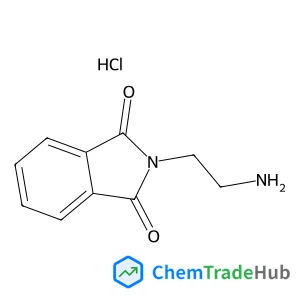
2-(2-Aminoethyl)-1H-isoindole-1,3(2H)-dione hydrochloride (1:1)
CAS Number:
30250-67-0
Molecular Formula:
C10H11ClN2O2
Recommended Suppliers





Disclaimer
This page provides academic journal information for reference and research purposes only. We are not affiliated with any journal publishers and do not handle publication submissions. For publication-related inquiries, please contact the respective journal publishers directly.
If you notice any inaccuracies in the information displayed, please contact us at support@chemtradehub.com. We will promptly review and address your concerns.