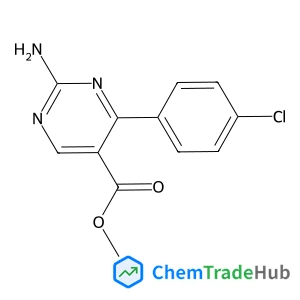
Methyl 2-amino-4-(4-chlorophenyl)-5-pyrimidinecarboxylate
CAS Number:
1133115-56-6
Molecular Formula:
C12H10ClN3O2
Ellen M. Adams, Bethany A. Wellen, Raphael Thiraux, Sandeep K. Reddy, Andrew S. Vidalis, Francesco Paesani, Heather C. Allen
Sea spray aerosols (SSA) are known to have an organic coating that is mainly composed of fatty acids. In this study, the effect of pH and salt on the stability and organization of a palmitic acid (PA) monolayer is investigated by surface vibrational spectroscopy and molecular dynamics simulations. Results indicate that alkyl chain packing becomes more disordered as the carboxylic headgroup becomes deprotonated. This is associated with packing mismatch of charged and neutral species as charged headgroups penetrate deeper into the solution phase. At pH 10.7, when the monolayer is ∼99% deprotonated, palmitate (PA−) molecules desorb and solubilize into the bulk solution where there is spectroscopic evidence for aggregate formation. Yet, addition of 100 mM NaCl to the bulk solution is found to drive PA− molecules to the aqueous surface. Free energy calculations show that PA− molecules become stabilized within the interface with increasing NaCl concentration. Formation of contact –COO−:Na+ pairs alters the hydration state of PA− headgroups, thus increasing the surface propensity. As salts are highly concentrated in SSA, these results suggest that deprotonated fatty acids may be found at the air–aqueous interface of aerosol particles due to sea salt's role in surface stabilization.
Aleena Pious, Shreya Muthukumar, Dharshini Karnan Singaravelu, Periyappan Nantheeswaran, Mariappan Mariappan, Arvind Sivasubramanian, Fuad Ameen, Anbazhagan Veerappan
DOI: 10.1039/D3NJ04494G
Zejie Yu, Yi Wang, Miaomiao Cai, Jiachang Chen, Qirong Zou, Quli Fan, Lei Zhang
DOI: 10.1039/D3TB02255B
Jiangtao Yu, Linhua Zhu, Xiaoxiao Yu, Jixing Liu, Jingzhou Yin, Peiwen Wu, Jian Liu
DOI: 10.1039/D3NJ04023B
Charles C. Chusuei, Ram Chandra Nepal
DOI: 10.1039/D3NJ04054B
Mohamed Saadi, Imen Dakhlaoui, Fadhel Hajlaoui, Nidhal Drissi, Mustapha Zighrioui, Fethi Jomni, Nathalie Audebrand, Marie Cordier
DOI: 10.1039/D3NJ04819E
Wei-Nan Zhao, Hongjuan Li, Shiguo Sun, Yongqian Xu
DOI: 10.1039/D3TB01564E
Francisco Gámez, Roberto Gallardo, Manuel Pernia Leal
DOI: 10.1039/D3TB01821K
Chunyu Shao, Xiuyan Gong, Dongxiang Zhang, Xin-Dong Jiang, Jianjun Du, Guiling Wang
DOI: 10.1039/D3TB02132G
6-(3-Fluorophenyl)picolinic acid is generally considered safe for laboratory use...
(3R)-3-Pyrrolidinol is used in the pharmaceutical industry as a precursor for dr...
When handling (4R,5R)-4,5-Diethoxycarbonyl-2,2-dimethyldioxolane (CAS: 59779-75-...
1-(6-Chloroimidazo[1,2-b]pyridazin-3-yl)ethanone is often synthesized via a mult...
The market for N-Ethyl-3,4-dimethylbenzylamine (CAS: 39180-83-1) remains steady,...
Tert-butyl 3-(pyrrolidin-1-yl)azetidine-1-carboxylate is a chemical compound wit...
1-Bromo-3-chloro-2,4-dimethoxybenzene (CAS: 1228956-93-1) falls under the classi...
The safety of 8-Bromo-2-methyl-3,4-dihydroisoquinolin-1(2H)-one (CAS: 1368622-07...
Benzyl [(3S)-2,6-dioxo-3-piperidinyl]carbamate is generally safe when handled wi...
1-{[4-(4,4,5,5-Tetramethyl-1,3,2-dioxaborolan-2-yl)phenyl]sulfonyl}pyrrolidine s...

Physical Chemistry Chemical Physics (PCCP) is an international journal co-owned by 19 physical chemistry and physics societies from around the world. This journal publishes original, cutting-edge research in physical chemistry, chemical physics and biophysical chemistry. To be suitable for publication in PCCP, articles must include significant innovation and/or insight into physical chemistry; this is the most important criterion that reviewers and Editors will judge against when evaluating submissions. The journal has a broad scope and welcomes contributions spanning experiment, theory, computation and data science. Topical coverage includes spectroscopy, dynamics, kinetics, statistical mechanics, thermodynamics, electrochemistry, catalysis, surface science, quantum mechanics, quantum computing and machine learning. Interdisciplinary research areas such as polymers and soft matter, materials, nanoscience, energy, surfaces/interfaces, and biophysical chemistry are welcomed if they demonstrate significant innovation and/or insight into physical chemistry. Joined experimental/theoretical studies are particularly appreciated when complementary and based on up-to-date approaches.