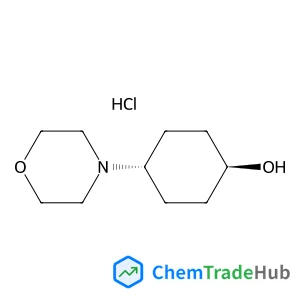
trans-4-(4-Morpholinyl)cyclohexanol hydrochloride (1:1)
CAS Number:
1588441-09-1
Molecular Formula:
C10H20ClNO2
Jing Li, Meng Cheng, Mei-Jin Li
A sensitive assay was demonstrated for the colorimetric and luminescent detection of heparin. Positively charged [Ru(phen)2np]2+ (np: naphtho[2,3-f][1,10]phenanthroline) can interact with negatively charged AuNPs through electrostatic interaction, leading to the luminescence quenching of [Ru(phen)2np]2+via energy transfer as well as the aggregation of AuNPs together with a color change in solution from red to blue. Upon the addition of negatively charged heparin to gold nanoparticles functionalized by ruthenium(II) complexes, the emission of [Ru(phen)2np]2+ recovered due to the competitive adsorption of [Ru(phen)2np]2+ to heparin and AuNPs. A linear calibration curve was obtained in the 0.4 μM to 100 μM range and 0.1 μM to 6 μM with a low detection limit of 0.22 μM and 0.024 μM based on 3σ/s for heparin quantification in buffer solution and in 1% fetal bovine serum (FBS), respectively. Interestingly, the naked eye alone can judge the presence of 0.02 μM heparin without the aid of any advanced instruments by color change. Thus a convenient and visual method to detect heparin was established.
DOI: 10.1039/D1CP03842G
Cristina Cantarutti, M. Cristina Vargas, Mireille Dumoulin, Sara La Manna, Daniela Marasco, Carlo Santambrogio, Rita Grandori, Giacinto Scoles, Alessandra Corazza
DOI: 10.1039/D1CP02536H
K. V. S. Dheeraj, Sarith P. Sathian
DOI: 10.1039/D1CP02771A
Yanan Wang, Tomoya Taguchi, Huan Li, Ai Suzuki, Yanting Zhang, Akari Miura, Mitsuki Ikeda, Hidenori Goto, Ritsuko Eguchi, Takafumi Miyazaki, Yen-Fa Liao, Hirofumi Ishii, Yoshihiro Kubozono
DOI: 10.1039/D1CP00042J
Wengan He, Danhong Liang, Hongjuan Diao, Ruibo Wu
DOI: 10.1039/D1CP01954F
Yu Sha, Xiaobing Zhang
DOI: 10.1039/D1CP03317D
Xue-fang Yu, Ting-he Fu, Bo Xiao, Hong-yuan Yu, Qingzhong Li
DOI: 10.1039/D1CP00030F
Siavash Zare, Mohammad Javad Abdolhosseini Qomi
DOI: 10.1039/D1CP02627E
Xiaozhi Bao, Tian Sun, Yan Liu, Chuan Xu, Weiliang Ma, Junpo Guo, Yun Zheng, Shivananju Bannur Nanjunda, Huating Liu, Zongyu Huang, Shenghuang Lin, Guichuan Xing, Wencai Ren, Qiaoliang Bao, Huaiyu Shao
DOI: 10.1039/D1CP03536C
Luca Bergamasco, Matteo Morciano, Matteo Fasano
DOI: 10.1039/D1CP00708D
Ethyl 4-chlorothieno[2,3-b]pyridine-5-carboxylate (CAS: 59713-58-5) can be synth...
5-Methyl-1H-indole-3-carbaldehyde (CAS: 52562-50-2) is subject to various regula...
(1,3-Dimethyl-2,4-dioxo-1,2,3,4-tetrahydro-5-pyrimidinyl)boronic acid is a white...
Waste containing Sulfocostunolide A (CAS: 1016983-51-9) should be handled with c...
When handling Murraxocin (CAS: 88478-44-8), ensure proper personal protective eq...
Formvar (CAS: 63148-64-1) is an alkyd resin characterized by a high molecular we...
(S)-4-benzyl-2-((benzyloxy)methyl)morpholine is generally safe when handled with...
Methyl 1-(5-bromo-2-pyrimidinyl)cyclopropanecarboxylate (CAS: 1447607-69-3) is p...
2-Methyl-1-phenyl-1-propanamine hydrochloride (CAS: 24290-47-9) is generally con...
3-(4-Bromophenyl)-2-methylpropanoic acid is synthesized through a multi-step pro...

Analyst publishes analytical and bioanalytical research that reports premier fundamental discoveries and inventions, and the applications of those discoveries, unconfined by traditional discipline barriers.