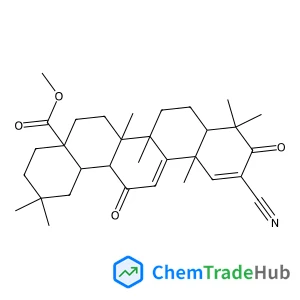
Methyl 2-cyano-3,12-dioxooleana-1,9(11)-dien-28-oate
CAS Number:
218600-53-4
Molecular Formula:
C32H43NO4
Shuang Wang, Chonggao Liu, Heng Zhou, Chengqiang Gao
A new strategy to prepare thermoresponsive molecular bottlebrushes of poly[o-aminobenzyl alcohol-graft-poly(N-isopropylacrylamide)] [P(oABA-g-PNIPAM)] via the grafting-through approach by combination of the RAFT polymerization and acid-catalyzed polymerization of aniline derivatives is proposed. Ascribed to the efficient acid-catalyzed polymerization, the present strategy affords the convenient synthesis of the thermoresponsive molecular bottlebrushes of P(oABA-g-PNIPAM). In the molecular bottlebrushes of P(oABA-g-PNIPAM), the thermoresponsive poly(N-isopropylacrylamide) (PNIPAM) chains are densely grafted to the poly(o-aminobenzyl alcohol) backbone, which leads to strong steric repulsion among the side chains of PNIPAM and therefore retards the soluble-to-insoluble phase transition of the tethered PNIPAM chains. It is found that the soluble-to-insoluble phase transition of P(oABA-g-PNIPAM) takes place at a higher lower critical solution temperature (LCST) than that of the linear PNIPAM counterparts, and the PNIPAM side chains in P(oABA-g-PNIPAM) are just partly dehydrated even at the temperature above LCST, which is different from the linear PNIPAM counterparts.
Ryusuke Futamura, Miguel Jorge, José R. B. Gomes
DOI: 10.1039/C3CP50193K
Joseph W. DePalma, Andrew J. Horan, Wiley A. Hall IV, Murray V. Johnston
DOI: 10.1039/C3CP44586K
Zoran Marković, Dragan Amić, Dejan Milenković, Jasmina M. Dimitrić-Marković, Svetlana Marković
DOI: 10.1039/C3CP44605K
Giancarlo Cicero, Bruno Camino, Stefano Bianco, Anna Maria Ferrari, Barbara Ballarin, Claudia Barolo
DOI: 10.1039/C3CP50559F
T. J. A. Wolf, R. Radloff, P. Lang, A. Stolow, A.-N. Unterreiner
DOI: 10.1039/C3CP44295K
Kirsten Harth, Ralf Stannarius
DOI: 10.1039/C3CP44055A
Terry D. Humphries, Derek Birkmire, Bjørn C. Hauback, G. Sean McGrady, Craig M. Jensen
DOI: 10.1039/C3CP50777G
Mega Kar, Bjorn Winther-Jensen, Maria Forsyth, Douglas R. MacFarlane
DOI: 10.1039/C3CP51102B
Xiaowei Li, Shunhong Zhang, Qian Wang
DOI: 10.1039/C3CP44660C
Alex Domingo, Martin Vérot, Fernando Mota, Juan J. Novoa, Vincent Robert
DOI: 10.1039/C3CP44647F
When handling 4-(2-Furylmethyl)thiomorpholine 1,1-dioxide (CAS: 79206-94-3), it ...
When handling 4-Chloro-N-[2-(4-morpholinyl)ethyl]benzamide (CAS: 71320-77-9), it...
Waste containing this compound (CAS: 62921-74-8) should be handled according to ...
Waste containing (S)-Methyl 2-amino-3-cyclohexylpropanoate should be collected i...
This compound can be synthesized using a multi-step process involving the conjug...
There are several alternatives to (2E)-3-(3,4-Dichlorophenyl)acrylic acid in syn...
Ethyl 6-(2-nitrophenyl)imidazo[2,1-b][1,3]thiazole-3-carboxylate (CAS: 925437-84...
Waste containing 2-(1,3-Thiazol-2-yl)ethanamine (CAS: 18453-07-1) should be coll...
Methyl 5-iodo-2-methylbenzoate can be synthesized through the iodination of meth...
5-Chloro[1,2,4]triazolo[1,5-a]pyridine is commonly synthesized via the condensat...

Polymer Chemistry welcomes submissions in all areas of polymer science that have a strong focus on macromolecular chemistry. Manuscripts may cover a broad range of fields, yet no direct application focus is required.