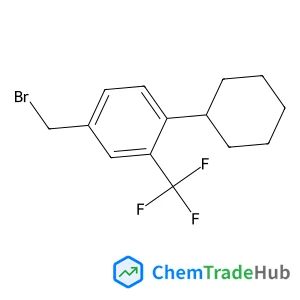
4-(Bromomethyl)-1-cyclohexyl-2-(trifluoromethyl)benzene
CAS Number:
800381-60-6
Molecular Formula:
C14H16BrF3
Xiang Hao, Xinquan Hu, Cun-Yue Guo
A new family of strained imino-cyclopenta[b]pyridines, 7-(ArN)-6-Me2C8H5N (Ar = 2,6-Me2Ph (L1), 2,6-Et2Ph (L2), 2,4,6-Me3Ph (L3), 2,6-Et2-4-MePh (L4), 2,6-i-Pr2Ph (L5)), have been synthesized in reasonable yield by a sequence of reactions from 2-chloro-cyclopenta[b]pyridin-7-one. Treatment of L1 and L3 with NiCl2·6H2O generates mononuclear bis-ligated [7-(ArN)-6-Me2C8H5N]2NiCl2 (Ar = 2,6-Me2Ph (Ni1), 2,4,6-Me3Ph (Ni3)), while with L2 and L4, the chloride-bridged binuclear complexes [7-(ArN)-6-Me2C8H5N]2Ni2(μ-Cl)2Cl2 (Ar = 2,6-Et2Ph (Ni2), 2,6-Et2-4-MePh (Ni4)), have been isolated; no apparent reaction occurred with L5. On activation with either MAO or MMAO, Ni1–Ni4 exhibited high activities towards ethylene polymerization with Ni3 the most active (5.02 × 10⁶ g PE per mol Ni per h at 20 °C); rapid regeneration of the active species (3096–5478 h−1 at 20 °C) is a feature of their catalytic performance. A detailed microstructural analysis of the polyethylenes reveals the presence of vinyl and higher levels of internal vinylene groups indicative of high rates of chain isomerization, e.g., the ratio of (–CHCH–) to (H2CCH–) groups is 2.2 : 1 using Ni3/MAO at 60 °C. Agostic interactions involving γ-, δ- and higher-hydrogens are inferred in addition to β-hydrogen elimination to account for the vinylene groups and the longer chain alkyl branches. The molecular structures of Ni1 and Ni2·2MeOH are also reported.

Current Pharmaceutical Biotechnology

Journal of Medical Biochemistry

Advanced Engineering Materials

Mini-Reviews in Medicinal Chemistry

Nature Reviews Drug Discovery

Faraday Discussions

Physical Chemistry Chemical Physics

European Journal of Organic Chemistry

Environmental Toxicology and Pharmacology

Contact Lens & Anterior Eye
David Rayeroux, Vincent Lapinte, Jean-Jacques Robin, Cécile Bouilhac
DOI: 10.1039/C7PY00632B
Tongmou Geng, Weiyong Zhang, Zongming Zhu, Guofeng Chen, Lanzhen Ma, Sainan Ye, Qingyuan Niu
DOI: 10.1039/C7PY01834G
Haitao Wang, Martin Möller
DOI: 10.1039/C7PY01264K
E. Lestini, L. D. Blackman, C. M. Zammit, R. J. Williams, M. Inam, B. Couturaud, R. K. O'Reilly
DOI: 10.1039/C7PY02050C
Abdel Khoukh, Pablo Taboada, Kamel Chougrani, Valérie Alard
DOI: 10.1039/C8PY00146D
Coralie M. Backlund, Federica Sgolastra, Ronja Otter, Toshihide Takeuchi, Shiroh Futaki
DOI: 10.1039/C7PY90169K
Rui Chen, Xiaoying Gao, Xiao Cheng, Anjun Qin, Jing Zhi Sun
DOI: 10.1039/C7PY01378G
DOI: 10.1039/C8PY00265G
Jian Zhang, Wenxue Dai, Youliang Zhao
DOI: 10.1039/C7PY01638G
Vasiliki Nikolaou, Fehaid Alsubaie, Alexandre Simula, David J. Fox, David M. Haddleton
DOI: 10.1039/C7PY90190A
When handling lithium chloride hydrate (1:1:1) (CAS: 16712-20-2), it is importan...
4-(4H-1,2,4-Triazol-4-yl)piperidine is generally considered safe for use in phar...
Waste containing 1,3-Thiazole-2-carboxamide (CAS: 16733-85-0) should be collecte...
5-(Difluoromethyl)-2-fluorobenzonitrile (CAS: 934175-58-3) is subject to regulat...
Methyl 3-acetamido-2-thiophenecarboxylate can be synthesized by the reaction of ...
4-Isoquinolinecarbonitrile is a chemical compound with the CAS number 34846-65-6...
Store Methyl 1H-1,2,3-triazole-4-carboxylate (CAS: 877309-59-6) in a cool, dry p...
6-Bromo[1,3]thiazolo[5,4-b]pyridin-2-amine (CAS: 1160791-13-8) is subject to the...
(2S,3S)-2-Ammonio-3-(3,4-dihydroxyphenyl)-3-hydroxypropanoate (CAS: 23651-95-8) ...
7-Bromo-3-methyl-3,4-dihydroquinazolin-4-one is a solid with a crystalline form....

Polymer Chemistry welcomes submissions in all areas of polymer science that have a strong focus on macromolecular chemistry. Manuscripts may cover a broad range of fields, yet no direct application focus is required.
![tert-butyl 8-benzyl-2,8-diazaspiro[4.5]decane-2-carboxylate structure](https://static.chemtradehub.com/structs/336/336191-16-3-bb55.webp "tert-butyl 8-benzyl-2,8-diazaspiro[4.5]decane-2-carboxylate structure")