


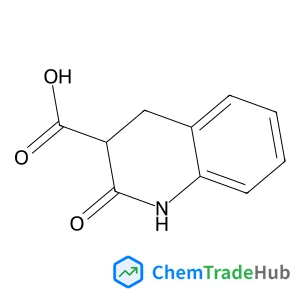
2-Oxo-1,2,3,4-tetrahydro-3-quinolinecarboxylic acid
CAS Number:
246867-17-4
Molecular Formula:
C10H9NO3
M. F. Knopper
We characterize the structure and mechanical properties of 1,3,5-benzenetricarboxamide (BTA) supramolecular polymers using correlative AFM and fluorescence imaging. AFM allows for nanoscale structural investigation but we found that statistical analysis is difficult because these structures are easily disrupted by the AFM tip. We therefore correlate AFM and fluorescence microscopy to couple nanoscale morphological information to far-field optical images. A fraction of the immobilized polymers are in a clustered or entangled state, which we identify based on diffraction limited fluorescence images. We find that clustered and entangled polymers exhibit a significantly longer persistence length that is broader distributed than single unentangled polymers. By comparison with numerical simulations we find significant heterogeneity in the persistence length of single unentangled polymers, which we attribute to polymer–substrate interactions and the presence of structural diversity within the polymer.

Environmental Toxicology and Pharmacology

Current Pharmaceutical Biotechnology

Mini-Reviews in Medicinal Chemistry

Photochemical & Photobiological Sciences

Angewandte Chemie International Edition

Lab on a Chip

Molecules

Foundations of Chemistry

Advanced Engineering Materials

Journal of Enzyme inhibition and Medicinal Chemistry
M. Jotkar, L. Rongy, A. De Wit
DOI: 10.1039/C9CP03044A
Andrés F. Marmolejo-Valencia, Zaahel Mata-Pinzón, Laura Dominguez, Carlos Amador-Bedolla
DOI: 10.1039/C9CP04041B
Arifin Luthfi Maulana, Refaldi Intri Dwi Putra
DOI: 10.1039/C9CP02970B
Suparna Khatun, Anurag Singh, Debabrata Mandal, Amar Nath Gupta
DOI: 10.1039/C9CP03238J
Jing Cui, Xueying Zhang, Lingpeng Meng, Qingzhong Li
DOI: 10.1039/C9CP03686E
Gregor Klinser, Roman Zettl, Heinz Krenn, Roland Würschum
DOI: 10.1039/C9CP04045E
Narcisse T. Tsona, Shanshan Tang, Lin Du
DOI: 10.1039/C9CP03612A
Kwang-Hyon Kim
DOI: 10.1039/C9CP02674F
Maximilian Lasserus, Daniel Knez, Florian Lackner, Martin Schnedlitz, Roman Messner, Daniel Schennach, Gerald Kothleitner, Ferdinand Hofer, Andreas W. Hauser, Wolfgang E. Ernst
DOI: 10.1039/C9CP04357H
When handling 2-Methyl-2-propanyl 5-amino-2-thiophenecarboxylate (CAS: 1498311-5...
5-Bromo-1,2-dichloro-3-fluorobenzene (CAS: 1000572-93-9) is a crystalline solid ...
(2R)-2-Amino-2-(4-bromophenyl)ethanol (CAS: 354153-64-3) should be stored in a c...
Methyl 4-(aminomethyl)tetrahydro-2H-pyran-4-carboxylate hydrochloride (CAS: 3627...
1,4-Dimethyl-1H-pyrazole-5-sulfonyl chloride is primarily used as an intermediat...
Dinaphtho[1,2-b:2',1'-d]furan is generally safe when handled with appropriate pe...
The market for 7-Methyl-7,9-dihydro-1H-purine-2,6,8(3H)-trione (CAS: 612-37-3) i...
2-(4-Chlorophenyl)malonaldehyde (CAS: 205676-17-1) is a colorless or light yello...
2-Methylchrysene (CAS: 3351-32-4) is typically synthesized via the reaction of c...
N-(6-aminopyrimidin-4-yl)acetamide (CAS: 89533-23-3) is generally considered saf...

Polymer Chemistry welcomes submissions in all areas of polymer science that have a strong focus on macromolecular chemistry. Manuscripts may cover a broad range of fields, yet no direct application focus is required.
![3-(benzotriazol-1-yl)-N-[[2-[(3-bromophenyl)methoxy]phenyl]methylideneamino]propanamide structure](https://static.chemtradehub.com/structs/559/5595-78-8-0a32.webp "3-(benzotriazol-1-yl)-N-[[2-[(3-bromophenyl)methoxy]phenyl]methylideneamino]propanamide structure")
![1-Oxa-8-azaspiro[4.5]decan-3-ol structure](https://static.chemtradehub.com/structs/757/757239-76-2-a0ec.webp "1-Oxa-8-azaspiro[4.5]decan-3-ol structure")
![2-[2-(2-Methoxyethoxy)ethoxy]-2-methylpropane structure](https://static.chemtradehub.com/structs/527/52788-79-1-71c1.webp "2-[2-(2-Methoxyethoxy)ethoxy]-2-methylpropane structure")





