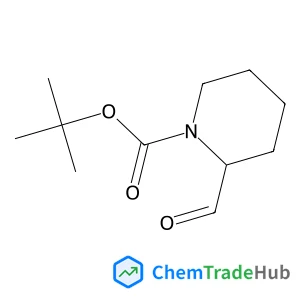
2-Methyl-2-propanyl (2R)-2-formyl-1-piperidinecarboxylate
CAS Number:
134526-69-5
Molecular Formula:
C11H19NO3
Laibing Wang, Yang Chen, Lu Yin, Shuangshuang Zhang, Nianchen Zhou, Wei Zhang, Xiulin Zhu
All visible-light-activated Azo photoswitches have recently blossomed. Herein two kinds of photoresponsive Azo hyperbranched polymers, HPTOF and HPTNF, were efficiently synthesized from the respective trinitro-functionalized monomers via combination of the AuNP-catalyzed photocatalytic method and the A3 monomer strategy. The polymerization process showed a very high monomer conversion (>95%) and a perfect selectivity. The molecular weights of the obtained Azo hyperbranched polymers were much higher than those of linear systems as reported previously, which could be efficiently adjusted by controlling the dosages of the mononitro-compound (the end-capping reagent) employed in the polymerization system. The resulting Azo hyperbranched polymers were well characterized by using GPC, NMR, FT-IR and UV-vis spectra. From unusual to common Azo-polymers, the π–π* absorptions in the UV-vis spectra show significant red-shifts; therefore the photoisomerizations of these Azo-polymers (HPTOF and HPTNF) can be induced by visible light. Interestingly, HPTOF and HPTNF demonstrated a double-wavelength (532 nm green light and 313 nm UV light) light-responsive Z → E photoisomerization. The relatively lower photoswitching ability of HPTNF than that of HPTOF was attributed to the partial overlap of π–π* (Z-isomer) and n–π* (E-isomer) transitions resulting from its much longer extending π-conjugation structure.
Xuefei Xu, Ewa Papajak, Jingjing Zheng, Donald G. Truhlar
DOI: 10.1039/C2CP23692C
Lin Tang, Quanmin Guo
DOI: 10.1039/C2CP23871C
Francesca Detto, Nicola Armani, Laura Lazzarini, Tullio Toccoli, Roberto Verucchi, Lucrezia Aversa, Barbara Rossi, Giancarlo Salviati, Salvatore Iannotta
DOI: 10.1039/C2CP40120G
W. Chuiling, M. V. Reddy, G. V. Subba Rao, B. V. R. Chowdari
DOI: 10.1039/C2CP40603A
Seo-Yeong Choi, Min-Hye Kim, Young-Uk Kwon
DOI: 10.1039/C2CP23545E
D. S. N. Parker, F. Zhang, Y. S. Kim, R. I. Kaiser, A. Landera, A. M. Mebel
DOI: 10.1039/C2CP22695B
Milka Nussbaum, Yaron Paz
DOI: 10.1039/C2CP23202B
Shuang Men, Bitu Birru Hurisso, Kevin R. J. Lovelock, Peter Licence
DOI: 10.1039/C2CP40262A
3-Fluoro-2-methylbenzylamine is an organic compound with the CAS number 771573-3...
Tert-butyl 2-(oxetan-3-ylidene)acetate is considered safe for its intended uses ...
Proper personal protective equipment (PPE) such as gloves, goggles, and a lab co...
2-Ethyl-4-methyl-1,3-thiazole is commonly synthesized via the reaction of thiour...
This compound should be stored in a cool, dry place away from direct sunlight an...
L-Lysine Acetate Salt (CAS: 52315-92-1) is subject to various regulatory guideli...
6-Fluoro-3-hydroxy-2-pyrazinecarboxamide (CAS: 259793-96-9) is generally conside...
1,1'-Sulfonylbis(1H-imidazole) is a crystalline solid with a molecular weight of...
4-Methyl-7-nitro-1H-indole-3-carbonitrile (CAS: 289483-82-5) is primarily used i...
Waste containing 5-Bromo-3-indolyl-beta-galactoside (CAS: 97753-82-7) should be ...

Polymer Chemistry welcomes submissions in all areas of polymer science that have a strong focus on macromolecular chemistry. Manuscripts may cover a broad range of fields, yet no direct application focus is required.