













Mussel-inspired multifunctional supramolecular hydrogels with self-healing, shape memory and adhesive properties
Literature Information
Publication Date
2016-08-04
DOI
10.1039/C6PY01112H
Impact Factor
5.582
Authors
Wei Lu, To Ngai, Xiaoxia Le, Jing Zheng, Ning Zhao, Youju Huang, Xiufang Wen, Jiawei Zhang, Tao Chen
View Original
Abstract
A novel multifunctional supramolecular hydrogel with self-healing, shape memory and adhesive properties is successfully developed on the basis of dynamic phenylboronic acid (PBA)–catechol interactions. The reversible nature of PBA–catechol bonds renders the hydrogel with outstanding self-healing and shape memory behavior, and the mussel-inspired catechol moieties generate fascinating adhesive properties.
Recommended Journals
Related Literature
Solvent effects of N,N-dimethylformamide and methanol on mass spectrometry imaging by tapping-mode scanning probe electrospray ionization
Nijiho Ote, Mengze Sun, Shuichi Shimma, Osamu Urakawa, Shinichi Yamaguchi, Tomoya Kudo
2023-02-20
Paper
DOI: 10.1039/D2AN01953A
Development of a gold nanoparticle-based lateral-flow strip for the detection of cannabidiol in functional beverages
Shuai Lv, Xinxin Xu, Lingling Guo, Liguang Xu, Liqiang Liu, Chuanlai Xu
2023-02-21
Paper
DOI: 10.1039/D3AN00084B
An integrated microfluidic chip for nucleic acid extraction and continued cdPCR detection of pathogens
Zehang Gao
2023-05-04
Paper
DOI: 10.1039/D3AN00271C
Differential response for multiple ions: a smart probe to construct optically tunable molecular logic systems
Monaj Karar, Rikitha S. Fernandes, Nilanjan Dey
2023-02-04
Paper
DOI: 10.1039/D2AN01945K
Monitoring bacterial spore metabolic activity using heavy water-induced Raman peak evolution
Rasmus Öberg, Tobias Dahlberg, Dmitry Malyshev
2023-04-04
Paper
DOI: 10.1039/D2AN02047E
Controllable synthesis of MoS2@TiO2 nanocomposites for visual detection of dopamine secretion with highly-efficient enzymatic activity
Chonghui Wei, Xuan Xie, Yue Mou, Shiqi Cheng, Jin Yang, Kaixin Xue, Kewei Yu, Xinru Lin, Chunfen Zhang, Yujie Zhao, Xingyu Luo, Yilin Wang
2023-03-10
Paper
DOI: 10.1039/D3AN00089C
An aptamer array for discriminating tetracycline antibiotics based on binding-enhanced intrinsic fluorescence
Yichen Zhao, Biwen Gao, Yijing Chen, Juewen Liu
2023-03-06
Paper
DOI: 10.1039/D3AN00154G
Suppressed DNA base pair stacking assembly of gold nanoparticles in an alcoholic solvent for enhanced ochratoxin A detection in Baijiu
Zhiyu He, Qianyuan Chen, Shansen Ding, Tohru Takarada, Mizuo Maeda
2023-02-13
Paper
DOI: 10.1039/D3AN00016H
You might also like
Compound Q&A
What are the main uses of 4-Nitrophenyl phosphate disodium salt hexahydrate (CAS: 333338-18-4)?
4-Nitrophenyl phosphate disodium salt hexahydrate is primarily used as a substra...
333338-18-44-Nitrophenyl phosph...
Compound Q&A
What are the main uses of 2-(Trifluoromethyl)-1,3-oxazole-4-carboxylic Acid (CAS: 1060816-01-4)?
2-(Trifluoromethyl)-1,3-oxazole-4-carboxylic Acid (CAS: 1060816-01-4) is widely ...
1060816-01-42-(Trifluoromethyl)-...
Compound Q&A
How should 2-Fluoro-4-biphenylcarboxylic acid (CAS: 137045-30-8) be stored?
2-Fluoro-4-biphenylcarboxylic acid should be stored in a cool, dry place at room...
137045-30-82-Fluoro-4-biphenylc...
Compound Q&A
What industries use Prednisolone-21-Carboxylic Acid (CAS: 61549-70-0)?
Prednisolone-21-Carboxylic Acid is primarily used in the pharmaceutical industry...
61549-70-0Prednisolone-21-Carb...
Compound Q&A
How should 4-(Hydrazinomethyl)-1,2,3-benzenetriol (CAS: 3614-72-0) be stored?
4-(Hydrazinomethyl)-1,2,3-benzenetriol (CAS: 3614-72-0) should be stored in a co...
3614-72-04-(Hydrazinomethyl)-...
Compound Q&A
What industries use 4-Amino-1-methyl-1H-pyrazole-5-carboxylic acid hydrochloride (CAS: 92534-70-8)?
4-Amino-1-methyl-1H-pyrazole-5-carboxylic acid hydrochloride (CAS: 92534-70-8) i...
92534-70-84-Amino-1-methyl-1H-...
Compound Q&A
What regulatory guidelines apply to dehydropachymic acid (CAS: 77012-31-8)?
Dehydropachymic acid (CAS: 77012-31-8) is regulated by various agencies. It fall...
77012-31-8Dehydropachymic acid
Compound Q&A
What is the market or research trend for 6-[(2,2-Dimethylpropanoyl)amino]nicotinic acid (CAS: 898561-66-5)?
The market and research trends for 6-[(2,2-Dimethylpropanoyl)amino]nicotinic aci...
898561-66-56-[(2,2-Dimethylprop...
Compound Q&A
How should 1,10-Phenanthroline-2,9-dicarbaldehyde (CAS: 57709-62-3) be stored?
1,10-Phenanthroline-2,9-dicarbaldehyde should be stored in a cool, dry place awa...
57709-62-31,10-Phenanthroline-...
Compound Q&A
How is 5-Carbamoyl-11-oxo-10,11-dihydro-5H-dibenzo[b,f]azepin-10-yl acetate (CAS: 113952-21-9) typically synthesized?
5-Carbamoyl-11-oxo-10,11-dihydro-5H-dibenzo[b,f]azepin-10-yl acetate can be synt...
113952-21-95-Carbamoyl-11-oxo-1...
Source Journal
Polymer Chemistry

CiteScore:
8.6
Self-citation Rate:
7.3%
Articles per Year:
457
Polymer Chemistry welcomes submissions in all areas of polymer science that have a strong focus on macromolecular chemistry. Manuscripts may cover a broad range of fields, yet no direct application focus is required.
Recommended Compounds
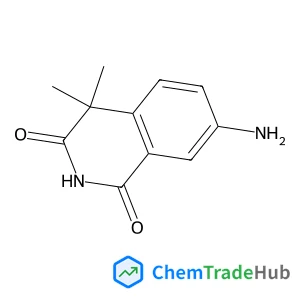
1,3(2H,4H)-Isoquinolinedione, 7-amino-4,4-dimethyl-
CAS Number:
14576-22-8
Molecular Formula:
C11H12N2O2
Recommended Suppliers






Disclaimer
This page provides academic journal information for reference and research purposes only. We are not affiliated with any journal publishers and do not handle publication submissions. For publication-related inquiries, please contact the respective journal publishers directly.
If you notice any inaccuracies in the information displayed, please contact us at support@chemtradehub.com. We will promptly review and address your concerns.