












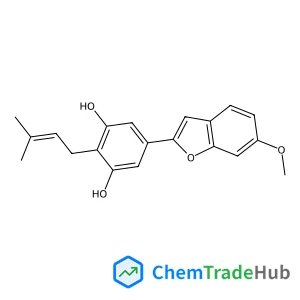
5-(6-Methoxy-1-benzofuran-2-yl)-2-(3-methyl-2-buten-1-yl)-1,3-benzenediol
CAS Number:
1017277-40-5
Molecular Formula:
C20H20O4
Mikhail Gavrilov, Zhongfan Jia, Virgil Percec, Michael J. Monteiro
Aqueous phase SET-LRP has become a useful method to produce water-soluble polymers directly in water. However, the major issue of hydrolysis of the halide chain-end has restricted the use of these water-synthesized polymers from further ‘click’ reactions. Here, we examined the kinetics of hydrolysis of poly(N-isoproplyacrylamide) (PNIPAM) synthesized using a new method to reduce Cu(II) directly and quantitatively to Cu(0) with no trace of Cu(I). It was found that hydrolysis followed a pseudo first order loss rate, reaching near completion after ∼15 h. The hydrolysis rate was not influenced by either molecular weight or the amount of Cu(0) or Cu(II) in the system. To overcome the issues of hydrolysis, we carried out an aqueous-phase in situ azidation, which usually is a very slow process (from 10–24 h) in organic solvents, to quantitatively transform the halide end-groups to azides within 30 s. This allowed the polymer to be purified and further coupled to an alkyne PNIPAM with greater than 97% coupling efficiency. Our work provides a direct and quantitative method to produce polymers made in water with stable ‘click’ functional end-groups, expanding the use of such polymers in the construction of more complex polymer architectures.
Gregor Klinser, Roman Zettl, Heinz Krenn, Roland Würschum
DOI: 10.1039/C9CP04045E
Xiaolu Xiong, Guangshi Li, Hongwei Cheng, Qian Xu
DOI: 10.1039/D0CP00197J
Zhengxi Yin, Yafu Guan, Bina Fu, Dong H. Zhang
DOI: 10.1039/C9CP03592C
Artur Nowak, Paweł Tecmer, Katharina Boguslawski
DOI: 10.1039/C9CP03678D
V. K. Sharma, D. K. Rai, E. Mamontov
DOI: 10.1039/C9CP03767E
Yuji Otsuki, Kazuya Watanabe, Yoshiyasu Matsumoto
DOI: 10.1039/C8CP07269H
Yesica Di Iorio, Mariana Berruet, Marcela Vazquez, Ricardo E. Marotti
DOI: 10.1039/C9CP04256C
M. Gnanaprakasam, G. Saranya, S. Bandaru, N. J. English, K. Senthilkumar
DOI: 10.1039/C9CP04271G
Evguenii Kozliak, Mark Sulkes, Ibrahim Alhroub, Alena Kubátová, Anastasia Andrianova, Wayne Seames
DOI: 10.1039/C9CP02025J
When handling 2-Methyl-2-propanyl 5-amino-2-thiophenecarboxylate (CAS: 1498311-5...
5-Bromo-1,2-dichloro-3-fluorobenzene (CAS: 1000572-93-9) is a crystalline solid ...
(2R)-2-Amino-2-(4-bromophenyl)ethanol (CAS: 354153-64-3) should be stored in a c...
Methyl 4-(aminomethyl)tetrahydro-2H-pyran-4-carboxylate hydrochloride (CAS: 3627...
1,4-Dimethyl-1H-pyrazole-5-sulfonyl chloride is primarily used as an intermediat...
Dinaphtho[1,2-b:2',1'-d]furan is generally safe when handled with appropriate pe...
The market for 7-Methyl-7,9-dihydro-1H-purine-2,6,8(3H)-trione (CAS: 612-37-3) i...
2-(4-Chlorophenyl)malonaldehyde (CAS: 205676-17-1) is a colorless or light yello...
2-Methylchrysene (CAS: 3351-32-4) is typically synthesized via the reaction of c...
N-(6-aminopyrimidin-4-yl)acetamide (CAS: 89533-23-3) is generally considered saf...

Polymer Chemistry welcomes submissions in all areas of polymer science that have a strong focus on macromolecular chemistry. Manuscripts may cover a broad range of fields, yet no direct application focus is required.
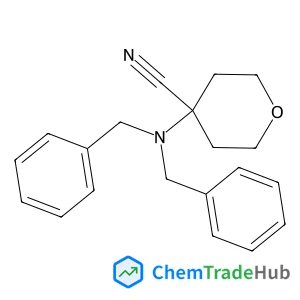
![2-[2-(2-Methoxyethoxy)ethoxy]-2-methylpropane structure](https://static.chemtradehub.com/structs/527/52788-79-1-71c1.webp "2-[2-(2-Methoxyethoxy)ethoxy]-2-methylpropane structure")
![3-[7-Amino-3-(3-pyridinyl)pyrazolo[1,5-a]pyrimidin-6-yl]phenol structure](https://static.chemtradehub.com/structs/861/861249-77-6-025b.webp "3-[7-Amino-3-(3-pyridinyl)pyrazolo[1,5-a]pyrimidin-6-yl]phenol structure")
![2,5-Dichloro-1H-pyrrolo[3,2-b]pyridine structure](https://static.chemtradehub.com/structs/100/1000342-87-9-f632.webp "2,5-Dichloro-1H-pyrrolo[3,2-b]pyridine structure")




